
The Trump administration's deployment of thousands of federal immigration agents to Minnesota between December 2025 and March 2026 led to widespread human rights violations, terrorized residents with long-lasting effects, and spotlighted the deeply abusive patterns in US immigration enforcement, Human Rights Watch said in a report released today.
The 180-page report, "'A Manufactured Crisis': Minnesota Communities Terrorized by the Federal Government," comprehensively documents how the US government's "Operation Metro Surge" caused a human rights crisis in Minnesota, particularly in and around the Twin Cities of Minneapolis and Saint Paul. The campaign included two unlawful killings, repeated instances of excessive force, racial profiling, unlawful detentions, and abusive detention conditions. These abuses and the terror they spread also led to less visible harm, forcing many people to stay at home out of fear, causing them to miss work, school, and even essential health care. The report calls for accountability at the highest levels of government, and names those with responsibility for overseeing the operation.
"The federal government sent hordes of masked, armed agents to grab people off the street, whisk them away in shackles, and abuse those who sought to bear witness," said Reagan Williams, crisis and conflict researcher at Human Rights Watch. "Minnesotans mobilized to protest, to document abuse, and to provide critical aid to one another. National-level action is needed to ensure accountability, end ongoing abuses, remedy the harm, and prevent another crisis of this scale."
Human Rights Watch interviewed over 130 people, including immigrants, human rights defenders, lawyers, healthcare providers, educators, current and former government officials, and others with first-hand knowledge of Operation Metro Surge and its impact. Researchers analyzed dozens of photographs and videos, sworn declarations and legal petitions, judicial decisions, documentation by local human rights defenders, government data, independent surveys, medical and public health research, news articles, and records maintained by healthcare professionals, educators, businesses, and organizations providing food assistance.
"There is no amount of press coverage that could ever fully document the scale of the ripple effect of trauma that this has on the city of Minneapolis," one resident said. "And when these cameras go away, we're still going to be here grieving and traumatized."
Operation Metro Surge was the largest interior deployment of immigration agents since President Donald Trump took office, but the campaign and its tactics fit a broader pattern of concentrated and abusive deployments of Department of Homeland Security (DHS) officers to US cities and towns. However, the scale of Operation Metro Surge-and the rapid response of residents to witness and document it-has provided ample evidence of the abusive practices and tactics of these agencies and the administration's immigration policies more broadly.
In two incidents that sparked national outrage in January, federal agents unlawfully shot and killed US citizens Renee Good and Alex Pretti. Agents threatened other Minnesota residents with lethal force, pulling guns on them without justification on numerous occasions. Agents also smashed car windows without justification, physically threw or pushed people to the ground who were not resisting, and deployed "less lethal" weapons such as chemical irritants and flash-bang grenades, sometimes at close range and without warning.
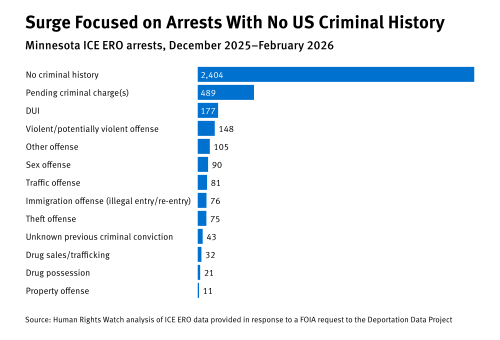
Over the course of this abusive campaign, Human Rights Watch found, Immigration and Customs Enforcement (ICE) detained approximately 4,000 immigrants, over 75 percent of whom had no US criminal convictions, and many of whom were detained arbitrarily. Lawyers filed habeas corpus petitions challenging these detentions, many of which resulted in orders for release or bond hearings, including nearly 90 percent of 532 cases resolved between December 1, 2025, and May 15, 2026.
Federal agents appear to have engaged in widespread racial profiling by stopping, arresting, or detaining individuals on the basis of their perceived race or ethnicity, including by using these factors as a crude proxy for a person's apparent nationality. In a survey by the US Immigration Policy Center at the University of California San Diego, people of color in Minneapolis who responded were about 40 percent more likely than white residents to report having an interaction with federal agents. Citizens of color interviewed by Human Rights Watch said they were so fearful of racial profiling that they began carrying their passports everywhere.
Many US citizens were among those unlawfully swept up, including through racial profiling or while observing or protesting ICE or Customs and Border Protection activity. Over 500 US citizen protesters were arrested, based on data from the National Lawyers Guild of Minnesota.
For months, the operation disrupted all aspects of everyday life, and normal activities, such as taking the bus to school or visiting the grocery store, became fraught with risk to physical safety and liberty. At the peak of Operation Metro Surge, some health care clinics saw dramatic drops in patient volumes-up to 50 percent at some facilities-with patients even missing urgent or emergency care. Thousands of students missed school or shifted to virtual learning. People were afraid to drive to work and suffered wage and job losses.
Fear, anxiety, and hardship had serious effects for mental health, especially for children. "I'm terrified of being here because I don't want that to happen to my dad again," said a 7-year-old girl whose father was taken by ICE during a raid on their home in December. Her father, who was later released, said that his daughter sometimes begs him not to leave the house. Her mother, who was pregnant, did not leave the house for months after the raid, even for prenatal appointments.
Minnesotans mobilized to alleviate these impacts, organizing themselves to provide grocery delivery, rent and other financial assistance, transportation to school, work, and healthcare appointments, and other forms of support.
While Operation Metro Surge has officially concluded, its far-reaching impacts demand attention and urgent remedy. DHS and its agencies, including ICE and CBP, should be overhauled. Officials should reconstitute and strengthen transparency and oversight mechanisms, implement meaningful protections against unnecessary force, and pursue consistent accountability for officials at all levels, including those responsible for the abuses of Operation Metro Surge.
On April 30, Human Rights Watch wrote to DHS agencies with a summary of findings and questions but has not received a response.
"Operation Metro Surge put the violent and abusive practices of these agencies on full display," Williams said. "We have clear proof of how they operate when impunity prevails, and we need to urgently chart a new way forward through accountability and structural reforms that put an end to these abuses."


