
Australia is famously home to some of the world's most dangerous animals, from land creatures like venomous snakes, crocodiles, and spiders, to marine life like sharks and jellyfish.
Dr Chris Jolly, a research fellow at Macquarie University's School of Natural Sciences, has spent his career studying how wildlife interacts with humans and the environments we share with them.
He's well known for his field work in places like Kakadu, where he helped test whether endangered northern quolls could be trained to survive the spread of poisonous, introduced cane toads.
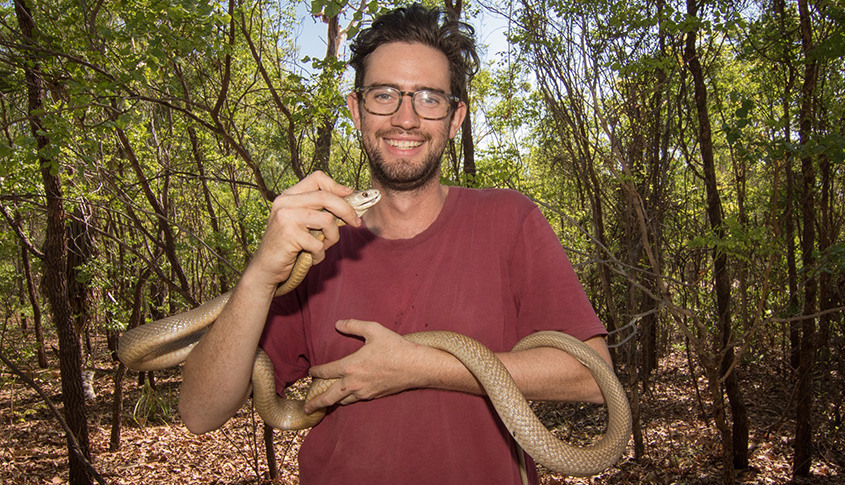 Dr Chris Jolly pictured with a coastal taipan caught during an ecological survey in the Kimberley. Photo: Max Jackson.
While Australia is viewed globally as a mecca of dangerous animals, on average there are only about 32 animal-related fatalities per year, while 1.5 million people are killed worldwide by animals every year.
A focus of his research is debunking the myths around deadly wildlife, while explaining our interactions with animals and their connection to fatalities in Australia.
He says widespread media coverage of deaths, involving predatory animals like snakes, sharks and crocodiles, has generated a belief that Australia is one of the world's most dangerous places to live.
"The reputation mostly comes from sharks and snakes," Dr Jolly says. "But actually 71 per cent of animal-related fatalities involve land mammals – including animals that we interact with on a daily basis like horses, dogs and even insects like honeybees."
The National Coronial Information System (NCIS) 2020 fact sheet summarised a study done between 2001 to 2017. During that period, 541 animal-related deaths were reported, and a quarter of deaths involve vehicle incidents.
"Bovines, cattle and other animals like buffalo, kill people most often through car strikes," Dr Jolly says.
Horses and dogs are the other two big contributors to animal-related fatalities, followed by kangaroos, snakes, and bees, with sharks and crocodiles combined contributing only 48 deaths in those 16 years.
"People falling from horses is an incredibly dangerous animal-related event," he says.
To further emphasise this point, while snakebites are serious, people rarely die from them because of access to anti-venom and medical care.
"Australia has many highly venomous snakes but we don't have many snake fatalities - and those rare and unfortunate fatalities often involved in incidents with brown snakes," Dr Jolly says.
A brown snake bite can trigger a rapid change of blood pressure, that can result in a person falling unconscious and risk hitting their head.
He says those who are unable to get medical support are in danger from a range of complications related to their venom consuming the blood's ability to clot.
"They can essentially bleed to death internally. Which is often why people die from brown snake envenomation, but in Australia, venom-related fatalities are extremely uncommon," he adds.
His research also examines how man-made environments may increase our interaction with wildlife.
"It's less so animals moving into human-dominated areas, but us expanding into animal habitats and reducing the critical resources available to them. Animals aren't necessarily adaptinging to climate change, but climate change is a selective pressure, and it alters animal behaviour and distribution," he argues.
With rising temperatures, Aussies are increasingly heading to the beach to swim and cool down. As water activities increase, so does the chance for encountering a shark or a crocodile.
"The trend for shark attacks is going up through time, but that doesn't necessarily reflect a change in sharks, but rather because of our very active beach culture." Dr Jolly explains. "The probability of a fatal shark encounter increases with the number of humans in their habitat, not necessarily the number of sharks. Same with crocodiles and snakes."
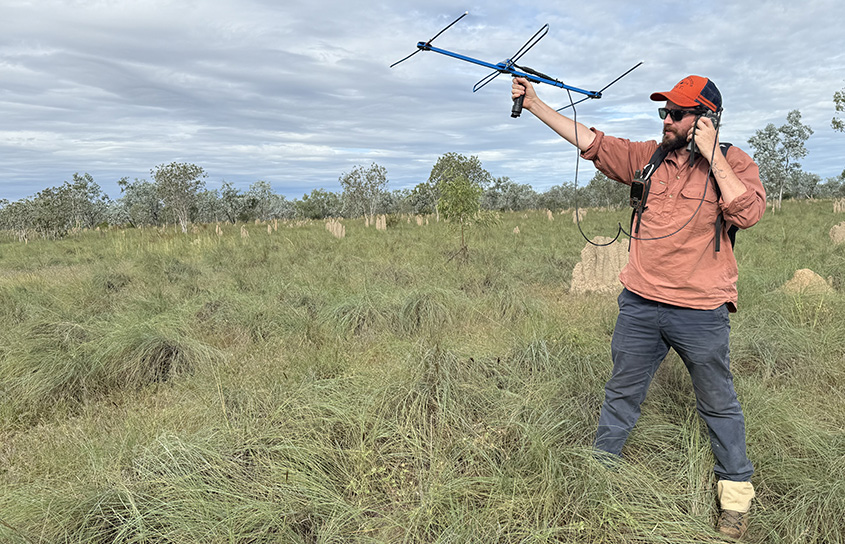 Chris Jolly pictured radio-tracking cane toads in central Northern Territory. Photo: Terri Shane.
Dr Jolly says that while climate change could contribute to the amount of interactions we have with animals, more importantly it is human populations expanding into animal habitats, which increases the probability of dangerous human–animal interactions.
"Extreme weather events could push animals into areas where humans are… but the effect of climate change on our interactions with dangerous wildlife such as crocodiles, sharks and snakes, via changes in their distribution, is likely to be more subtle and progressive."
He says flying foxes are a better example of the type of animals interacting more with humans.
"Flying foxes are increasingly roosting in cities and towns and people are concerned because they think they are loud, they smell, and they can carry Hendra virus. But they are moving into these areas because the resources that would have once been available to them outside cities and towns are not anymore," he says.
Australians have access to a great variety of medical treatments, but education is the most important factor in staying protected.
"We are incredibly lucky to have access to world class medical treatment for snakebites, and we have an educated public when it comes to snakebite first-aid. The most effective strategy for being safe around wildlife is education. Understanding the risks, the times of days and places that are risky for certain species and taking preventative measures to reduce the chance of encounter," he cautions.
Although for decades Australia has had the reputation of being one of the world's most dangerous places for its wildlife, animal-related human deaths in our wild environments are extremely low.
"It is our behaviour that results in animal-related human deaths. The risks are driven by people," he says.
"The reality in Australia is that animals are not as dangerous and threatening to human life as the media would have you believe."
Dr Jolly says an important part of his role as an academic is helping the public to understand how our emotions and fears around animals like snakes, sharks and crocodiles, can actually blind us to the everyday dangers in homes, roads, and workplaces.
But the risks posed by animals to humans are relatively small. Dr Jolly's research is increasingly looking at how native animals evolve to persist in our rapidly changing world. That includes everything from exotic species like cane toads, introduced by humans into sensitive environments, through to wide-scale climatic events like bushfires that can disrupt entire ecosystems.
His most recent publication in Trends in Ecology and Evolution reviews how humans have reshaped the physical, behavioural and social traits of wild animals and the effect this has had on the interactions between predators and their prey.
Dr Chris Jolly is a Macquarie Research Fellow in the School of Natural Sciences.


