
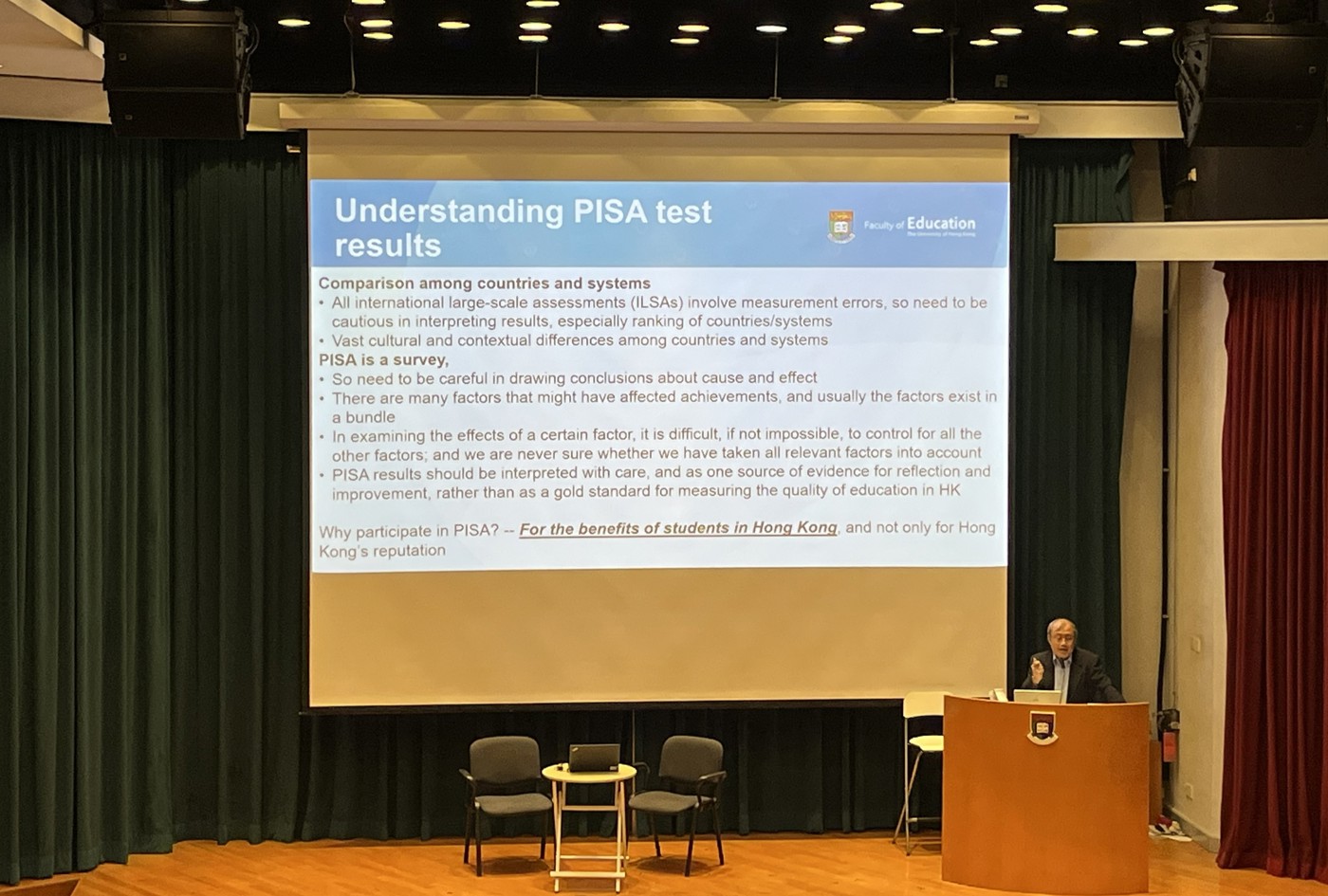
The Programme for International Student Assessment (PISA) 2025 Project Team of the Faculty of Education at The University of Hong Kong (HKU) organised the seminar "What Can We Learn from the PISA Results?" on October 17, 2026. The event brought together nearly 200 participants with a keen interest in Hong Kong education. The speakers conveyed a key message: building on foundational knowledge and competencies across different domains, Hong Kong should cultivate students' agency to learn proactively, exercise sound judgement and act responsibly, thereby strengthening their capacity to adapt to and shape the future.
The seminar featured presentations by members of the Faculty of Education's PISA 2025 Project Team, including Professor Frederick Leung, Professor Nancy Law, Professor Kennedy Chan, Professor Wai Ip Lam, and Professor Choo Mui Cheong, who analysed Hong Kong students' performance in PISA 2025. Professor Youyan Nie of the National Institute of Education, Nanyang Technological University, Singapore, and Dr Tsung-Hau Jen of National Taiwan Normal University joined the seminar online to share experiences from Singapore and Chinese Taipei. School leaders and teachers, academics, non-governmental organisation representatives, university students, and other participants engaged in lively professional discussions on curriculum, teaching and student development, exploring how international assessment data could be used to inform everyday classroom practice to better prepare students for the future.
Understanding Students' Strengths and Needs through Assessment Results
Professor Frederick Leung stressed that PISA assesses whether 15-year-old students can apply knowledge and skills in unfamiliar and real-life contexts. It can be regarded as a "health check" on the education system. PISA helps identify students' strengths and learning needs and encourages the education sector to reflect on teaching goals, but it is not a comprehensive report card on an education system. When interpreting the results, it is also necessary to consider that the PISA assessment framework evolves across different cycles and is adjusted in response to the competencies required in contemporary society and in the future. Students' learning backgrounds should also be taken into account, and the causes of changes in performance cannot be determined based on a single assessment alone. Therefore, the value of PISA lies not only in presenting performance outcomes, but also in informing improvement and providing an evidence-based foundation for empowering students.
Hong Kong students' performance across the three core domains, namely Science, Mathematics, and Reading, has shown an overall downward trend since peaking in 2012. The distribution of students across proficiency levels also warrants attention. The proportion of top performers in mathematics fell from 33.7% in 2012 to 20.7% in 2025, while around one-fifth of students did not reach baseline proficiency in both science and reading. By contrast, Hong Kong students scored 545 in Learning in the Digital World, reflecting strengths in programming, modelling, and computational problem solving. Competencies such as defining problems, interpreting data, testing solutions, and reviewing outcomes are shared across Science, Mathematics, and Reading. Professor Nancy Law noted that the strengths demonstrated in Learning in the Digital World could serve as an entry point for connecting instruction across Science, Mathematics, and Reading and promoting the transfer of competencies. An important next step is therefore to deliberately design learning experiences that connect the disciplines so that students can transfer their strengths in digital learning to other domains.
Developing Higher-order Competencies on a Strong Foundation
Education for the future requires both a solid foundation of knowledge and competencies across different domains and their ability to exercise sound judgement in applying what they have learned. Students need to understand concepts and master basic skills, while also having opportunities to explain their reasoning, compare approaches, evaluate evidence, and address problems without ready-made answers. As digital platforms, social media, and artificial intelligence become increasingly prevalent, verifying sources, identifying bias, and integrating different perspectives have become essential capabilities for learning and everyday life.
Student agency was another central theme of the seminar. It refers to students' purposeful participation in and shaping of their own learning, including setting goals, making evidence-informed choices, using feedback to adjust strategies, and taking responsibility for learning. Solid subject knowledge, clear guidance from teachers, and students' active thinking need to work together to help students apply their learning in new contexts and prepare for further study, work and life.
Four Interconnected Dimensions of Learning and Teaching
Drawing on the seminar discussions, student agency can be supported in four ways. First, teachers should design learning opportunities that promote deep thinking, enabling students to explain their reasoning, examine evidence, and revise their ideas with guidance. Second, schools should foster a sense of belonging so that students feel accepted and are confident in asking questions, seeking help, and trying new approaches. Third, subject learning should develop students' self-regulation by helping them plan, monitor, and adjust their learning. Fourth, attention should be given to learning motivation, with meaningful tasks and visible progress used to cultivate curiosity, confidence, and enjoyment of learning.
Students' confidence and motivation also deserve attention. Whether students feel capable and supported, and whether they perceive value in learning, are closely related to their engagement. Through appropriate challenge, specific feedback, and support from teachers and peers, students are able to sustain their willingness to learn when they encounter difficulties. These interrelated factors should be considered collectively in everyday teaching.
Learning from Global Educational Experiences
Professor Youyan Nie noted that the Singapore students who participated in PISA 2025 were the first cohort to have experienced both the new Primary School Leaving Examination scoring system and the removal of mid-year examinations. These changes reduced overly fine-grained comparisons of scores and created more time for deeper learning and teaching, greater student participation, and holistic development. Singapore's continued strong performance in PISA shows that fewer examinations and less intensive competition can coexist with academic excellence.
Recent policy initiatives in Singapore also offer examples of efforts to support students' healthy development. Grow Well SG is a national health promotion strategy jointly launched by the Ministry of Health, the Ministry of Education, and the Ministry of Social and Family Development. It aims to help families and schools establish healthy lifestyle habits in children from an early age, laying a strong foundation for their long-term health and development. Such initiatives remind the education community that, alongside academic performance, family engagement, physical activity, and mental and physical well-being also deserve due attention.
Dr Tsung-Hau Jen discussed the competency-oriented curriculum implemented in Chinese Taipei in 2019, which emphasises mathematical reasoning, modelling, and the application of mathematics to real-life contexts. A study comparing students across grades before and after the reform found that Grade 9 students, who had experienced the new curriculum for a longer period, showed greater gains in mathematics than Grade 10 students. This experience suggests that curricula should focus on strengthening students' understanding and their capacity to handle complex problems. When these competencies are developed, students are able to address real-life challenges more confidently and demonstrate their learning in assessments that emphasise the application of knowledge.
Teaching for Learning: Translate Insights into Classroom Practice
Throughout the seminar, the speakers emphasised that education should not be about teaching to the test. The insights from PISA should instead be used to cultivate the competencies students need to face and shape the future. Building on Hong Kong's strong subject foundations and teacher professionalism, students should be given more opportunities to engage in inquiry, explain their reasoning, and address unfamiliar and complex problems.
In the process of empowering students, teachers play an important role as guides and facilitators. Their roles include clarifying learning goals, designing challenging tasks, providing scaffolding and timely feedback, and guiding students' reflection. When using artificial intelligence, students should continue to verify content, identify bias, protect privacy, and respect intellectual property, while retaining independent judgement and accountability. The use of technology should be aligned with learning goals and should support deeper student thinking.
Turning Dialogue into Action
The HKU Faculty of Education looks forward to continuing its dialogue with schools, educators, policymakers, non-governmental organisations, parents and students. It aims to integrate student agency, the critical evaluation of information, and the use of evidence into everyday teaching, and to evaluate impact through students' learning outcomes, learning processes, and school experiences. The Faculty will also continue to organise public seminars and teacher professional development workshops to promote understanding and effective use of PISA data, and to build new momentum for the advancement of education in Hong Kong.
The seminar provided a valuable opportunity for professional exchange across sectors. By interpreting evidence carefully, continuously improving classroom practice, and sharing practical experience, Hong Kong can build on its existing strengths to support students in developing deeper understanding, a more proactive approach to learning, and stronger capacities for the future. By empowering students, we can shape the future together. Building on the insights from PISA, the education community can work collectively to turn reflection into action and build sustained momentum for the development of Hong Kong education.


