

A warmer Arctic is a foggier Arctic, which can slow shipping times for the Northwest Passage and Northern Sea Route, says a new study in the AGU journal Geophysical Research Letters. Credit: Xianyao Chen
As the Arctic warms and loses sea ice, trans-Arctic shipping has increased, reducing travel time and costs for international trade. However, a new study finds that the Arctic Ocean is getting foggier as ice disappears, reducing visibility and causing costly delays as ships slow to avoid hitting dangerous sea ice.
The study was published in Geophysical Research Letters, which publishes high-impact, short-format reports with immediate implications spanning all Earth and space sciences.
Arctic sea ice has been shrinking for decades. That loss has opened shipping channels in the Northwest Passage and the Northern Sea Route, allowing even non-icebreaker vessels to skip the time-consuming Panama and Suez Canals farther south. But as the ice recedes, cold air is exposed to more warm water, and warm vapor condenses into fog in those new passages. Hidden chunks of ice already pose risks to vessels making their way through foggy, low-visibility routes.
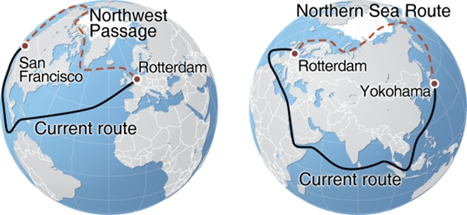
Crossing the Arctic from East Asia to northwestern Europe is shorter than crossing via the Suez or Panama canals. For example, the Northern Sea Route cuts the 20,000-kilometer (12,427-mile) voyage through the Suez Canal in half; based on distance alone, that reduces the estimated travel time from 20 to 11 days. Credit: European Space Agency
"The future of shipping in the Arctic is unclear, but fog could pose a significant challenge," said Xianyao Chen, a physical oceanographer at the Ocean University of China and author of the study. "When designing shipping routes across the Arctic, we need to consider the impact of fog."
To examine how climate change has impacted fog conditions along Arctic shipping routes, and to see how conditions will change during the 21st century, researchers used data on Arctic fog collected from 1979 to 2018 and climate projections from the Fifth Phase of the Coupled Model Intercomparison Project. The researchers also modeled alternate routes that could minimize foggy days during transit.
They found that ships crossing the Northwest Passage are more likely to encounter fog than ships in the Northern Sea Route. Fog in the Northwest Passage, which avoids the Panama Canal, is more frequent and persistent and so likely to increase sailing time by up to three days. Sailing time for the less-foggy Northern Sea Route, avoiding the Suez Canal, is projected to be no more than one day longer. According to the study, both proposed passages would encounter less fog if the routes shifted farther away from the sea ice edge.
Fog is already cutting into time gained by taking the much shorter Arctic routes; shipping speeds on foggy days are slower than on clear days, Chen found. As the Arctic gets foggier, shipping could continue to slow unless routes are adjusted. With daily operating costs for large container ships typically reaching $50,000 to $150,000, a multi-day delay due to fog quickly increases the costs of a trans-Arctic crossing.
"Avoiding ice is critical," said Scott Stephenson, a physical scientist at the RAND Corporation who was not affiliated with this study. "This study did a good job at identifying the risks of fog - an important environmental constraint in the Arctic, and one that has largely been ignored."


