
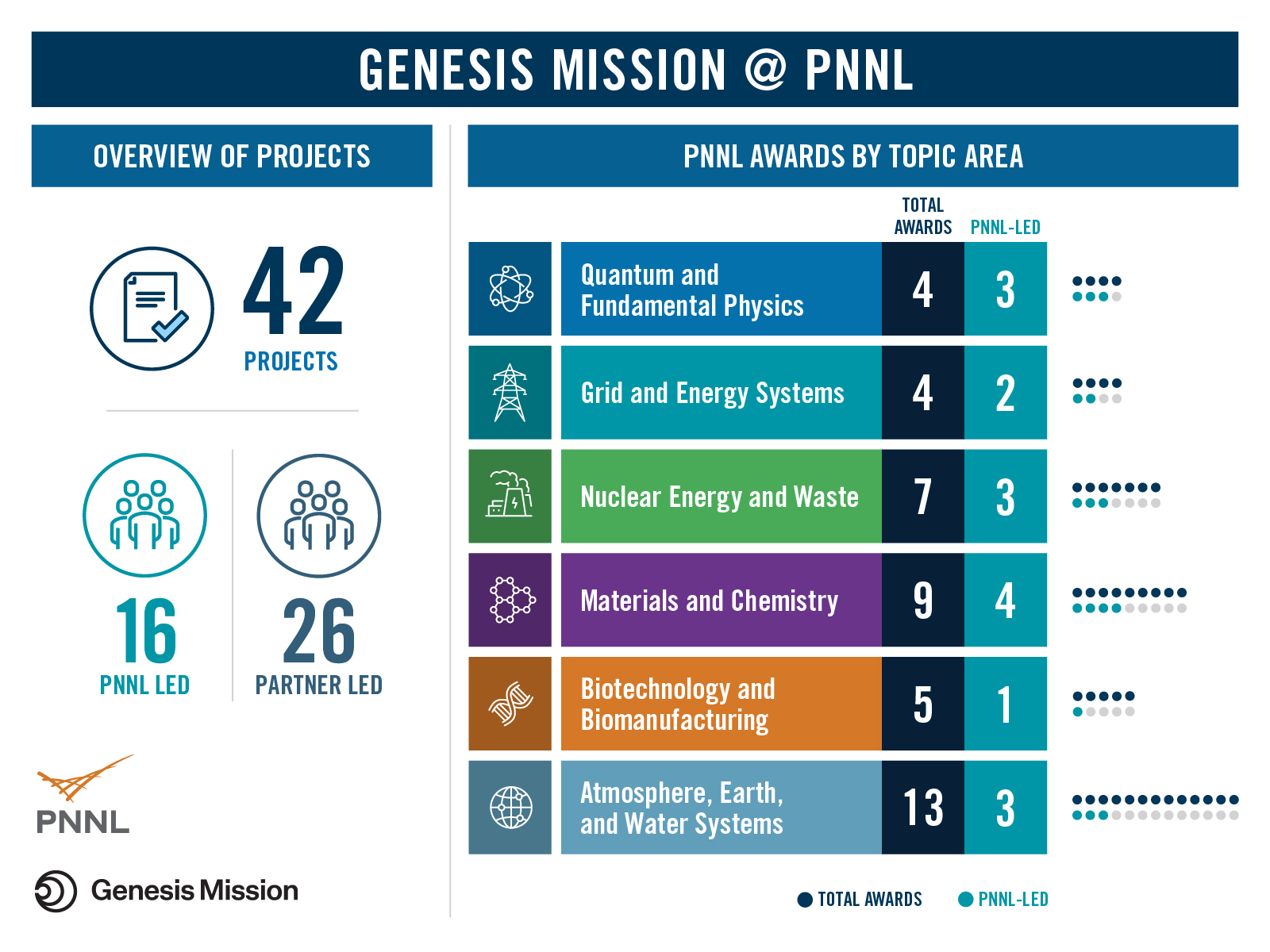
RICHLAND, Wash.-The Department of Energy today announced Phase I funding awards for its Genesis Mission, including 42 that involve research teams from Pacific Northwest National Laboratory.
The Genesis Mission is a historic national initiative led by DOE, which is building the world's most powerful integrated science discovery platform. By uniting government, industry, academia and philanthropy, it is accelerating breakthroughs in energy, scientific discovery and national security through a new platform that combines AI, supercomputing, quantum systems and advanced scientific instruments.
"AI is transforming how we discover, innovate and solve problems," said PNNL Director Deb Gracio. "PNNL's significant role in the Genesis Mission positions the Laboratory at the forefront of a once-in-a-generation transformation in how science is conducted, placing our researchers at the center of developing AI-enabled capabilities that will fundamentally accelerate discovery. The Genesis Mission projects will help ensure those advances serve the nation's greatest needs in science, energy and national security. PNNL is proud to contribute our scientific expertise and mission focus to a future where AI expands what is possible."
Genesis Mission launch @ PNNL
PNNL researchers will lead 16 projects that address urgent national science and energy needs. They will collaborate with academic and industry partners on an additional 26 projects.
The Genesis Mission projects led by PNNL will address the following research challenges:
- Harnessing AI to help tune quantum computers
- Optimizing underground uranium recovery with AI-powered simulations
- Understanding how to make geothermal energy systems practical energy suppliers
- Embedding AI into physics experiments to improve the path to discovery
- Uniting decades of data and expert insight into one AI engine built to accelerate nuclear waste cleanup
- Deploying autonomous workflows across the Genesis Mission's computational resources
- Using AI to improve decision-making for reliable, affordable power system planning and operation
- Using AI to demonstrate improved turbomachinery design and control
- Integrating experiments, simulation and operational data to accelerate manufacturing for fuel cells
- Leveraging an AI-enabled scientific workflow for improved high-performance microelectronics
- Modeling Earth systems for improved seasonal weather prediction using AI
- Using AI to predict and manage fractures in oil and gas reservoir
- Using AI to transform how we study and model the turbulence that helps clouds produce rain
- Predicting water availability in energy systems using AI-driven watershed modeling
- Coupling AI with science to improve algae-based biomass reactors
- Enabling AI-driven continuous monitoring of molten salt nuclear reactor operations
The goal of the Phase I RFA awards is to identify promising pathways toward transformative scientific capabilities and establish a foundation for future investment and scale. Project teams will design and demonstrate research workflows that integrate AI with scientific investigation, while rigorously evaluating whether those approaches can accelerate discovery, improve predictive capabilities, enhance experimentation or generate new scientific insights.


