
Published on
A UNIGE team conducted a field study on gender inclusion in urban spaces in Carouge and Meyrin, two municipalities of the canton of Geneva, offering a practical framework to equip urban planning professionals.
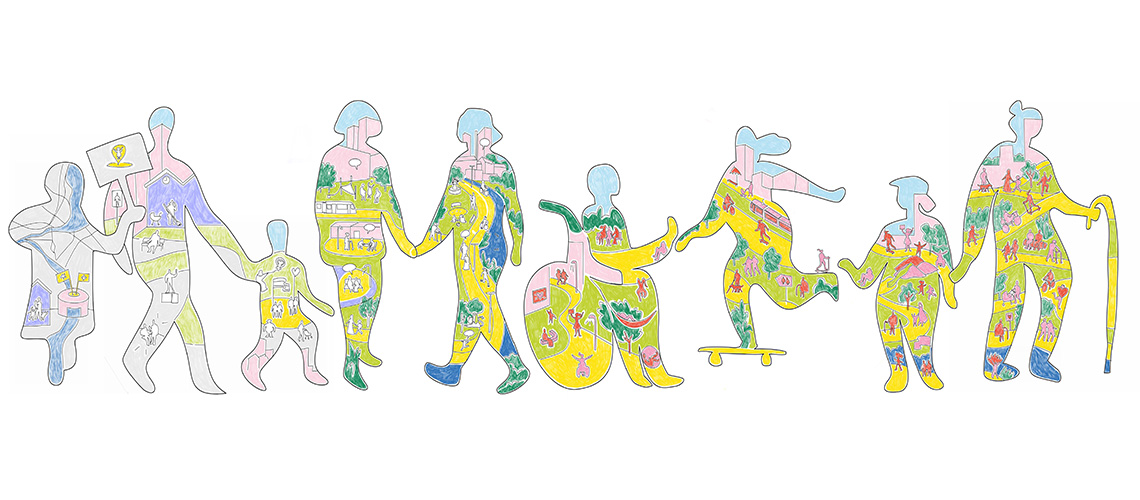
How to design inclusive public spaces? Commissioned by the Public Spaces Projects Department of the State of Geneva, a team from the University of Geneva (UNIGE) has published an original field study on gender equality in urban planning in the canton. This report provides public authorities with a framework and concrete tools to bring about sustainable urban change. Covering mobility, sanitation infrastructure, symbolic representations, and signage, it reviews all the levers that can be used to design inclusive public spaces for all. The report will be presented on May 7 as part of the Explore Demain festival.
Public spaces are not neutral. Their design reflects — and sometimes reinforces — social inequalities, often excluding certain users from the outset. As part of the implementation of the action plan for the Law on Equality and the Fight Against Discrimination Based on Sex and Gender (LED-Genre), adopted by the Geneva Grand Council in March 2023, geographer Karine Duplan conducted a field study on gender inclusion in Carouge and Meyrin, two municipalities of the canton of Geneva.
Theoretical and Practical Tools
Conducted at UNIGE's Environmental Governance and Territorial Development Institute (IGEDT), in collaboration with the Urban Hub, a university expertise centre that focuses on cities and urban societies, this study has resulted in the publication of a guide to gender-sensitive planning (French title: ''Vers des espaces publics inclusifs. Aménager au prisme du genre'' / English translation: ''Towards Inclusive Public Spaces: A Guide to Gender-Sensitive Planning'' ). The report traces the evolution of regulatory frameworks in Geneva, analyzes gender issues in local case studies, and sets out a selection of key principles. It also highlights successful planning initiatives from around the world, alongside a selected bibliography. The report is supplemented by guiding questions and checklists designed to facilitate planning processes.
"This report articulates theoretical inputs for a better understanding of gender inequalities, with practical observations in selected areas of Geneva. It works as a key tool for reflection for urban planning professionals, and more broadly, for public policymakers and citizens," explains the author.
The challenge is to turn spatial planning into a tool for social justice, so that women and sexual and gender minorities can make full use of these spaces.
Two Case-studies in Geneva
The analysis conducted in the La Prulay neighborhood, in the municipality of Meyrin, highlights the lack of attention given to gender issues. This situation stems from the neighbourhood's urban planning heritage, which has resulted in inadequate street lighting, disused playgrounds, and narrow paths that female users tend to avoid, preferring to take shortcuts considered safer and that require them to cross private properties. "The creation of high-quality pedestrian infrastructure, including green spaces and meeting places, would be a first step towards improving the existing public spaces," says Karine Duplan.
Along the greenway in the municipality of Carouge, the focus has been on the challenges of coexistence between different types of use — and therefore between different users — as well as the environmental issues linked to the site's location on the banks of the Arve River. "The new playground and its surroundings have been a real success, although the lack of toilets in this area has been highlighted. Further along, maintenance issues— particularly of street furniture — are prominent. This shows how maintenance, as presence and attention, contributes to a sense of safety."
Taking Proactive Measures
More broadly, the study advocates for multi-purpose street furniture. This includes providing more seating, arranged to encourage both privacy and social interaction, non-prescriptive sports facilities, and open, unobstructed spaces that foster a sense of community while minimizing blind spots and anxiety-inducing "corridors." The study also calls for a rethinking of symbolic representations, particularly by feminizing street names and diversifying public sculptures. The study highlights the need for urban diagnosis focused on local areas and on the needs of users when designing or developing public spaces. "The challenge is to turn spatial planning into a tool for social justice, so that women and sexual and gender minorities can make full use of these spaces," concludes the researcher.
The study will be presented and discussed on May 7 during a panel discussion organized as part of the Explore Demain festival, with several experts in attendance.


