Microbiologist Karen Guillemin considered many universities when she was searching for her first faculty position 25 years ago. In the end, she came to the University of Oregon, largely because of a pet store fish.
The zebrafish is one of the most widely used model organisms at the UO, helping researchers better understand biology and disease. It made its splash in the scientific world in the 1980s when the late UO biologist George Streisinger demonstrated the striped minnow as a promising candidate for genetics research.
Zebrafish, like humans, are vertebrates, and they share 70 percent of our genetic code. Plus, they have transparent skin as embryos, so scientists can watch their wriggling development in real time under a microscope.
Today, genetic varieties of zebrafish developed in Eugene are used for research around the world. And the freshwater fish is helping UO scientists get a handle on a range of health conditions, including scoliosis, COVID-19 and deaf-blindness.
For Guillemin, the fish are a powerful tool to understand the gut microbiome, the collection of microscopic life housed in our intestines.
Guillemin hadn't worked with zebrafish when she stepped onto campus in 2001. But she had a feeling that they might provide more insights than the fruit flies she had worked with before. The fish's transparent skin could allow her to spy and eavesdrop on gut bacteria, uncovering how they sculpt the animal's early physiology, inside out.
"I had never heard of such a thing. Most people hadn't heard of such a thing," said Judith Eisen, a UO neuroscientist who's spent decades using zebrafish, recalling when she was interviewing Guillemin for the position.
But over the past two decades, Guillemin has used zebrafish to show that the gut microbiome's role in health reaches far beyond digestion. It influences chronic inflammation, affects our risk for type 1 diabetes, and even shapes our social behaviors.

Alongside neuroscientist Judith Eisen, biophysicist Raghuveer Parthasarathy and ecologist Brendan Bohannan, Guillemin will spend the next five years tracking how microbes spread through social interactions and affect the developing brain.
The project builds on each scientist's decades of expertise in their own discipline, from microbiology to neuroscience to physics to evolution, plus years of team science, all backed by the UO's long-standing expertise in one mighty fish.
"What you're looking at is the result of 20 years of collaboration," Bohannan said.
How gut bacteria orchestrate social development
Illustration by Griffin Torrey
The newly awarded $9 million grant is allowing the research team to expand their experiments in ways that better translate to real-world biology.
To test how social life builds the microbiome, and, in turn, brain development and behavior, the researchers set up experiments where they housed fish together, allowing them to pass microbes through their water and physical interactions. They then measured aspects of the fish's behavior, microbiome and brain development, comparing those results with fish that were raised in isolation.
"We can't scientifically control and manipulate the housing and social interactions of humans, but we can with zebrafish," Bohannan said. "That's one of the powers of this little fish."

Tracking zebrafish behaviors

Parthasarathy is a physicist embedded in the zebrafish community. He's built custom 3D microscopes at the UO for aquatic research that keep the fish alive and suspended for hours, solving a long-standing challenge in real-time imaging of microbes inside the gut.
His lab also is developing computer algorithms that track social behaviors between zebrafish, shedding light on their various and sophisticated interactions, including carefully orchestrated turns, physical contact and body reorientations.
Applying ecological theory

With expertise in ecology, Bohannan is popularizing the theory that our bodies are ecosystems, colonized with bacteria we've coevolved with for millennia and grown dependent on for our development.
The gut microbiome can vary widely from person to person - as distinctive as a fingerprint - and scientists have only been able to attribute 20 percent of that variation to individual factors like diet, age and medical history, Bohannan said. He's looking to uncover what drives the rest of that unexplained diversity, which he theorizes could be social environments and behaviors.
Examining microbial cells and products

While Bohannan focuses on the big-picture bacterial diversity, Guillemin zooms in on the individual players in the gut. She discovers secreted bacterial products, like proteins and neurotransmitters, that influence the fish's development.
She also identifies the strategies bacteria deploy to colonize the gut and, with the help of Parthasarathy's microscopes, explores the dynamics of microbial communities.
Scanning brain development

For this study, Eisen examines the development of the forebrain, which sits between the eyes and is involved in social behavior.
Using brain imaging, she looks for differences in how the brain grows or wires up, in hopes of connecting the structural changes to the behavioral differences the team observes.
Across the experiments, the fish are studied around two weeks old, when social patterns and preferences begin developing. It's an age understudied compared to its transparent larval and charismatic adult stages.
"All our group experiments are unusual," Parthasarathy said. "There are no previously established methods or well-defined protocols, and many places where things can go wrong. The experiments are hard and fail often."
"But you see things that nobody else has seen before," he added. "And that continues to be rewarding and exciting."
Of microbes and minds
The researchers' preliminary findings suggest that solitary zebrafish are less social, performing fewer social behaviors than fish living in the same tank. Their microbiomes reflect those differences, with fewer and more peculiar bacterial species. They lack key beneficial bacteria that promote normal brain and immune system development.
"Being social encourages your social development through your microbiome," Guillemin said, "whereas being isolated deprives you of the microbes that are important for the development of the brain regions related to social behavior. And that reinforces isolation behavior, which is a really fascinating loop."
The discovery is what the team calls the social microbiome, the collection of microbes we acquire through social interactions that further feed our social development and behaviors.
The next challenge is finding exactly how the gut and the brain are communicating and the specific microbial activities that influence neural development. Disentangling those may shed light on how neurodevelopmental disorders arise in humans, some of which have been associated with changes in the early microbiome, Guillemin said.
"It's still sort of a pipe dream," she said, adding that the hypothesis needs to be better understood in humans. But she believes the team is well-positioned.
"It's been a long saga getting here, but it's a continuation of this really productive and genuine collaboration that we've had," Guillemin said. "It's clear that with our combined expertise as different investigators, we're going to advance the science."
For now, Guillemin hopes the latest findings can help shift how people think about microbes - not just as threats but as beneficial partners we rely on for far more than digestion.
In other words, it's worth learning to trust your gut, like Guillemin did when she took a chance on a little fish in 2001.
"I remember coming out of my interview at the UO thinking how wonderful and refreshing it is to be in a place where people are really pursuing big scientific questions out of curiosity," Guillemin said. "I felt there was room and support to start and try something totally new here."

This research is supported by the National Institute of General Medical Sciences.
Zebrafish:
A uniquely UO story
While zebrafish research is a cornerstone at the UO, the campus reflects its commitment in subtle ways. The exterior of the Allan Price Science Commons and Research Library, for example, nods to decades of discovery, featuring decorative panels that trace the genome of the shimmery minnow.
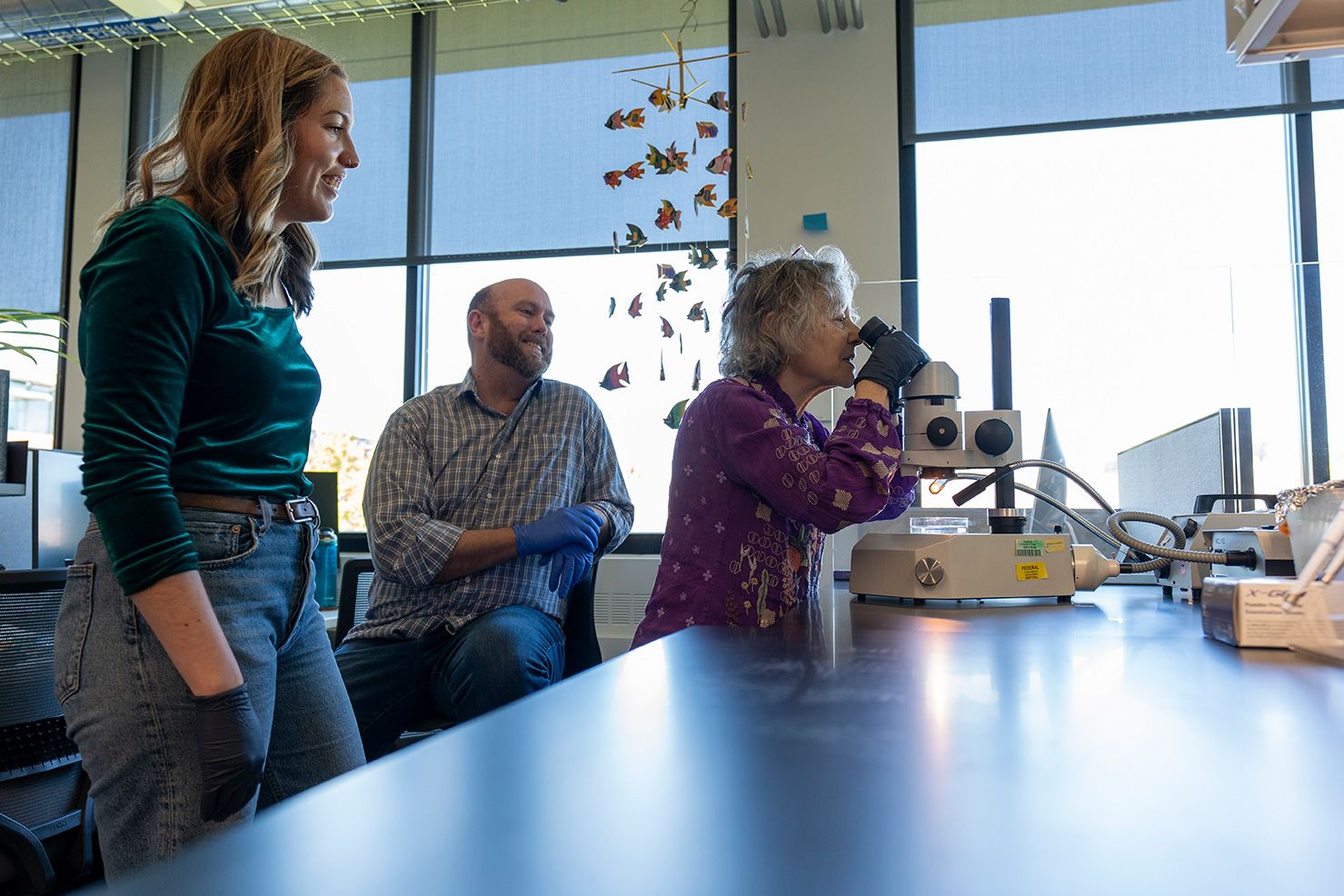
Judith Eisen's lab continues the celebration, with zebrafish artwork and mobiles hanging from the walls and ceilings.
"People who have zebrafish in their home aquaria might not know how much they have done for science," she said. "Zebrafish have brought therapeutics for diseases from bench to bedside and made possible the identification of genes underlying disease in ways that haven't been able to be done in different model systems."
Geneticist and fish hobbyist George Streisinger brought the first zebrafish from a local pet store into his UO lab in the 1960s. He was in search of a model organism more complex than fruit flies but easier to maintain than rodents.
In 1981, he cloned a zebrafish, the first vertebrate cloned by genetic manipulation - 15 years before the famous cloning of Dolly the sheep - proving the species could be easily modified and studied genetically.
Today, more than 1,500 labs worldwide use zebrafish as a model organism. Many use the strains developed from the UO's Zebrafish International Resource Center, which maintains over 43,000 genetic varieties.
Image captions