
Africa's rising influence is being constrained by outdated global institutions, unfair borrowing costs and cascading global crises, UN Secretary‑General António Guterres warned in Addis Ababa, as the United Nations and African Union reaffirmed their strategic partnership.
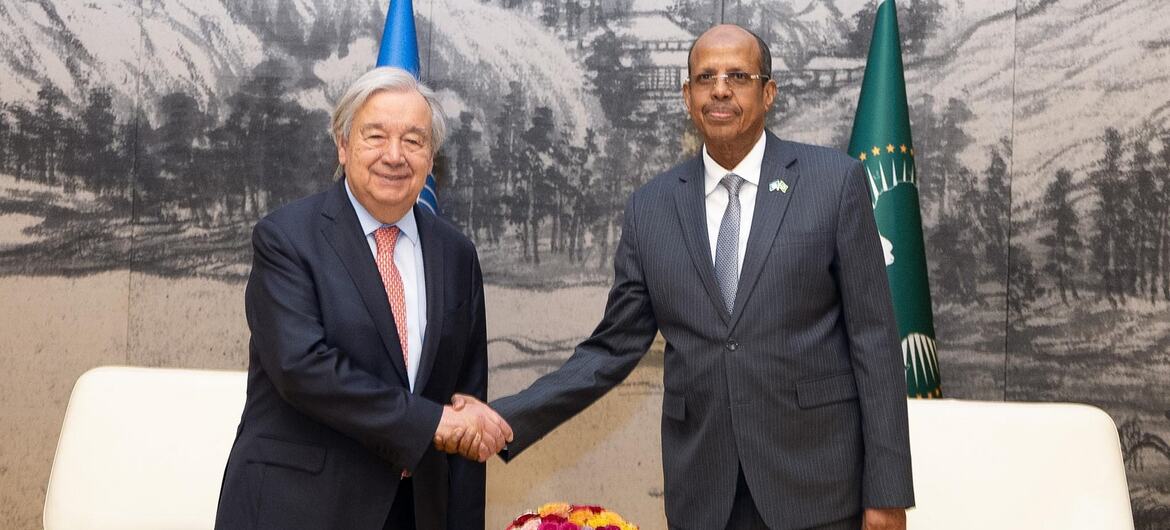
Meeting with AU Commission Chairperson Mahmoud Ali Youssouf, the two sides focused on deepening cooperation across peace and security, sustainable development and human rights.
It also marked what Mr. Guterres said would most likely be his final AU-UN summit as Secretary-General.
"This is my final AU-UN Conference as Secretary-General," he told reporters in the Ethiopian capital afterwards. "But the ties between our organizations are stronger than ever - and will remain so."
The Secretary-General and the AU Commission Chairperson signed a declaration reaffirming the principles of the UN-AU joint frameworks, further institutionalizing cooperation between the two organizations.
Pillar of global progress
Mr. Guterres described the African Union as "the flagship for multilateralism in Africa" and "a collective voice of justice for the developing world," highlighting the continent's importance and potential.
He said the Pact for the Future, adopted in 2024, underscored the importance of regional organizations, particularly the AU, and called for reform of the Security Council to make it more representative of today's world.
"Africa's continued exclusion from permanent representation is indeed a historical injustice - and we cannot accept it," he said.
"This is not about privilege or symbolism. This is about ensuring that the Council is fit for purpose and able to act with legitimacy and effectiveness."
Financial reform
The Secretary-General also highlighted what he described as deep inequalities in the international financial architecture, saying African countries continue to face high borrowing costs and limited access to affordable capital.
"Today's global financial architecture is not providing adequate levels of support, nor sufficient voice and participation for Africa," he said.
He noted that many African countries often pay up to three times the benchmark rate for borrowing, draining public resources that could otherwise be invested in water, sanitation, health and education.
Mr. Guterres praised African-led reform efforts, including the African Development Bank's initiative to create a New African Financial Architecture for Development, bringing together African financial institutions.
"Africa assumes the leadership in solving African problems," he said.
Climate and energy
Mr. Guterres also warned that climate change continues to hit Africa hardest, even though the continent contributes least to the crisis.
A temporary overshoot of the 1.5°C temperature limit is now "inevitable - but not irreversible," he said, calling for stronger adaptation finance and greater investment in Africa's renewable energy potential.
By 2040, he said, Africa could generate 10 times more electricity than it needs entirely from renewables, while delivering power to the 600 million Africans who still lack electricity.
But he warned that Africa receives only two per cent of global clean energy investment, urging action to remove barriers such as weak grids, high capital costs and fragile supply chains.
Middle East fallout
In a separate meeting with French President Emmanuel Macron and the AU Commission Chair, Mr. Guterres also warned that Africa is especially vulnerable to the global economic effects of the Middle East crisis, particularly disruptions linked to the Strait of Hormuz.
He said even an immediate reopening would still bring serious consequences, including slower growth and higher inflation, while prolonged disruption could raise the risk of a global recession.
The effects, he warned, would be particularly severe for African economies already facing high debt, energy costs and difficulties accessing fertilizers.
Silencing the guns
Peace and security also featured prominently in the AU-UN talks.
Mr. Guterres said the UN strongly supports the African Union's 'Silencing the Guns' initiative and the African Humanitarian Agency, while pointing to cooperation on conflicts in Sudan, South Sudan, the Democratic Republic of the Congo, Libya and the Sahel.
He called for an immediate cessation of hostilities in Sudan and renewed dialogue in the Sahel to confront violent extremism and terrorism.
"I have always believed that Africa should be seen for what it is: a continent of immense richness and promise," he said.


