
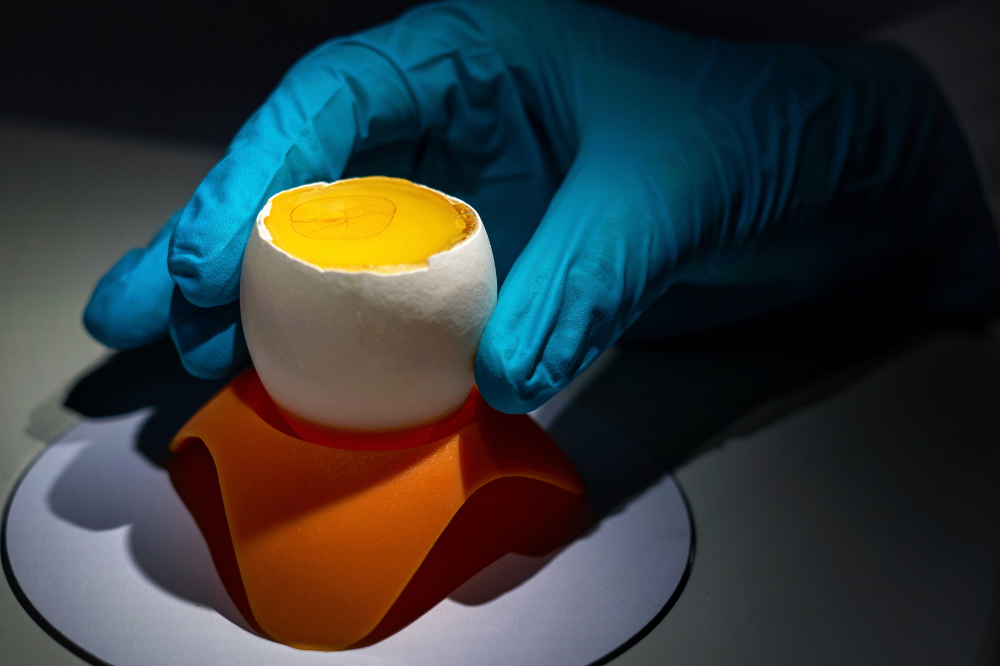
Neion bio is tailoring the genetics of chickens to turn eggs into high-quality protein factories. (Credit: Marco Figueroa/Neion Bio)
Sam Levin and Dimi Kellari had the vision and funding for a new biotech company. But then, they hit a wall. Well, more like a city of walls-the Big Apple. Finding a location in NYC that could house a team of scientists and extensive laboratory equipment, along with the kind of specialized animal operations at the scale they required seemed like an insurmountable task.
Then, they heard about a new kind of space on Manhattan's Upper Eastside: Rockefeller's Ford Center Incubator.
The incubator, which opened its doors in March 2024, had a lot to offer: 8,000 square feet of workspace tailored for early-stage life science companies; 50 desks for up to 15 companies at a time; shared lab benches and core equipment, including cryogenic storage, flow cytometry, and a vivarium; and business services, guided by Director Carlo Yuvienco.
It was the perfect fit for a scrappy startup looking to optimize pharmaceutical manufacturing. Since the 1970s, the biotech and pharma industries have relied on Chinese hamster ovary cells to produce medical compounds, spending billions of dollars on infrastructure to coax these microscopic workhorses to churn out medicine. That process is slow, expensive, and increasingly overwhelmed: Currently each batch of product cost $150 to $400 per gram to produce and consumes over 200 raw materials, according to the founders, while building new facilities on the old model can cost up to $2 billion and take five to seven years on average to construct.
This stands in sharp contrast to the accelerating pace of digital drug discovery: Around the world, AI tools are designing and discovering new proteins at a pace that feels like science fiction, slashing the time and cost required to discover and test a new drug.
Levin, an evolutionary biologist, and Kellari, an aerospace engineer, spent months exploring the manufacturing bottleneck, looking for a way to make protein manufacturing match the speed of digital discovery tools. Then, they found an opening.
"I joke that after months of exploring this problem, we had a chicken-shaped hole," says Levin. The duo had stumbled across research, some of it 25 years old, describing an idea to engineer chickens to serve as bioreactors. The idea was simple but radical: redesign the process around the most efficient protein-producing machine nature ever designed-the egg.
The platform they envisioned was built on decades of research into the chicken genome that had been de-risked by academic and commercial teams. With modern laboratory tools, it was conceivably possible to tailor the genetics of chickens to produce abundant amounts of a desired protein in each egg.
But pulling that off would require not just the right kind of lab, but also the right setup. The proximity of the Ford's facilities quickly became key to their vision, allowing the team to move at a speed that would be impossible elsewhere. "Being able to have a lab space and an office space so close to a facility where we interact with animals makes our iteration loops much faster and efficient," Kellari says.
The flexible space has enabled their company Neion Bio to scale incrementally without overbuilding, growing their team from 3 to 20 over the past year, according to the founders. Access to on-site university core facilities has also been essential, notes Levin, including flow cytometry to sort chicken germ cells and mass spectrometry for proteomics.
But being embedded in a medical research institution provides more than just hardware. It offers an "intangible benefit" in the intellectual community, says Levin. On any given afternoon, the team can attend lectures by Nobel laureates or run into the researchers behind the latest medical breakthroughs in the elevator. For example, the founders appreciated connecting with Erich Jarvis, who studies songbirds and the development of vocal learning as head of Rockefeller's Laboratory of Neurogenetics of Language. The company and the lab share a deep interest in the genetic engineering of birds and have projects of mutual interest, says Levin.
But the alignment isn't just intellectual, it's also philosophical, says Yuvienco. "The incubator is an extension of the mission of the university," says Yuvienco. "Given what Neion Bio is poised to accomplish, and what that could mean for the future of drug development, we saw the opportunity to create a partnership that could tangibly benefit humanity."
Today, the technology that powers Neion Bio is a trifecta of modern biology: precision genetic engineering, the ability to culture avian stem cells, and the abundance of cheap genomic data. "We can send off a sample and get a sequence back in a day," says Levin. "It has unlocked our understanding of the chicken genome, and allowed us to improve rapidly on what already exists."
The company has already announced a partnership with an unnamed pharmaceutical company to bring three proteins to market. Kellari and Levin's ultimate vision is to solve unmet medical needs by making biopharmaceuticals as cost-effective and scalable as farming. "Farms have provided proteins for grocery stores for decades," says Kellari. "We envision a future where farms also provide proteins for hospitals."
The path forward still has roadblocks. Right now, the company faces a speed hurdle: Engineering the genetics of a chicken, and then waiting five to six months for the chicken to reach maturity, still takes a long time compared to traditional laboratory methods to manufacture proteins. The company is pursuing technologies that will allow them to "win on speed," says Kellari, aiming to beat current manufacturing timeli
Disrupting a 50-year-old manufacturing layer that has seen billions of dollars in infrastructure investment is a radical move. But for the Neion Bio team, the potential to increase the accessibility and resilience of the drug supply chain is worth the challenge. They plan to stay at the Rockefeller's Ford Incubator as long as they can fit in the space.
By filling that "chicken-shaped hole" in the manufacturing process, Levin and Kellari hope to ensure that pharmaceuticals of the future don't remain just promising ideas, but actually make it into the hands of the patients who need them.


