
How questions, guidance and unseen work help teams before the final pitch.
When teams step onto the stage at the Grand Finals of the Nature-based Future Challenge, the audience sees the finished version. Strong visuals, clear storylines, and students presenting future visions for the Mississippi River Delta with confidence. What often remains unseen is everything that happened before: the first uncertain brainstorms, ideas that did not work, group discussions that went in circles, deadlines that suddenly felt close, and the many small decisions that slowly shaped a concept into something stronger.
This is where coaches make a difference. Throughout the Challenge, professionals from partner organisations support teams behind the scenes as they work on one of the world's most complex landscapes. Their role is not to hand out answers on a silver platter or redesign a project for the students. Instead, they help teams ask sharper questions, challenge assumptions, and think more critically about where their ideas could lead.
More questions than answers
Many people imagine coaching as giving expert advice. In reality, it is often about knowing when not to give the answer too quickly. Martine Roseboom, who coached this year alongside colleagues from Witteveen+Bos, says the most valuable moments often came when students had to work through uncertainty themselves.
"You only see the pitch at the end. You don't see the struggle that comes before it"
- Martine Roseboom
- Witteveen+Bos, NbF Challenge Coach
Rather than telling a team what to do, coaches help students test their own thinking. Who benefits from this solution? What happens elsewhere in the system? Is this realistic? Is it bold enough? "As a coach, you shouldn't take over the design," Martine explains. "You help by asking the questions that move students forward." She noticed that once teams were given space to reflect and rethink, progress often came quickly. What looked stuck one week could suddenly become clear the next.
Thinking beyond the technical fix
This year's Challenge asks students to imagine the future of the Mississippi River Delta, a place where ecology, economy, infrastructure and local communities are deeply connected. Because of that, a strong proposal needs much more than one clever technical solution. David Mornout and Maud Vink, both working at GOPA MetaMeta, coached a technically strong team this year. Their role was to help students widen the frame of their thinking. "The challenge is not about one solution for one problem," says David. "It is about understanding the whole system."
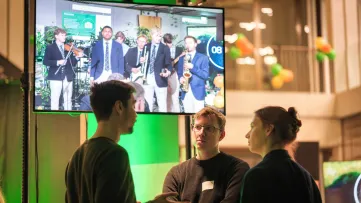
Participants meeting the coaches at the Kick-off.
That meant asking students to look beyond engineering alone and consider biodiversity, climate adaptation, livelihoods, and how one intervention might affect another part of the Delta. For many teams, this systems thinking can be one of the hardest parts of the Challenge. Students often begin with the logic of their own discipline. The Challenge asks them to step outside it.
Serious challengers returning
David Mornout and Maud Vink brought a particularly valuable perspective because both know what it feels like to be on the other side of the table. David previously took part in an earlier WUR student challenge focused on nature-based solutions. Maud was part of the winning team in the very first Nature-based Future Challenge two years ago, and later also won the Biodiversity Hackathon. Between them, they know exactly how intense, rewarding, and unpredictable these programmes can be.
"As a participant, I knew how much work happens between meetings. As a coach, I saw that process from the outside"
- Maud Vink
- GOPA MetaMeta, NbF Challenge Coach and winner of the 2024 edition
That experience matters. It means they understand the pressure of deadlines, the uncertainty of not knowing if an idea is strong enough, and the long hours teams invest between official sessions. It also helps them recognise when students need practical advice, encouragement, or simply reassurance that struggling is part of the process.
Learning goes both ways
Coaching is not only valuable for participants. Several coaches described learning from students as well. Martine says working with younger teams reminded her how refreshing open-minded thinking can be. In professional life, people often become focused on their own area of expertise. Students are more likely to ask bigger questions and explore ideas before habit tells them something cannot be done. For David and Maud, coaching was also a chance to reconnect with the energy that first drew them into student challenges themselves. The curiosity, ambition, and willingness to try new things are exactly what make these programmes special.
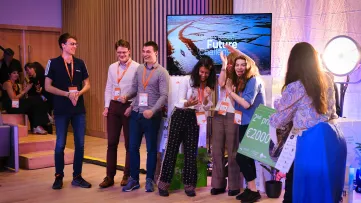
Maud Vink, and her team Delta Harmonics winning the NbF Challenge in 2024.
Beyond the Spotlight
When the finalists present at the Grand Finals on 2 June, attention will rightly go to the teams and their visions for the Mississippi River Delta. But behind many strong ideas is another story: a coach who challenged an assumption, a conversation that changed direction, or a better question asked at exactly the right time. And if past editions are any guide, some of this year's students may one day return to do the same for others.


