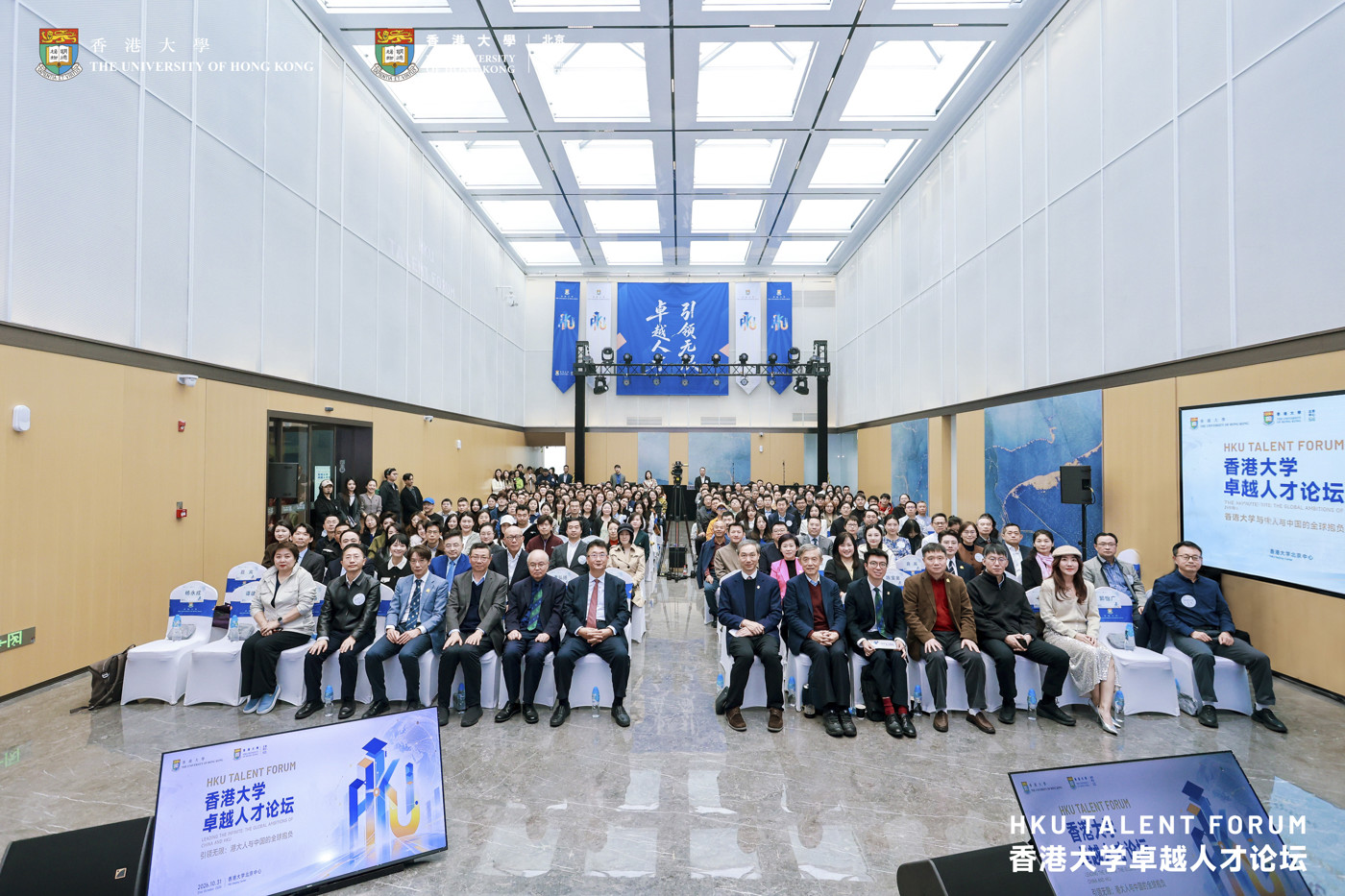
The University of Hong Kong (HKU) held the "HKU Talent Forum" in Beijing at the HKU Beijing Centre on 31 October 2026. The event, themed "Leading the Infinite: The Global Ambitions of China and HKU", brought together scholars, industry leaders and public-sector representatives to explore talent development and innovation in the era of artificial intelligence (AI), as well as how HKU partners across sectors to strengthen connections between China and the world.
The Forum focused on talent development, bringing together frontier research, university education, industry practice and international exchange. It aimed to cultivate individuals equipped with scientific literacy, innovative capabilities and global perspectives.
In his opening remarks, Professor Chen Lin, Vice-President (Business) of HKU, highlighted that outstanding talent today should possess strong problem-solving capabilities, a solid theoretical foundation and independent, innovative thinking, and should be capable of making responsible decisions amid significant global change. He said that HKU was ready to collaborate with partners across sectors, respond to the times through innovation, strengthen open connections with the world, and help cultivate exceptional young people who are patriotic, globally minded and willing to assume responsibility.
Expanding Talent Development Perspectives through Frontier Research
The Forum featured two masterclasses showcasing cutting-edge scientific insights. Professor Xiao-Jing Wang, Chair Professor in the School of Computing and Data Science and the School of Biomedical Sciences, LKS Faculty of Medicine, HKU, delivered a masterclass titled "Computational Neuroscience: Intelligence and the Prefrontal Cortex". He discussed the central role of the prefrontal cortex in intelligence and cognition, sharing cutting-edge research findings on whole-brain models and future development plans.
The masterclass delivered by Professor Bing Zhang, Chair Professor of Astrophysics in the Department of Physics, HKU, and Founding Director of the Hong Kong Institute for Astronomy and Astrophysics (HKIAA), was titled "From the Big Bang to Artificial Intelligence - About the Origin and Fate of the Universe and Humanity". He explored the rapid development of artificial intelligence from a cosmic perspective, addressing its potential risks and implications.
Zhou Zhonghe, an Academician of the Chinese Academy of Sciences and a Foreign Member of the U.S. National Academy of Sciences, shared insights in a keynote address titled "Papers, Evaluation and the Mechanisms of Scientific Trust". He discussed how, in the era of AI, the scientific community has lost its absolute authority and control over peer-review processes. Amid scientific advancement at an unprecedented pace, this has led to a crisis of trust in science. He emphasised the importance of redefining and rebuilding trust mechanisms within the scientific enterprise to address these challenges and restore confidence in scientific research.
Professor Xue Lan, Dean of Tsinghua University's Schwarzman College, delivered a keynote speech titled "Governance Challenges in the Age of AI Transformation", examining the challenges currently facing higher education and providing an in-depth analysis of directions for reconstructing foundational elements such as academic disciplines and degree-accreditation systems.
Mr Huo Xuewen, Director of the Economic Committee of the Beijing Municipal Committee of the Chinese People's Political Consultative Conference and former Party Secretary and Chairman of the Bank of Beijing, noted: "Cultivating high-calibre talent is a vital pillar of Hong Kong's status as an international financial centre." He pointed out that, as AI reshapes financial operations, professionals with expertise in finance, technology and an international outlook are increasingly valued. He emphasised that talent is the core capital of a city or financial hub, and that cultivating high-calibre talent is essential to Hong Kong's future.
Responding to AI-Driven Change: Connecting Academia and Industry Practice
Building on the research and keynote speeches, the Forum shifted its focus to specific challenges in talent development. The first panel, moderated by Professor Chen Lin, focused on demand for technological talent amid the AI wave and on university reform. It brought together representatives from academia, investment and entrepreneurship for an exchange of insights. The discussion explored how universities can cultivate talent equipped with solid scientific foundations, interdisciplinary thinking and innovative capabilities. Key issues included the application of AI tools, the quality of entrepreneurship and the credibility of AI-generated content.
A fireside chat, hosted by Professor Yang Wang, Vice-President and Pro-Vice-Chancellor (Institutional Advancement) at HKU, featured Dr Duan Nan, Vice President of JD Group and Deputy Director of JD Explore Academy, and Dr Wang Bin, Director of the AI Lab and Chief Scientist for Natural Language Processing at Xiaomi Group. The discussion examined talent standards, organisational structures and global innovation in the era of AI-native technologies. Commenting on entrepreneurial trends in the AI age, Professor Wang cited recent surveys indicating a significant increase in entrepreneurship among individuals aged 50 and above, whose success rate was twice that of people in their thirties.
Advancing Global Connectivity through Technological Innovation and Cultural Exchange
The final panel, moderated by Professor Anderson Shum, Vice-President (Research) at HKU, focused on AI applications, technological innovation and cultural exchange, exploring connections between China and the world. Guests from business, academia and the media discussed AI's practical applications in enterprises and real-world scenarios, as well as how trustworthy technologies, open collaboration and cultural exchange can facilitate cross-border cooperation.
This session extended the conversation to the broader themes of intelligent applications and global connectivity, examining how technological innovation can address diverse societal needs. It also highlighted how innovation and cross-cultural understanding can reinforce one another, while encouraging young people to pursue technological innovation alongside an appreciation of the humanities.
About the HKU Talent Forum Series
The HKU Talent Forum Series aims to foster dialogue and collaboration among government, employers, alumni and strategic partners. With events held in Zhangjiang (Shanghai), Qianhai (Shenzhen), Hong Kong and Beijing, the Series continues to serve as an international platform for talent exchange and partnership.