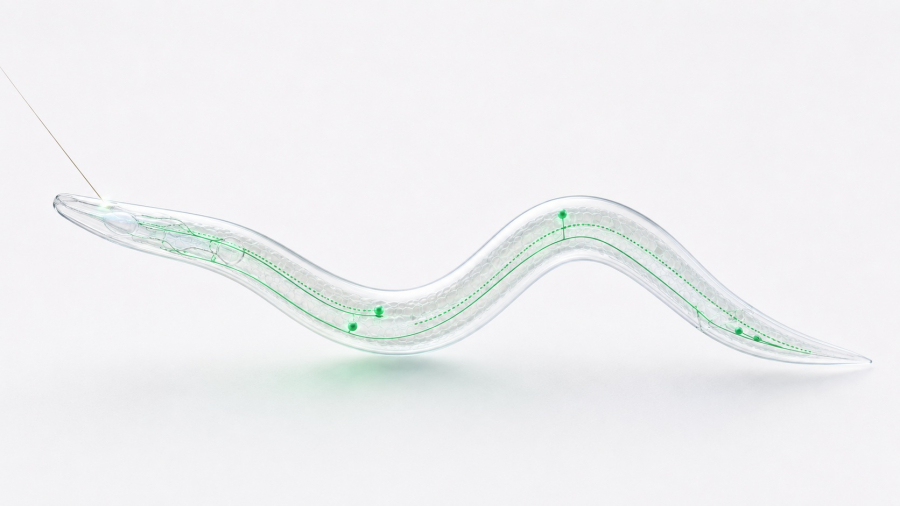
Image 1. Artistic illustration of the gentle touch response in C. elegans. A fine hair-like probe activates touch receptor neurons involved in the animal's escape reflex.
A research team led by Professor Chaogu ZHENG from the School of Biological Sciences at The University of Hong Kong (HKU), in collaboration with scientists from Princeton University and Columbia University, has discovered how sensory-motor circuits—nerve circuits that turn sensory signals into reflex actions—remain reliable even when some genes or neural connections are disrupted.
Using the gentle touch reflex of the nematode Caenorhabditis elegans (C. elegans) as a model, the team found that this essential survival response is not controlled by a single biological component. Instead, it is supported by several overlapping mechanisms, including existing alternative neural pathways and molecular components that enable neurons to send and receive signals. These layers of genetic redundancy help maintain the touch response and improve the animal's ability to escape from predators. The findings were recently published in the Proceedings of the National Academy of Sciences (PNAS).
Research Background
Reflex actions are among the most basic and important functions of the nervous system. When an animal senses danger, sensory neurons detect the stimulus and pass the signal through synapses, the contact points where neurons communicate, to downstream neurons that control movement.
The gentle touch circuit of C. elegans is a classic model in neuroscience. Its cellular wiring was mapped at single-cell resolution about 40 years ago, showing how sensory neurons, interneurons, and motor neurons are connected in the reflex pathway. However, the molecular details of how these neurons communicate, and how this communication supports a reliable reflex response, were not fully understood.
To address this question, the team examined synapses in the gentle touch reflex circuit and mapped the molecular mechanisms that allow signals to pass from sensory neurons to downstream neurons.
Key Findings
Through genetic screens and follow-up analyses, the team found that the touch reflex circuit is protected by several layers of genetic redundancy. These mechanisms operate at different levels, including individual genes, synapses, and neural pathways.
In the posterior touch circuit, two gap junction proteins help connect sensory neurons with interneurons. Either protein alone is sufficient to maintain the connection, so losing one of them does not disrupt the touch response.
In the anterior touch circuit, the team found another form of redundancy: two neural pathways can both support the backward movement triggered by touch. Blocking either pathway alone does not stop the motor response, showing that the circuit can continue to function through an alternative existing route.
The team also found that these redundant components are not simply spare parts. Some synaptic genes may not be essential for starting the touch response, but they still affect how strong and effective the response is. For example, removing one gene may not stop the animal from moving backwards after being touched, but it can shorten the reversal distance and make the animal less likely to turn afterwards. This weaker response reduces its ability to escape from carnivorous nematodes.
These findings show that redundancy in the nervous system serves two purposes: it helps prevent an essential reflex from failing, and it strengthens the escape response.
Implications
The study provides new insight into how nervous systems protect essential behaviours. It shows that robust neural circuits can be built through overlapping genes, synapses, and neural pathways, so that the loss of one component does not necessarily stop the behaviour.
The corresponding author, Professor Chaogu ZHENG of the HKU School of Biological Sciences, explains, "From an evolutionary perspective, the findings suggest that components which appear redundant in a standard laboratory test may still be preserved because they improve survival in real-life situations, such as escaping from predators. In this way, redundancy is not merely a backup system, but part of how neural circuits produce reliable and effective behaviour."
For more details, please refer to the journal paper "Synaptic and neural pathway redundancy enables the robustness of a sensory-motor reflex and promotes predation escape in Caenorhabditis elegans" published in the Proceedings of the National Academy of Sciences (PNAS).