
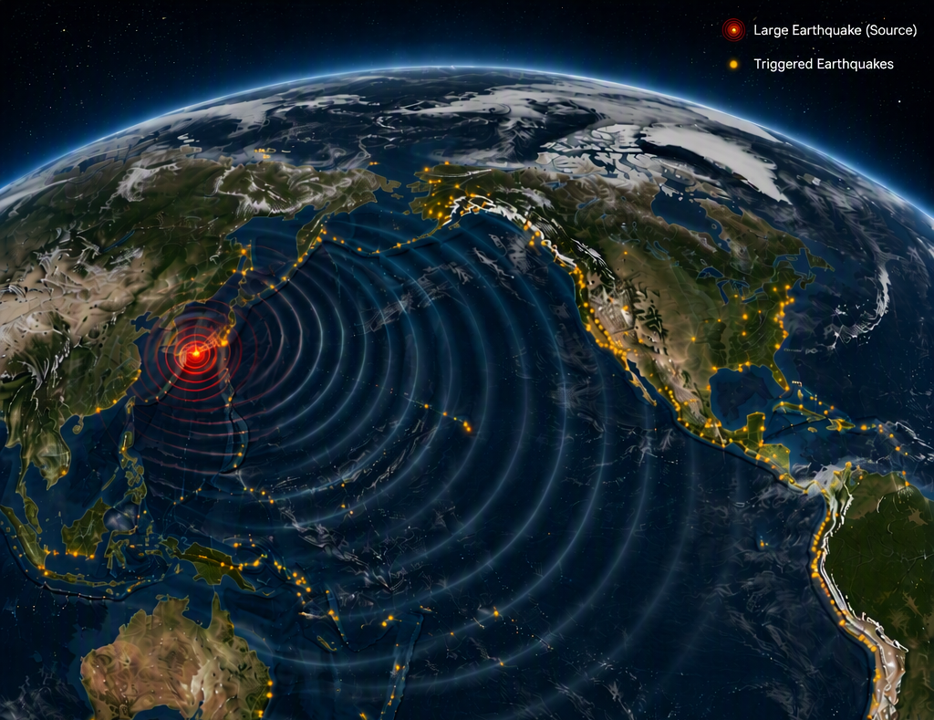
Understanding earthquake mechanisms and mitigating earthquake hazards remain a critical global challenge. For decades, seismologists have observed that seismic waves of large earthquakes can trigger seismic activity at distances of thousands of kilometres-a phenomenon known as remote (dynamic) triggering. Yet two puzzles persisted: Why do some triggered events occur long after the seismic waves have passed? And why do Rayleigh waves, which carry lower shear stresses than Love waves, appear more effective at triggering?
A pioneering study led by Professor Jun Yang and his team at the Department of Civil Engineering, Faculty of Engineering, The University of Hong Kong (HKU), proposes that dynamic pore‑pressure evolution within fault gouge-a porous granular material lining fault surfaces-provides a unified explanation.
This study centres on the mechanical complexity of fault gouge, a critical zone adjacent to the fault surface whose behaviour is far more intricate than that of damaged rock. To address this, the researchers present a novel analysis framework in which the gouge's essential mechanical behaviour is captured by a bounding surface model rooted in critical-state soil mechanics.
The researchers simulated stress and pore‑pressure responses in a gouge‑bearing fault subjected to wave perturbations. Despite the tiny amplitudes of wave‑induced stresses, the simulations show progressive pore‑pressure buildup within the gouge, which substantially reduces effective normal stress and progressively weakens the fault.
This mechanism reframes the triggering problem-under the traditional Coulomb failure view, wave-imposed stresses must be large enough to push a near‑critical fault to failure. The new results suggest that seismic waves need not supply direct shear stress; instead, they elevate pore pressure, indirectly lowering fault strength.
Crucially, after the waves cease, pore pressure does not recover instantly, allowing the fault to remain weakened for an extended period. This provides a physical explanation for delayed triggering-seismic waves may not trigger rupture instantaneously, but instead push the fault into a persistently weakened state that facilitates subsequent failure.
The study also finds that the compressional (dilatational) component of waves drives pore‑pressure buildup far more efficiently than the shear component. This may resolve a long‑standing observational paradox: remote triggering correlates more strongly with Rayleigh waves than with Love waves, even though the latter impose larger theoretical shear stresses.
"The core significance of this work extends beyond proposing a novel remote triggering mechanism," Professor Yang explained. "It transforms the remote‑triggering problem from a classical stress‑amplitude question into a coupled problem involving material rheology, fluid dynamics, and wave propagation".
The research paper, titled "What triggers seismicity thousands of kilometers away from a mainshock?" and authored by PhD student Chao Huang and Professor Jun Yang, has been published in Science Advances.
Paper link: https://www.science.org/doi/10.1126/sciadv.aec4754
About Professor Jun Yang
Professor Jun Yang joined HKU's faculty in 2003 and is currently a Full Professor in the Department of Civil Engineering. He is an internationally acclaimed scholar in the fields of geotechnical and earthquake engineering. Among many recognitions, he was elected a Fellow of the American Society of Civil Engineers (F.ASCE), the Institution of Civil Engineers in London (FICE) and the Hong Kong Institution of Engineers (FHKIE). He is also a recipient of the Humboldt Fellowship of the Alexander von Humboldt Foundation in Germany and the JSPS Invitation Fellowship of the Japan Society for the Promotion of Science. Most recently, he was conferred by the State Council of China the prestigious State Natural Science Award (Second Class Prize). An author of more than 200 scientific papers in peer-reviewed international journals, Professor Yang has been listed by Clarivate among world's top 1% scholars by citations and has also been named in Stanford's list of the world's top 2% most-cited scientists (in both categories of career-long impact and single-year impact) for many consecutive years.


