
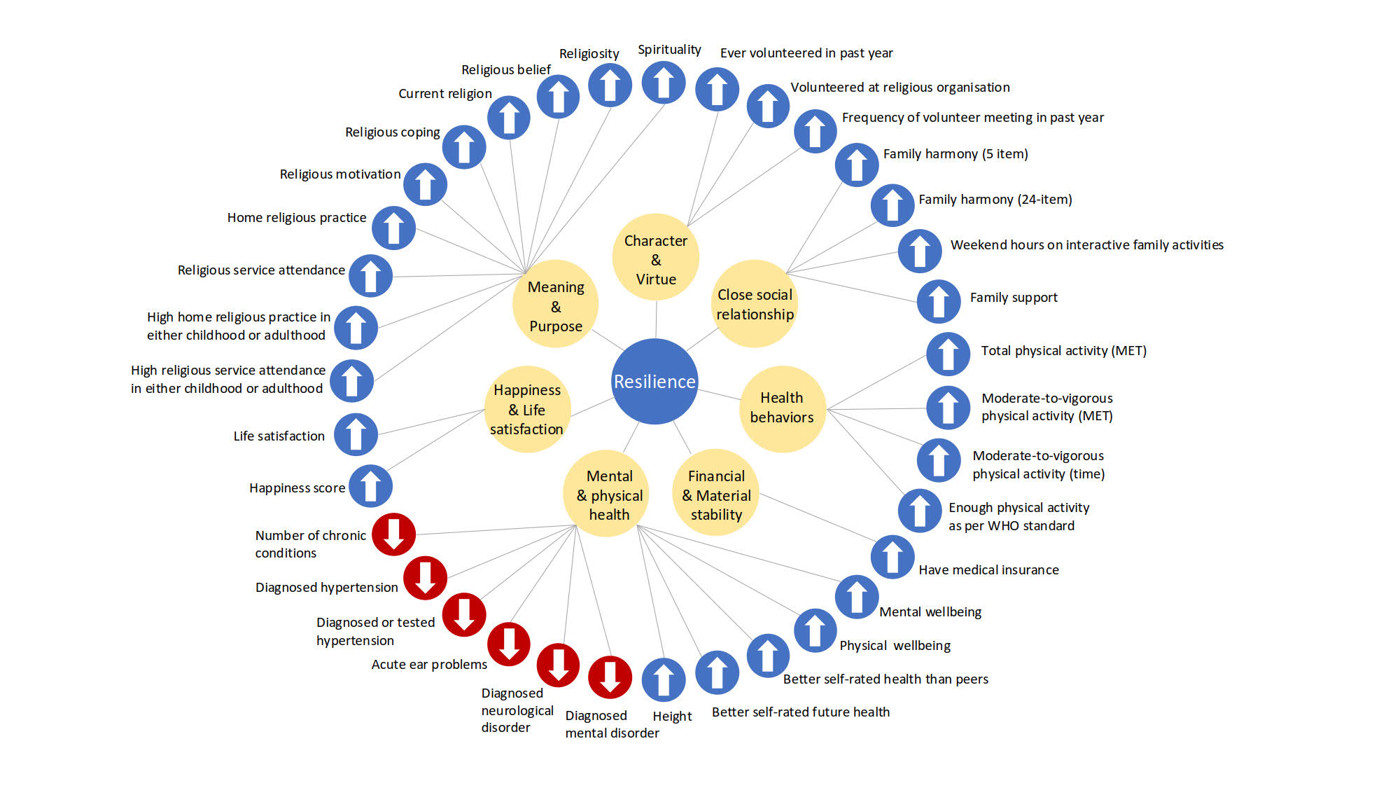
A research team led by the School of Public Health, LKS Faculty of Medicine of the University of Hong Kong (HKUMed), recently conducted one of the largest and most systematic studies to date on predictors of psychological resilience. Analysing data from 26,210 Hong Kong residents, the researchers systematically evaluated 208 candidate predictors and ultimately identified 35 factors associated with an individual's capacity to cope with adversity. The study found that everyday factors, such as family relationships, volunteering, physical activity, life satisfaction and religious activities, are associated with higher psychological resilience. Published in the international journal Nature Mental Health (link to the publication), these findings can help strengthen public resilience and inform strategies for preventing mental health conditions and reducing their burden on individuals and society.
Comprehensive large-scale data analysis enhances research reliability
Psychological resilience is the ability to maintain or recover mental health in the face of adversity. Despite growing access to evidence-based treatments, the global prevalence of stress-related mental health conditions, such as depression and post-traumatic stress disorder (PTSD), has not declined. This indicates that while current treatment approaches can address existing cases, they do not sufficiently prevent the emergence of mental health issues. Therefore, it is crucial to identify factors that contribute to psychological resilience.
Previous research on predictors of resilience has often focused on a single factor at a time and involved primarily Western populations. This study utilised data from the FAMILY Cohort, a large population-based prospective cohort established by HKUMed School of Public Health. Using an environment-wide association study (EWAS) approach, the researchers analysed data from 26,210 participants aged 15 or above, and evaluated 208 potential predictors covering personal, family, social and lifestyle domains, among others. Unlike previous studies that tested pre-selected factors, this data-driven approach comprehensively screened all potential variables. Through rigorous statistical corrections and internal validation, the study minimised the risk of false-positive and selective reporting, thereby improving the reliability of the findings.
Positive lifestyle habits associated with higher psychological resilience
The research team identified 35 validated predictors related to psychological resilience, covering seven domains: mental and physical health, happiness and life satisfaction, meaning and purpose (e.g. religious activities), character and virtues (e.g. volunteering), close social relationships, financial and material stability (e.g. access to medical insurance), and health behaviours (e.g. physical activity).
The study found that many predictors associated with higher psychological resilience are closely linked to everyday life. For example, engaging in interactive activities with family during weekends, such as exercising, shopping, playing games, sharing meals, and chatting, was positively correlated with higher psychological resilience over time. Conversely, more passive family activities showed no significant association with psychological resilience. Individuals who participated in volunteering in the previous year, achieved physical activity levels recommended by the World Health Organization or reported harmonious family relationships also tended to demonstrate greater psychological resilience.
Additionally, the factors associated with psychological resilience varied across age and gender groups. Family harmony and access to medical insurance were more strongly associated with resilience among women than among men, whereas physical activity and religious involvement showed stronger links among men than among women. Across almost all domains, including religious activities, volunteering, family support and physical activities, positive associations with resilience were more pronounced among older adults aged 60 years or older than among young people aged 15 to 24 years. However, the negative association between chronic illnesses and psychological resilience was also more pronounced among older adults.
Building psychological resilience takes more than individual effort
The study findings highlight that psychological resilience is often shaped by everyday behaviours, which can be strengthened through public health services, community support, and social care activities. 'This study reveals that many predictors of psychological resilience in Hong Kong are consistent with evidence from Western contexts, suggesting that some foundations of resilience may be shared across cultures. While this observational study does not establish causality, it provides important directions for future research,' said Dr Michael Ni Yuxuan, Clinical Associate Professor in the School of Public Health, HKUMed, who led the study. 'Our study also suggests that strengthening mental health support may require more than treatment alone. A comprehensive public health approach is needed to help individuals build psychological resilience across multiple domains of daily life.'
Dr Karmel Choi from the Department of Psychiatry at Harvard Medical School and Massachusetts General Hospital, also a member from the research team, said, 'This study identifies predictors of psychological resilience across multiple levels and domains, from individual health and behaviour to family relationships and volunteering. These findings reinforce the idea that psychological resilience is not solely a personal ability but is also shaped by the social and structural resources around us. The next step is to test whether intervention targeting these factors can causally strengthen psychological resilience, which would have important implications for mental health prevention worldwide.'
About the research team
This study was led by Dr Michael Ni Yuxuan, Clinical Associate Professor in the Division of Community Medicine and Public Health Practice, School of Public Health, HKUMed. The co-first authors are Dr Ning Ke from the Research Division, Institute of Mental Health, Singapore; Dr Kim Yoona and Dr Fan Xiaoyan from the School of Public Health, HKUMed. Other research organisations included Harvard TH Chan School of Public Health; Department of Psychology, The Education University of Hong Kong; Department of Urban Planning and Design of the Faculty of Architecture, HKU; and Department of Psychiatry, Harvard Medical School and Massachusetts General Hospital.
Acknowledgements
The establishment of the FAMILY Cohort was funded by the Hong Kong Jockey Club Charities Trust. The present analysis is part of the Hong Kong Youth Barometer project, funded by WYNG Foundation.


