
Key points
- Black holes are so massive and dense not even light can escape, making them something of a cosmic mystery.
- The extreme gravity near black holes provides a laboratory where we can test our understanding of physics.
- Only a telescope the size of Earth can take a black hole's picture.
1. What is a black hole? Is it really a hole in space?
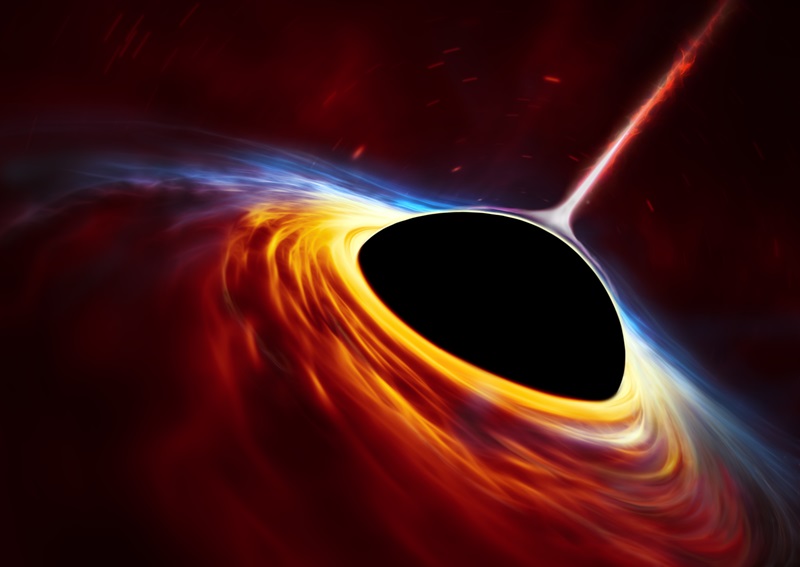
First things first, a black hole is not really a hole.
Black holes are objects so dense they create an area of space with so much gravity nothing can escape, not even light. The edge of this area is called the event horizon. It's not a physical edge, but a boundary in space, like a point of no return. Once something is across the event horizon, it's not coming back.
Black holes are extraordinarily heavy, ranging from a few times as heavy as our Sun and upwards. But unlike our Sun, all that mass is in a much smaller area. This extreme density leads to their unusual behaviour.
Their name comes from how a black hole can appear to be a gap in space that other objects move around.
2. How does a black hole form?
Black holes form and grow in different ways.
Smaller black holes that are only a few times the mass of our Sun form at the end of a star's life. If the star is big enough its core will collapse in on itself when it runs out of fuel, forming a black hole. They're called stellar-mass black holes.
Black holes can also combine or grow by sucking in matter that gets too close to the event horizon.
The largest black holes are at the centre of large galaxies, called supermassive black holes . We don't know how they formed and grew so rapidly.
What about the black holes in between? They're very elusive. Astronomers have found evidence for a few so-called intermediate-mass black holes, but they remain difficult to confirm.
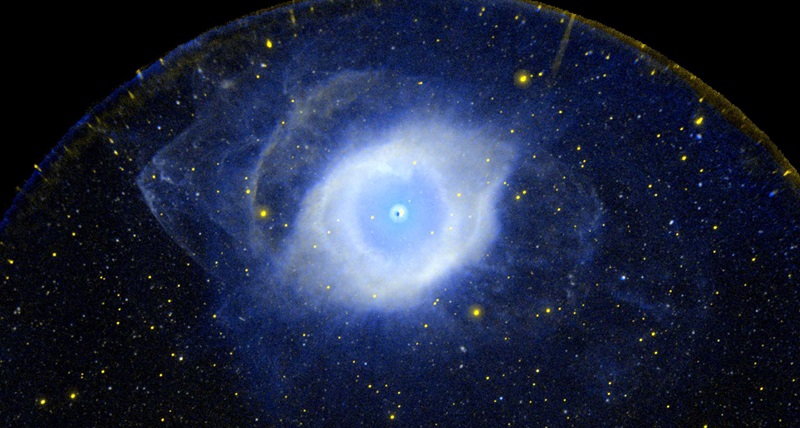
Worried about our Sun? It's not big enough to collapse into a black hole in the future. It'll probably become a white dwarf star like this when it runs out of fuel in a few billion years.
3. What's inside a black hole?
Simple answer, we don't know what's inside a black hole. Black holes are among science's most enduring mysteries.
Things get extreme near the event horizon – not even light can escape, so it's impossible for us to see past to what's inside.
Current theories predict matter becoming so compressed within a black hole that our understanding of physics breaks down. This is one of the reasons black holes are so interesting to study.
4. Would a black hole swallow our Solar System?
Don't panic, their reputation as cosmic vacuum cleaners is undeserved. Black holes only suck things in if they get too close.
From a distance, the gravity of a black hole acts like anything else that has the same mass. If the Sun was replaced with a black hole that has the same mass, the Earth would continue to orbit happily around. It would be fine, if very cold and dark.
If something orbiting a black hole gets slowed down and no longer has enough motion to maintain its distance, the black hole's gravity will pull it in, much like a spacecraft returning to Earth. Once it crosses the event horizon escape is impossible.
Much of the Universe is in orbit around a black hole of some sort, including our Solar System – safely in orbit around the supermassive black hole at the centre of our Milky Way galaxy.
5. What would happen if you got too close to a black hole?
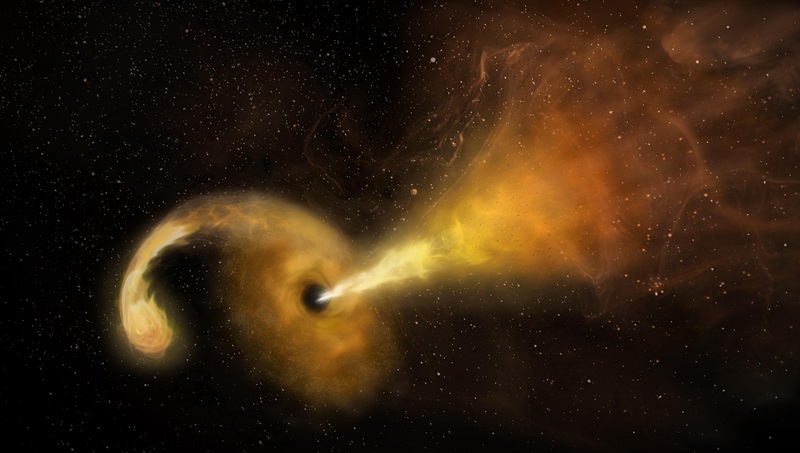
If you are in a stable orbit around a black hole you would continue on your way. When things get sticky is if you get slowed down or decide to head straight towards the event horizon.
The strength of gravity is related to distance – the closer you are, the stronger the gravitational pull. This means when standing on Earth gravity pulls slightly more on your feet than your head, because your feet are closer. We don't notice much difference because the distances are small.
The density of a black hole means its gravity is so extreme that the strength of its pull changes rapidly, even over short distances. If you were approaching feet first a black hole's gravity would pull much more strongly on your feet than your head.
The result? You get stretched out by the extreme forces caused by gravity.
This phenomenon is called spaghettification.
Yes, seriously.
6. How big can a black hole get?
Astronomers classify black holes by their mass rather than their physical size. With masses this large, measuring by the kilogram doesn't cut it. Astronomers compare things to the mass of our Sun – called a solar mass.
Stellar-mass black holes are the babies of the bunch, weighing in at up to around 100 solar masses. They can grow by feeding on material that gets too close or combining with another stellar-mass black hole.
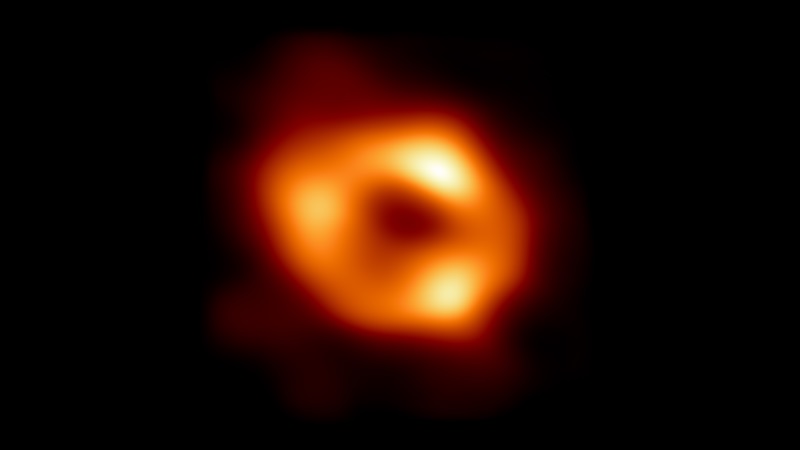
Supermassive black holes found at the centre of galaxies can be millions to billions of times heavier than our Sun. Some of the largest supermassive black holes studied are estimated to be more than 60 billion solar masses. In comparison, the supermassive black hole at the centre of our galaxy, Sagittarius A*, is about 4 million solar masses.
While this doesn't explain how they grew so quickly within the centre of most galaxies, supermassive black holes can also grow by feeding on nearby material. They're very messy eaters. When they're actively feeding, astronomers can see the bright radio signals emitted nearby – just one of the ways these enigmatic objects can be found.
7. If black holes are black, how do astronomers find them?
Because the black hole within the event horizon boundary can't be directly observed, astronomers look for the impact it has on its surroundings.
The strong gravity of a black hole influences nearby matter and causes effects that can be observed by a variety of methods:
- Sagittarius A* in the centre of our galaxy has been measured by closely following stars orbiting its invisible mass at great speeds .
- The hot material swirling around some black holes moves so quickly that it emits X-rays and other high-energy waves that can be seen by some space-based telescopes .
- Supermassive black holes which are actively feeding can emit strong radio waves from jets of matter spat out before it could be eaten. These jets can be imaged by radio telescopes like our ASKAP radio telescope .
- When two black holes collide, they emit gravitational waves that stretch and squeeze spacetime. They can be measured by extremely sensitive detectors on Earth , or through minute changes in the arrival time of radio pulses from rapidly spinning neutron stars called pulsars .
- The matter around the event horizon of a supermassive black hole has been directly imaged by combining radio telescopes to act like a telescope the size of the Earth.
[Video contains no sound]
Stars, seen as bright white dots on a black background, are moving around a square-framed patch of sky.
Some of the stars are moving towards the centre of the image and then rapidly change direction to slingshot back around travelling in a tight ellipse.
They're orbiting around a blank spot of sky with no stars, where the black hole at the centre of the Milky Way is located.
Video credit ESO/MPE.
- View transcript
- Copy embed code


