
A partial solar eclipse will be visible in Germany during the evening of 12 August. An expert from the University Eye Clinic has warned against looking directly at the sun without protection.
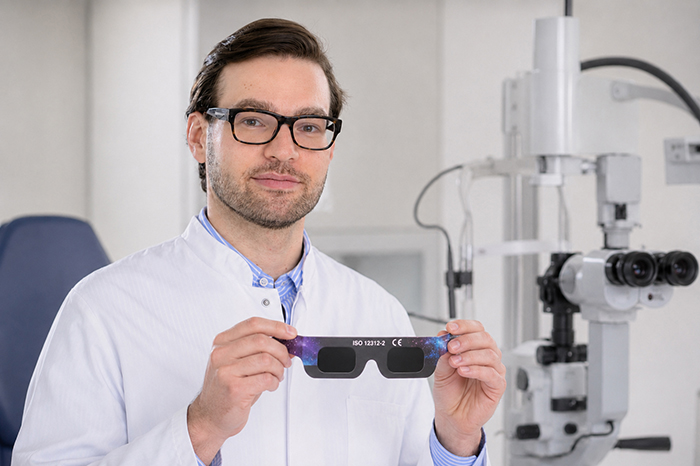
When the Moon passes between the Earth and the Sun on Wednesday, 12 August 2026, Lower Franconia will also be treated to an impressive celestial spectacle. In Würzburg, the partial solar eclipse will begin at around 7.20 pm. It will reach its peak at around 8.13 pm and end with sunset at around 8.43 pm.
Anyone wishing to observe the event should under no circumstances neglect to wear the correct eye protection. This is emphasised by experts from the Eye Clinic at Würzburg University Hospital (UKW).
Only look at the sun through certified protective glasses
"Certified solar eclipse glasses are the most important requirement for observing a solar eclipse safely," emphasises senior consultant Dr Andreas Berlin. It is also important that the protective glasses are undamaged and comply with the international standard ISO 12312-2.
The glasses must be put on before looking at the sun and must not be removed until you have looked away from the sun.
Damage often goes unnoticed at first
Anyone who looks directly at the sun without protection can develop solar retinopathy after just a short time. This causes permanent damage to the light-sensitive sensory cells of the retina.
Typical symptoms such as blurred vision, a dark spot in the centre of the field of vision or distorted vision often only appear hours later.
"The retina has no pain receptors. That is why those affected often only notice the damage once it has already occurred," explains Dr Berlin. Although the changes may partially reverse, in some cases a permanent impairment of central vision remains.
Sunglasses are not enough
Contrary to a widespread assumption, ordinary sunglasses do not offer sufficient protection. Whilst they reduce brightness and filter out a large proportion of UV radiation, they do not sufficiently attenuate the intense sunlight. Furthermore, the pupils dilate behind the dark lenses, meaning that, under certain circumstances, even more harmful light may reach the retina.
Particular caution is also required when using binoculars, cameras or telescopes. These must never be used in conjunction with solar eclipse glasses. Instead, special solar filters are required, which must be fitted over the lens aperture.
Children should only be allowed to watch under supervision
In principle, the same protective measures apply to children as to adults. They, too, should use only certified solar eclipse glasses. As younger children are often unable to judge reliably whether the protective glasses are fitted correctly or are damaged, the UKW recommends that they only observe under adult supervision.


