
Marine scientists have conducted the first resurvey of Northern Patagonia's kelp forests in more than 50 years and discovered dramatic changes across one of the world's most remote marine ecosystems due to human activities.
Lead author Dr Albert Pessarrodona, from The University of Western Australia's Oceans Institute and School of Biological Sciences, worked with international researchers on the study published in Regional Environmental Change, which gained important insights into the current state of Northern Patagonia's vast giant kelp forests.
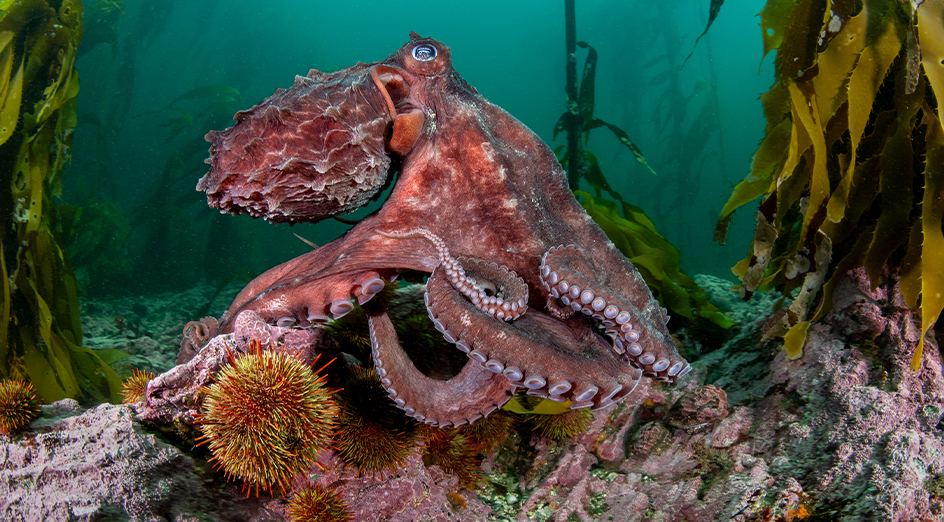
"Giant kelp forests are crucial breeding grounds for marine biodiversity, providing food and shelter and play a key role in the ocean's carbon cycle," Dr Pessarrodona said.
"Patagonia's giant kelp forests are among the most extensive on the planet, and until recently were largely believed to be stable due to their isolation and remoteness."
The team is conducting a "Megatransect" across more than 1,200 km of Patagonian coastline from the Gulf of Corcovado to Cape Horn to study kelp forest biodiversity and carbon sequestration potential.
Researchers discovered threats to the kelp including the invasive anemone Metridium senile, that now covers up to 88 per cent of the seafloor of sheltered fjord lands, and a proliferation of sea lettuce (Ulva spp.).
"This invasive anemone now blankets hard substrates across many locations – from the seafloor to animals and even plants," Dr Pessarrodona said.
"It first appeared in Chilean Patagonia in 2005, and has subsequently expanded to numerous locations, likely at the expense of native filter feeders."
Another species that suffered dramatic changes was the red sea urchin (Loxechinus albus), whose abundance has declined by 59 per cent to 90 per cent following the establishment of the world's largest sea urchin fishery.
The dwarf sea urchin (Pseudechinus magellanicus) – historically very abundant – had altogether disappeared from shallow waters, where it plays an important.
"These findings show that there are now very few places in the ocean untouched by human activity and even some of the most remote marine ecosystems on the planet are showing clear signs of human influence," Dr Pessarrodona said.
Mathias Hüne, director of Rewilding Chile's Marine Program and co-author of the study, said the results show it is crucial to create marine protected areas in southern Chile to conserve these giant kelp forests
This is the first scientific paper to come from the Patagonian Megatransect project of Fundación Rewilding Chile and is supported by the Prince Albert II of Monaco Foundation, the Ecological Restoration Fund and the Plum Foundation.
The study was co-authored Mr Hüne, Mauricio Palacios and Jonathan Poblete, from the Marine Program of the Rewilding Chile, in collaboration with Iván Gómez (Austral University, Chile), Alejandra Mora (University of Victoria, Canada), Julieta Kaminsky (CADIC-Conicet, Argentina) and Dr Pessarrodona.


