
All visible matter in the universe - stars, planets, you, me - is made up of some combination of 12 fundamental particles . The lightest and most abundant of these are neutrinos . They are also the least visible. With every tick of the clock, more than 100 billion of these " little neutral ones " stealthily zip through you, with energies so low that they leave no trace of their passage.
Author
- Doug Cowen
Professor of Physics and Professor of Astronomy and Astrophysics, Penn State
Neutrinos have uniquely small masses and the ability to penetrate just about anything, which make them a razor-sharp tool for physicists like me to study how fundamental particles interact with one another. For example, neutrinos may give researchers their best shot at learning why the universe is predominantly made of matter , rather than equal parts matter and antimatter.
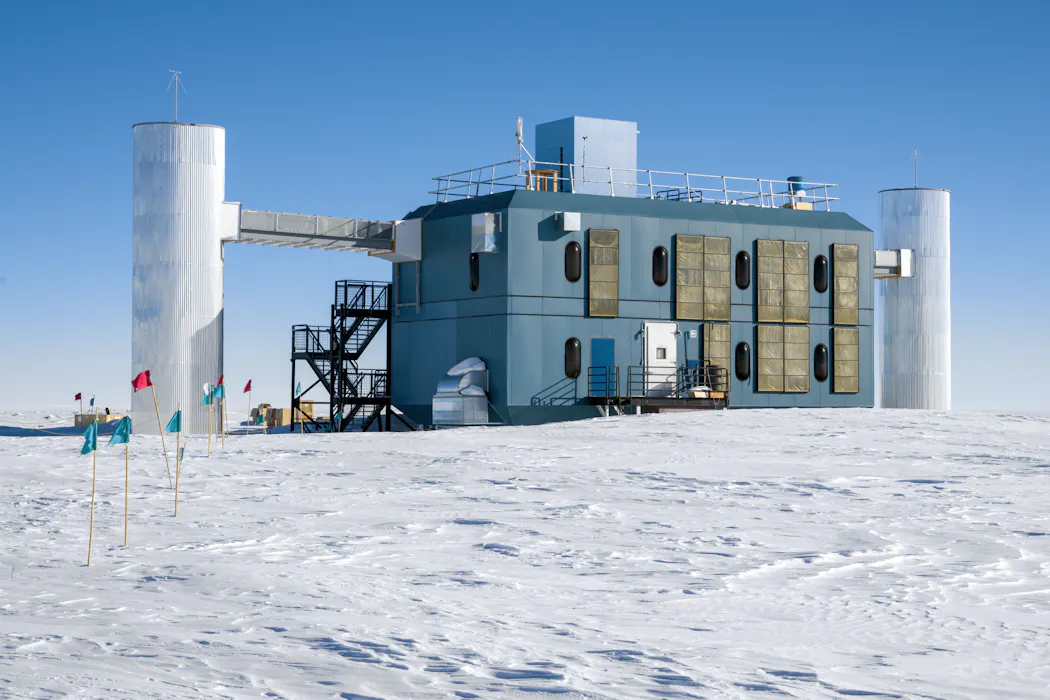
Their unusual properties also make neutrinos fiendishly difficult to detect. Physicists have risen to meet this challenge by employing specialized materials at industrial scales. The 2026 Nobel Prize in physics went to physicist Francis Halzen for his work on the IceCube Neutrino Observatory , a detector located at the South Pole that is one of the longest-running experiments using massive amounts of material to try and catch a glimpse of these fleeting, tiny particles.
Scientists first proposed the existence of neutrinos in 1930, but it took another quarter-century for physicists to discover them. They did so using 10 tons of liquid placed near a nuclear reactor core . They detected the faint whisper of energetic neutrinos emerging from the process of nuclear fission as they collided with particles in the liquid. The first neutrino-related Nobel Prize was awarded in 1995 for this discovery.
Since then, researchers have won Nobel Prizes for discoveries using neutrinos created with particle accelerators , in cosmic-ray air showers in the Earth's atmosphere and in the core of the Sun . The 2026 Nobel Prize in physics was awarded for the detection of neutrinos created in astrophysical sources, far away from the solar system. Many of the neutrinos used in these discoveries traversed the entire Earth before being detected.
Neutrino oscillations
Neutrinos come in three types , dubbed electron neutrino, muon neutrino and tau neutrino due to their close relationship with charged particles of the same names. For example, if a particle's decay products include an electron, they will often also include an electron neutrino.
Neutrinos are so light that scientists first assumed them to be massless. We now know that neutrinos of one type have been observed to change, or "oscillate," into another type: something that can only happen if neutrinos have a nonzero mass, even if it's just a tiny amount.
The Super-Kamiokande experiment , an enormous 110 million-pound (50-kiloton) vessel of ultrapure water buried under a mountain in Japan, discovered in 1998 that neutrinos produced in the atmosphere were oscillating. Scientists observed neutrinos changing their type as they sped through the Earth below the detector and - rarely - produced a signal by banging into a water molecule inside the detector.
The signature of an electron neutrino is a 4-inch (10-centimeter) blob of light, while the signature of a muon neutrino is a meters-long track of light. The experiment measured a nonuniform pattern that muon neutrinos could only produce if some of them were oscillating into electron or tau neutrinos as they passed through the Earth, between where they were born in the atmosphere to where they were detected by Super-Kamiokande.
The Sudbury Neutrino Observatory experiment discovered in 2002 that neutrinos produced in the Sun were also changing their type as they emerged from the solar core and traveled to Earth. Previous experiments measuring solar neutrinos were only able to see electron neutrinos, which are the only type produced in fusion reactions in the Sun's core.
This observatory, in Sudbury, Canada, used 1 kiloton (over 2 million pounds) of heavy water, which allowed it to see all neutrino types at once. Heavy water contains deuterium instead of hydrogen. And deuterium nuclei contain a neutron that can be liberated by a neutrino and then detected, regardless of the type of neutrino.
Together, Super-Kamiokande and Sudbury Neutrino Observatory solved a mystery that had preoccupied physicists for nearly three decades: Why weren't we seeing as many neutrinos from the Sun's fusion reactions as expected, given the Sun's luminosity? Was the Sun, and by extension many of the stars in the universe, doing something we did not understand?
The definitive answer provided by Super-Kamiokande and Sudbury was that it was the neutrinos themselves that had oscillated. The leaders of the two experiments were awarded a Nobel Prize for the discovery of neutrino oscillations in 2015.
The need for an even larger detector
Around the same time that researchers discovered neutrino oscillations, Francis Halzen and others conjectured that powerful astrophysical phenomena out in space, like active galactic nuclei , gamma-ray bursts , supernovas and binary neutron star mergers ought to produce very energetic neutrinos.
They knew that the high energies of these astrophysical neutrinos would make them more likely to interact with matter and easier to detect. However, they also realized that they would be much rarer. These neutrinos would be so energetic that to capture an appreciable number of them, and to contain the ones that were captured, the detector would have to be huge, even by neutrino detector standards. It would need a volume of about a quarter of a cubic mile (1 cubic kilometer), and something that big could not be built by hand.
To discover astrophysical neutrinos, they had to piggyback on Mother Nature.
Building IceCube
The experiment's medium had to be clear. That way, when a neutrino collided with a particle in the ice and produced both charged particles and light, that light could be detected hundreds of yards away. The team determined that the deep ice found at the South Pole was sufficiently clear and would allow for a sparse - and affordable - sensor array. The scientists built a prototype detector called AMANDA . Once operational, it soon registered a pattern of light produced by a charged particle moving upward in the detector.
They knew this pattern could only have come from a neutrino created in the Northern Hemisphere that burrowed through most of the Earth. It must have ended its journey by colliding with an atom in the ice near the bottom of the AMANDA detector, producing the upward-going particle.
Now that they'd demonstrated the South Pole ice cap's viability for neutrino detection, Francis Halzen and his colleagues embarked on a campaign to build a detector at the cubic kilometer scale, encompassing a gigaton of pristine glacial ice. The result was IceCube , which has about 5,000 optical sensors sunk more than 1 mile (1.6 kilometers) under the surface of the ice cap.
It took seven years to build IceCube , with construction limited to a few months per year during the Southern Hemisphere's summer. Then in 2013, a few years after it was turned on, IceCube discovered neutrinos of such high energy that they had to be astrophysical in origin. Researchers were unable to pinpoint what produced them, though.
A few years later, IceCube saw an energetic neutrino at the same time as a NASA space telescope spotted an energetic gamma ray coming from the same place as the neutrino. Together, these two observations confirmed the origin of an astrophysical neutrino.
As the IceCube scientists learned more about the detector, and developed more sophisticated analysis techniques, they discovered neutrinos emitted by the center of our galaxy , as well as neutrinos emitted by several other astrophysical sources .
IceCube scientists also discovered the first astrophysical tau neutrinos by detecting their unique "double cascade" signature. They are also using the detector to make precise measurements of how neutrinos oscillate and to search for new types of neutrinos.
New neutrino telescopes will soon join IceCube's ranks, like KM3NeT , under construction in the Mediterranean, and P-ONE , under development in the Canadian Pacific. IceCube will propose an expansion to IceCube-Gen2 . These developments make it highly likely that exciting new discoveries are just around the corner.
Almost 70 years ago, neutrinos announced their presence with the quietest of whispers. Now, to paraphrase the singer Tom Waits, they're " making speeches ," and physicists are hanging onto every word.

Doug Cowen receives funding from the National Science Foundation.


