

The research originated in a project aimed at developing biofuels for ships but has since evolved into an environmentally friendly method for wood preservation. The path to new inventions is rarely straight or predictable, and this has certainly been the case for University of Copenhagen researchers Emil Thybring and Sune Tjalfe Thomsen. For several years, they have been working on a new, sustainable way to impregnate wood without harming the environment.
Today, the wood industry treats timber with heavy metals such as copper to extend its lifespan when used as a construction material. In the pressure treatment process, water with dissolved preservation chemicals is forced into the wood. The problem is that a large proportion of these substances is later leached out when the wood is exposed to rain, ultimately ending up in soil, marine environments and drinking water.
- Approximately 6.5 million cubic meters of pressure-treated timber are sold annually on the European market.
- Pressure-treated timber typically has only a single life cycle and is often transported to Germany for incineration at the end of its use.
- Pressure-treated timber is treated with heavy metals such as copper to extend its service life.
"The toxic substances we introduce into the wood using water to make it last longer also leave the wood with water and end up in nature. It is a serious problem, and one we aim to solve with our technology," says Emil Thybring, associate professor at the Department of Geosciences and Natural Resource Management.
The wood's own 'glue' - in hyperconcentrated form
The researchers' method is based on lignin, a natural binding agent in wood that stiffens the material and holds its cells together. Lignin is available in vast quantities as a residual product from the paper industry, where it is separated out and typically burned because it gives paper a brownish colour rather than the desired white. According to the researchers, just 15 percent of the EU's lignin production could replace the environmentally harmful substances used across the entire EU production of pressure-treated timber.
"It makes perfect sense to take a global industrial by-product and use it as an environmentally friendly alternative to the most widely used - and environmentally damaging - wood protection methods we rely on today," says Sune Tjalfe Thomsen, associate professor at the Department of Geosciences and Natural Resource Management.

Lignin in powder form as it comes from paper mills. Photo: Sune Tjalfe Thomsen
By dissolving lignin in alcohol, the researchers have succeeded in creating an extremely concentrated solution with such a high lignin content that it can impregnate wood very efficiently - a process they have dubbed "hyperlignification".
"Others have previously considered using lignin as a wood preservative and experimented with relatively dilute solutions. We work with much higher concentrations, which truly saturate the wood and protect it against fungal decay and rot," says Emil Thybring.
Blocking fungi and moisture
The method works by dissolving lignin - a natural binding agent in wood - in an alcohol-based liquid, allowing it to penetrate the wood's microscopic structure. The researchers use a process similar to conventional pressure impregnation, in which the liquid is forced into the wood under pressure. The key difference is the much higher lignin concentration, making it possible to fully 'saturate' the wood with the natural material.
Once inside the wood, the lignin alters the material's internal composition, making it far less attractive to wood-degrading fungi. At the same time, the wood's ability to absorb moisture is reduced, which is one of the primary drivers of biological degradation. The result is a wood material that is far more resistant to the mechanisms that normally lead to rot and decay.
"In laboratory trials, where we expose the wood to some of the most aggressive wood-degrading fungi under optimal growth conditions, we see a striking difference between untreated and hyperlignified wood. For example, tests on pine and beech show that when fungi have decomposed around 50 percent of untreated wood, they have only broken down about 1 percent of the hyperlignified wood," says Sune Tjalfe Thomsen.
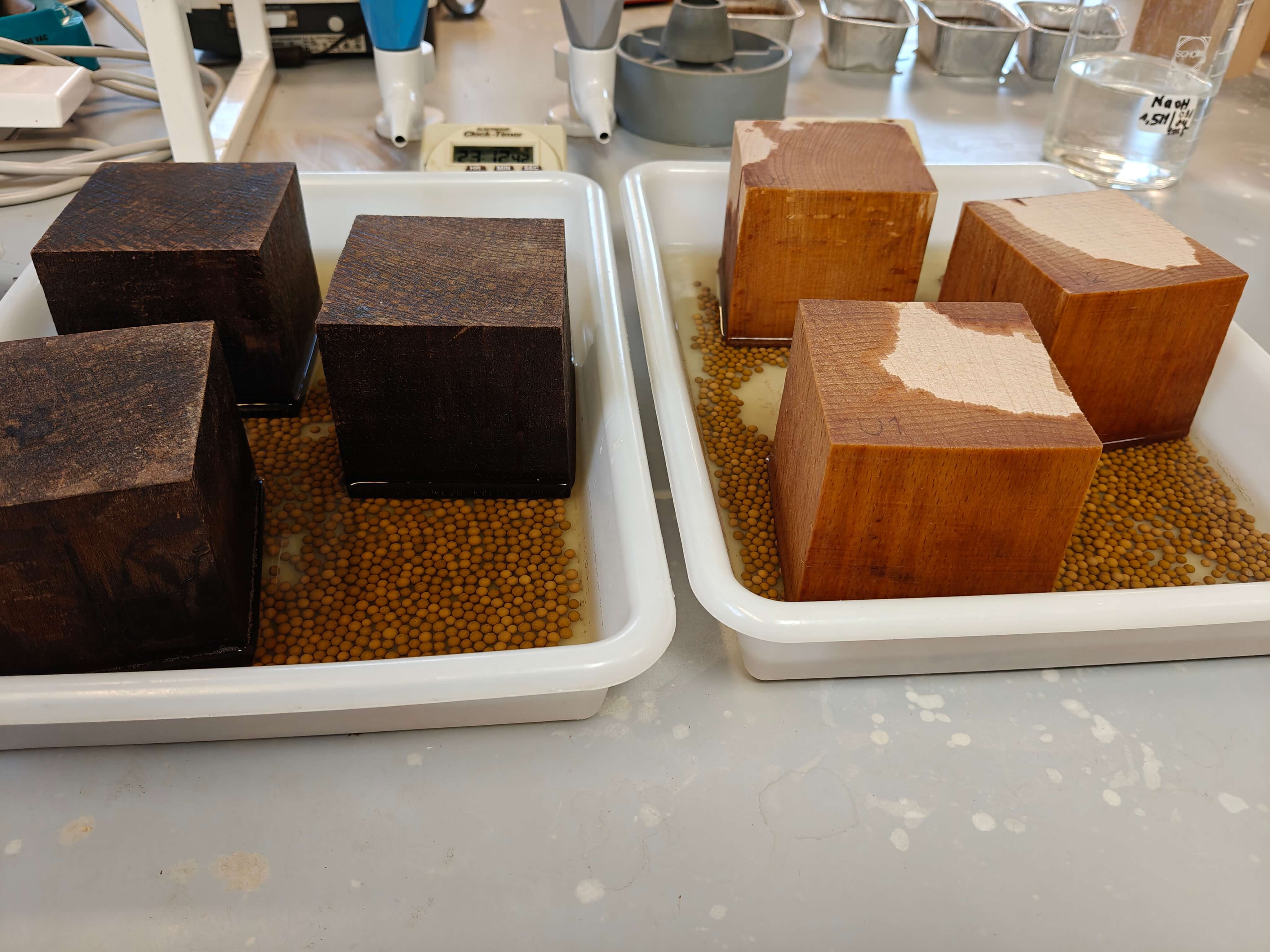
A simple test of water uptake in hyperlignified wood blocks (left) and untreated beech wood blocks (right) shows that the treatment significantly reduces moisture absorption, which helps increase durability. Photo: Sune Tjalfe Thomsen
These results indicate that the treatment has the potential to significantly reduce the rate of degradation. The findings were obtained under controlled laboratory conditions. An important next step is therefore to assess the effect at larger scales and under realistic outdoor conditions.
From backyard experiments to full-scale research
Ensuring that wood withstands outdoor exposure is not a new interest for Emil Thybring and Sune Tjalfe Thomsen, who could best be described as researchers with a long-standing interest in wood durability. For years, Emil Thybring conducted his own experiments in his backyard, testing various natural wood protection methods and monitoring them over time.
Today, that interest has evolved into a full-scale research project, which has recently received more than DKK 15 million in funding from Innovation Fund Denmark's Grand Solutions programme. Last year, the researchers also won a major European innovation competition, the "Evergreen Prize for Innovation", receiving EUR 300,000 to further develop their non-toxic wood protection technology.
The Hyperligno project
The Hyperligno project has received DKK 15.5 million in funding from Innovation Fund Denmark to further develop the research for industrial application.
Last year, the researchers won the European innovation competition "Evergreen Prize for Innovation" and received EUR 300,000.
The researchers behind the project are Associate Professor Emil Thybring and Associate Professor Sune Tjalfe Thomsen from the Department of Geosciences and Natural Resource Management at the University of Copenhagen.
The Grand Solutions project has been named "HYPERLIGNO" and was officially launched on 1 April. In collaboration with Frøslev - Denmark's largest timber supplier to the construction industry - as well as architects and other partners, the project aims to bring the research from the laboratory into production, transforming new knowledge into new wood products.
"We need to dive deep into the lignin molecules because we can see that certain types of lignin penetrate deeper into the wood and provide better protection. This allows us to identify the optimal lignin source from the paper industry," explains Sune Tjalfe Thomsen.
The Hyperligno team aims to develop a product that could replace today's toxic wood impregnation methods in Denmark and across Europe. At the same time, the EU is moving towards stricter regulation of biocides in wood, with a phase-out expected by 2030.


