

< The research team. From left: Ph.D. students Hyoju Kim, Junho Lee, Haneol Oh, and Tae Gyun Woo, and Professor Tae Kyu Kim (KAIST Department of Chemistry). >
To produce hydrogen using sunlight, the energy obtained from light must be retained until it can be used in a chemical reaction. However, if an electron that has gained energy from light quickly returns to its original position, it becomes difficult to make use of that energy. A KAIST-led research team has uncovered how tiny vacant sites inside a material that uses light to drive chemical reactions act like an "electron waiting room," providing more time for light energy to be utilized.
KAIST (President Choongsik Bae) announced on October 25 that a research team led by Professor Tae Kyu Kim of the Department of Chemistry, in collaboration with research teams led by Professor Tae Wu Kim of Kyung Hee University, Professor Joonghan Kim of The Catholic University of Korea, and Dr. Jae Hyuk Lee of the Pohang Accelerator Laboratory, identified the mechanism by which "oxygen vacancies" in titanium dioxide help retain electrons for longer periods. Oxygen vacancies are empty sites created when oxygen atoms are missing from a material.
Titanium dioxide is a representative photocatalytic material that promotes chemical reactions when exposed to light. It has been studied in the fields of clean energy and environmental technology because it can be used to produce hydrogen using sunlight, convert carbon dioxide into useful substances, and decompose pollutants.
When light strikes onto this material, electrons gain energy and move, leaving behind "holes". Simply put, a hole is a site vacated by an electron. Electrons and holes can each participate in chemical reactions, but if an electron fills the hole again before taking part in a reaction, the opportunity to use the energy obtained from light is lost. This process is called "recombination". Therefore, it is important to prevent electrons and holes from recombining too quickly and to secure enough time for them to participate in reactions.
The research team focused on "blue titanium dioxide (blue TiO₂)", which has a bluish color due to the absence of some oxygen atoms. The oxygen vacancies in this material can serve as temporary sites where electrons remain. While a hole is a "site vacated by an electron", an oxygen vacancy is a "site vacated by an oxygen atom", meaning the two are different. In this study, the researchers investigated how oxygen vacancies trap electrons and delay recombination.
To do so, the team used the X-ray Free Electron Laser at the Pohang Accelerator Laboratory, a fourth-generation light-source facility. Much like an ultrafast camera captures instantaneous motion, the system uses extremely short X-ray pulses to track changes inside a material after it absorbs light. The researchers observed changes around titanium atoms on the femtosecond timescale, equivalent to one quadrillionth of a second. They also combined these observations with optical analyses that measure changes in light absorption and with computational calculations.
The results showed that immediately after light absorption, electrons in both conventional titanium dioxide and blue titanium dioxide rapidly lost some of their energy and became temporarily trapped. The difference emerged in what happened next. In blue titanium dioxide, oxygen vacancies caused the electrons to enter a more stable "deep trap state."
This can be compared to a ball being less likely to roll out of a deep hollow than a shallow dip. However, this does not mean that an actual deep hole forms inside the material. Rather, it means that the electron occupies an energy state from which it is more difficult to escape. This state acts as an "electron waiting room," delaying recombination with holes.
In blue titanium dioxide, the electrons moved into the more stable deep trap state over approximately 1.5 nanoseconds. One nanosecond is one billionth of a second, meaning that the electrons settle into this "waiting room" in a period far shorter than the blink of an eye. Afterward, electron-hole recombination occurred approximately 2.5 times more slowly than in conventional titanium dioxide. This means that electrons retain the energy obtained from light for longer, potentially increasing the opportunity for that energy to be used in chemical reactions.
In blue titanium dioxide, the electrons moved into the more stable deep trap state over approximately 1.5 nanoseconds. One nanosecond is one billionth of a second, meaning that the electrons settle into this "waiting room" in a period far shorter than the blink of an eye. Afterward, electron-hole recombination occurred approximately 2.5 times more slowly than in conventional titanium dioxide. This means that electrons retain the energy obtained from light for longer, potentially increasing the opportunity for that energy to be used in chemical reactions.
The significance of this study lies in connecting the entire process, from the trapping of electrons by oxygen vacancies to changes in the surrounding atomic structure and the resulting delay in recombination. The findings could be used in the future to design photocatalysts that retain electrons for longer periods by controlling the amount and distribution of oxygen vacancies.
The research team expects the findings to contribute to the development of highly efficient photocatalysts for applications such as solar hydrogen production, carbon dioxide conversion, and pollutant decomposition. To improve actual performance, however, follow-up studies will be needed to determine whether the electrons that remain trapped for longer periods can also participate effectively in chemical reactions.
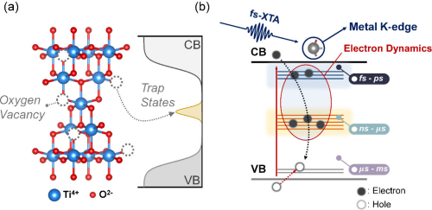
< Figure 1. Delayed photoinduced charge recombination caused by deep trap states formed by oxygen defects >
Professor Tae Kyu Kim said, "This study shows that vacancies created by missing oxygen atoms in a material are not simply defects, but play an important role in helping electrons remain for longer periods," adding, "We expect these findings to contribute to the design of photocatalysts that utilize light energy more effectively by controlling the microscopic structure of materials."
Tae Gyun Woo, a Ph.D. student in the KAIST Department of Chemistry, participated in the study as the first author. Professor Tae Kyu Kim of KAIST, Professor Tae Wu Kim of Kyung Hee University, Professor Joonghan Kim of The Catholic University of Korea, and Dr. Jae Hyuk Lee of the Pohang Accelerator Laboratory participated as co-corresponding authors. The research findings were published online on September 17, 2026, in the Journal of the American Chemical Society (JACS).
Paper title: Femtosecond X-ray Tracking of Oxygen Vacancy-Driven Shallow-to-Deep Trap Transition and Its Impact on Charge Carrier Dynamics in Blue TiO₂,
DOI: 10.1021/jacs.6c10078
Key author information: Tae Gyun Woo (Ph.D. student, Department of Chemistry, KAIST; first author), Tae Kyu Kim (Professor, Department of Chemistry, KAIST; corresponding author), Tae Wu Kim (Professor, Kyung Hee University; corresponding author), Joonghan Kim (Professor, The Catholic University of Korea; corresponding author), Jae Hyuk Lee (Senior Scientist, Pohang Accelerator Laboratory; corresponding author)
This research was supported by the Mid-Career Researcher Program of the National Research Foundation of Korea, the InnoCORE Program of the Ministry of Science and ICT, the Samsung Science & Technology Foundation, and the KAIST Cross-Generation Collaborative Lab Project. The experiments were conducted using the X-ray Free Electron Laser facility at the Pohang Accelerator Laboratory, supported by the Ministry of Science and ICT.


