
Combining fractions with basketball improves pupils' mathematical skills in primary school, a new study from the University of Copenhagen concludes. The researcher behind it calls for the approach to be integrated into primary and lower secondary education.
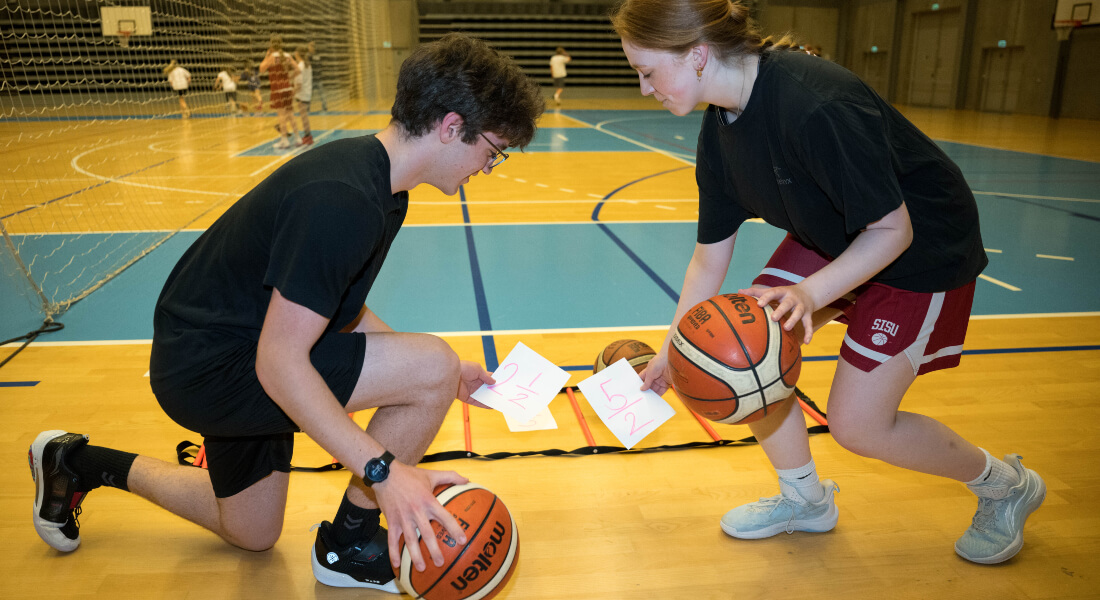
A dribble and a jump shot - followed by a fractions task. That is what physical education classes looked like for a group of pupils and the pupils not only found the lessons more engaging than usual; they also became better at mathematics with a basketball in their hands. That is the conclusion in a new study from the University of Copenhagen.
The study involved more than 300 pupils aged 11 to 13 who took part in an eight-week teaching programme called Basketball Mathematics. Here, fractions were directly linked to basketball activities during physical education classes. For example, pupils would take ten shots at the basket and then calculate what fraction of the shots were successful and convert the result into percentages.
Afterwards, pupils who participated in Basketball Mathematics performed 15 per cent better in a fractions test compared with a control group that received standard physical education. The results please Jacob Wienecke, Associate Professor at the Department of Nutrition, Exercise and Sports at the University of Copenhagen and lead researcher on the study.
"I am convinced that sport and physical activity can open up mathematics for pupils who are not otherwise engaged by the subject," he says.
Basketball Mathematics consisted of one weekly lesson over eight weeks, during which mathematics was integrated into basketball drills. According to the researchers, the results show that even relatively small changes to teaching can make a difference.
"These are quite substantial improvements over a short period of time. This suggests that it is possible to strengthen pupils' mathematical skills without having to find additional teaching time," says Jacob Wienecke.
More effort in the classroom
Fractions are an area that many pupils struggle with. But how well they understand fractions appears to matter. Several studies have shown that pupils' fractions skills are a strong indicator of how they will perform in other areas of mathematics later in life.
In the study, pupils experienced the teaching as more engaging than traditional classroom instruction. To a greater extent than usual, they felt they mastered the tasks and took a more active part in the lessons.
This was also reflected in their results. In addition to improvements in fractions, pupils performed around five per cent better in other mathematical tasks.
"Our hypothesis is that the children get positive experiences with mathematics, and that this may encourage them to put more effort into math in the classroom as well," says Jacob Wienecke.
At the same time, the pupils also improved their basketball skills which shows that integrating academic content into physical education does not come at the expense of learning a new sport.
Small changes with a big impact
The researchers stress that the results should be interpreted with caution. This is partly because the pupils received slightly more mathematics teaching than the control group, and partly because the study was relatively short. Thus, it is unclear whether the effect will last in the longer term.
"But we know from other studies that pupils' level of math at this stage is often linked to their later performance. So, if you can raise their level here, it may potentially influence their educational trajectory long term," says Jacob Wienecke.
More ball games in class
So, should schools start integrating more ball-playing activities into other subjects? Yes, says Jacob Wienecke, who is an advocate of this approach.
"Our research shows that you can easily invite other subjects into physical education and make it work. And it can actually make children experience that subject in a completely different way, while still preserving their motivation and enjoyment of learning," he says.
The researchers hope that more schools will work to integrate physical activity into teaching. They have developed a teaching compendium that teachers can use freely if they want to try the method in practice. Although the study is based on basketball, the principles can be transferred to other activities, such as volleyball.
"If it were up to me, one out of five math lessons each week would be active math. The most important thing is that the movement makes sense in relation to what the pupils are meant to learn, so that they are not just solving a task and then running a lap around the school," says Jacob Wienecke.
About Basket Mathematics
- The study involved 309 pupils in Years 5 and 6 (aged 11 to 13)
- An eight-week programme with one lesson per week (60 minutes)
- Mathematics was directly linked to basketball teaching, with pupils using their performance (for example shots or dribbling) to work with fractions and percentages
- There were two control groups: one received standard physical education, and the other only had basketball in physical education
- The result was a 15 per cent improvement in fractions and a 5 per cent improvement in other mathematical tasks
- Both pupils in Basketball Mathematics and in the basketball control group improved their basketball skills
- Pupils also reported higher motivation, engagement and a sense of mastery during the lessons
- Participants in Basketball Mathematics received slightly more mathematics teaching than the control groups
- Basketball Mathematics has also been tested with 756 pupils in Years 1 to 5, although the focus there was not on academic improvement
- The study "Integrating fractions into physical education classes can improve mathematical performance in 11-13-year-olds - the Basketball Mathematics project" is published in Educational Psychology Review.


