
Newly identified methods to harness the properties of tungsten carbide could yield viable substitutes for precious metals like platinum.
Important everyday products-from plastics to detergents-are made through chemical reactions that mostly use precious metals such as platinum as catalysts. Scientists have been searching for more sustainable, low-cost substitutes for years, and tungsten carbide-an Earth-abundant metal used commonly for industrial machinery, cutting tools, and chisels-is a promising candidate.
But tungsten carbide has properties that have limited its applications. Marc Porosoff, an associate professor in the University of Rochester's Department of Chemical and Sustainability Engineering, and his collaborators recently achieved several key advancements to make tungsten carbide a more viable alternative to platinum in chemical reactions.
The best turn of phase
Sinhara Perera, a chemical engineering PhD student in Porosoff's lab, says that part of what makes tungsten carbide a difficult catalyst for producing valuable products is that its atoms can be arranged in many different configurations-known as phases.
"There's been no clear understanding of the surface structure of tungsten carbide because it's really difficult to measure the catalytic surface inside the chambers where these chemical reactions take place," says Perera.
In a study published in ACS Catalysis, Porosoff, Perera, and chemical engineering undergraduate student Eva Ciuffetelli '27 overcame this problem by very carefully manipulating tungsten carbide particles at the nanoscale level within the chemical reactor-a vessel where temperatures can reach above 700 degrees Celsius. Using a process called temperature-programmed carburization, they created tungsten carbide catalysts in their desired phase inside the reactor, ran the reaction, and then studied which versions performed the best.
"Some of the phases are more thermodynamically stable, so that's where the catalyst inherently wants to end up," says Porosoff. "But other phases that are less thermodynamically stable are more effective as catalysts."
The researchers identified one particular phase-β-W₂C-that works especially well for a reaction that turns carbon dioxide into important precursors for making useful chemicals and fuels. With further fine-tuning by industry, Porosoff and his team think this phase of tungsten carbide could be as effective as platinum without the drawbacks of high cost and limited supply.
Plastic upcycling
Porosoff and his colleagues have also explored tungsten carbide as a catalyst for upcycling plastic waste and converting old plastics into high-quality new products. A study in the Journal of the American Chemical Society, led by Linxao Chen from the University of North Texas, and supported by Porosoff and URochester Assistant Professor Siddharth Deshpande, showed how tungsten carbide can be used for a process called hydrocracking.
Hydrocracking involves taking big molecules such as polypropylene-the basis of water bottles and many other forms of plastic-and chemically breaking them down into smaller molecules that can be used for new products. While hydrocracking has been used in oil and gas refining, applying it to process plastic waste has been a problem because of the high stability of polymer chains that make up most single-use plastics, and presence of contaminants that deactivate the catalysts. The precious metals, such as platinum, that are currently used as catalysts deactivate rapidly and are supported within microporous surfaces that do not have room for the long polymer chains in single-use plastics.
"Tungsten carbide, when made with the correct phase, has metallic and acidic properties that are good for breaking down the carbon chains in these polymers," says Porosoff. "These big bulky polymer chains can interact with the tungsten carbide much easier because they don't have micropores that cause limitations with typical platinum-based catalysts."
The study showed that not only was tungsten carbide less costly than platinum catalysts for hydrocracking, it was more than 10 times as efficient. The researchers say this opens exciting new avenues for improving catalysts and turning plastic waste into new materials, supporting a circular economy.
Taking the temperature
Underpinning these advancements in creating more efficient catalysts is the ability to accurately measure temperatures on the catalyst surfaces. Chemical reactions can either absorb heat (endothermic) or release heat (exothermic), and controlling the catalyst surface temperature allows scientists to efficiently coordinate multiple reactions. But the measurements currently used to take the temperature of catalysts provide rough averages that do not give enough nuance to accurately measure the precise conditions needed to effectively study chemical reactions.
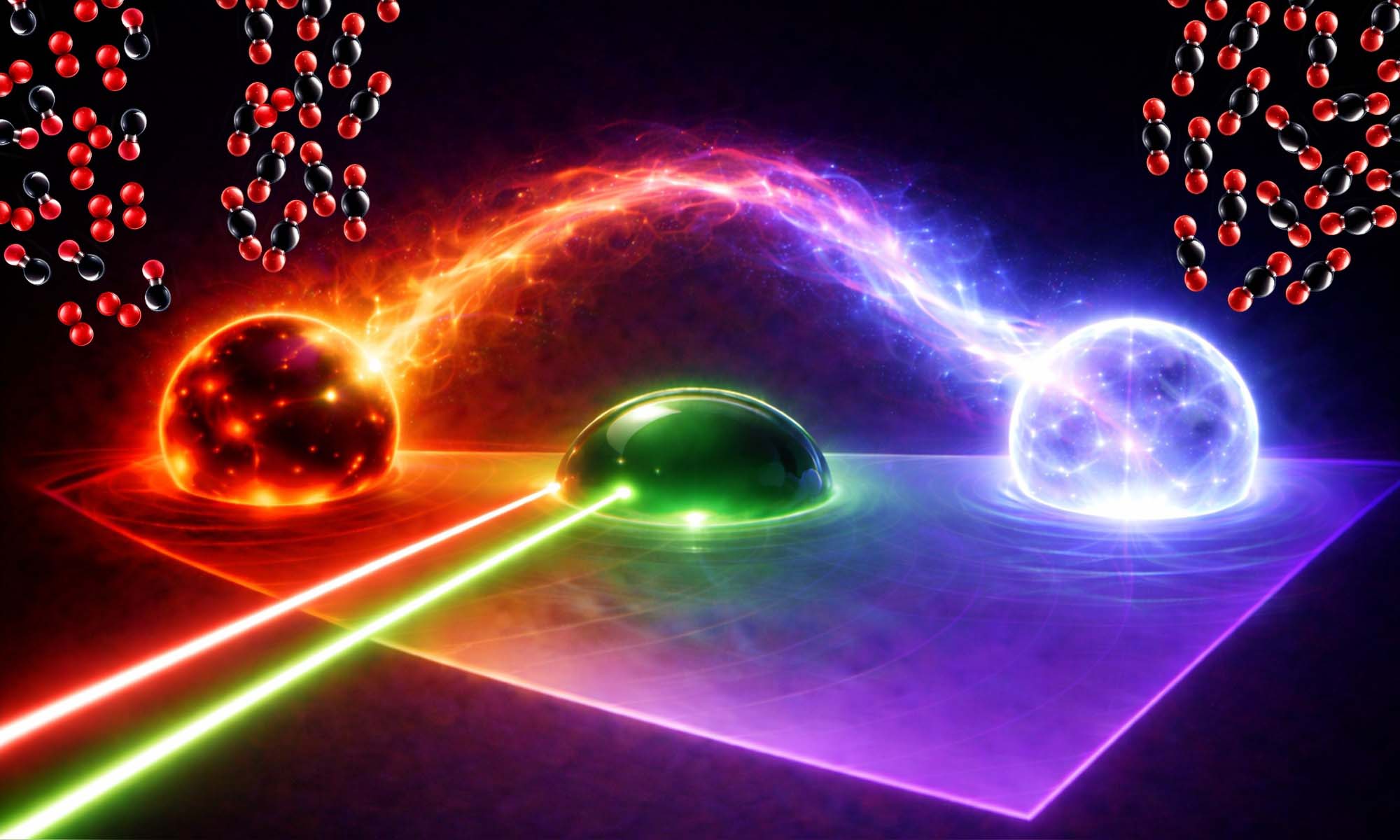
Using optical measurement techniques developed in the lab of Andrea Pickel, a visiting professor in the Department of Mechanical Engineering, the researchers devised a new way to measure temperature within chemical reactors. They described the new technique in a study published in EES Catalysis.
"We learned from this study that depending on the type of chemistry, the temperature measured with these bulk readings can be off by 10 to 100 degrees Celsius," says Porosoff. "That's a really significant difference in catalytic studies where you're trying to ensure that measurements are reproducible and that multiple reactions can be coupled."
The team applied their new technique to study tandem catalysts, where an exothermic reaction provides enough heat to trigger an endothermic one. Effectively pairing these reactions can minimize waste heat and lead to more efficient chemical engineering processes.
Porosoff says the technique could also help change the way researchers conduct catalysis studies, leading to more careful measurements, reproducible work, and more robust findings across the field.
The ACS Catalysis study was funded with support from the Sloan Foundation and the Department of Energy; the Journal of the American Chemical Society study was funded with support from the National Science Foundation; the EES Catalysis study was funded with support from the New York State Energy Research and Development Authority via the Carbontech Development Initiative.


