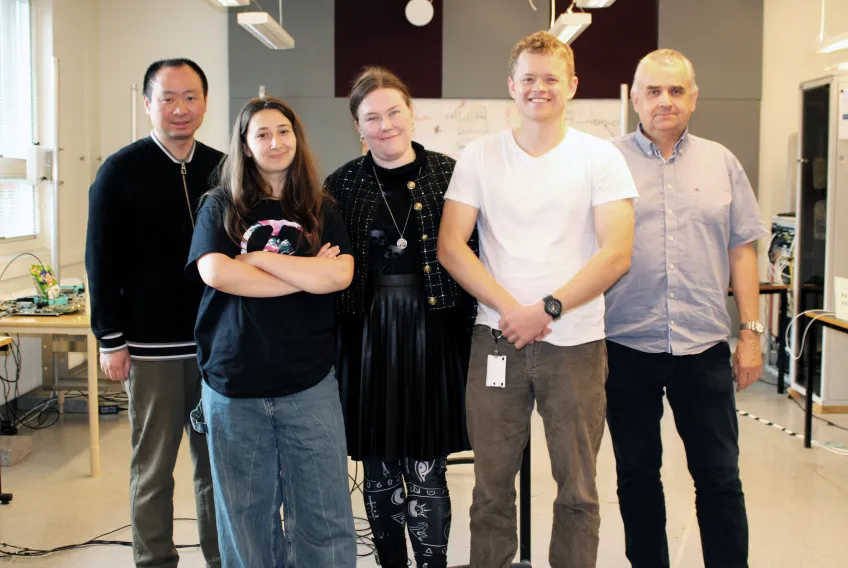
Researchers at the Faculty of Engineering (LTH) at Lund University in Sweden have developed one of the world's most advanced test environments for the wireless communications of the future. Using the new test system, researchers have demonstrated for the first time that a distributed wireless network with 256 digitally beam-steered antennas can operate in real time.
This breakthrough opens up new opportunities to develop the technologies expected to be central to the 6G networks of the future.
"We have demonstrated that the technology works using 256 antennas sited at different locations, where signals and data are managed in a coordinated manner in real time," says Dumitra Iancu, a doctoral student in integrated electronic systems at LTH.
The demand for new communication technology is growing rapidly. The number of internet users continues to grow, whilst industrial digitalisation, autonomous vehicles and new critical societal services are placing ever-greater demands on capacity, reliability and security. At the same time, the radio frequencies used to transmit wireless signals are a limited resource that must be used more efficiently. Resolving that issue is an important step towards the wireless networks of the future.
"We can use the test bed to investigate how to make more efficient use of the existing spectrum for transmitting radio signals, which will enable more users and greater network capacity," says Ove Edfors, professor of radio systems at LTH.
16 programmable panels
The Lund University Large Intelligent Surface (LuLIS) consists of 16 programmable panels, each with 16 antennas, and is based on specialised hardware from AMD. In terms of size, it is in a class of its own. The system has a modular design, which makes it possible both to add components and to deploy them in different settings.
"The setup is controlled by software, which makes it flexible and means that changes to the way data is transmitted, for example, can be made more easily than if we had to replace the hardware," says Lina Tinnerberg, doctoral student in integrated electronic systems.
"An important aspect of building and demonstrating various technologies in practice is that it enables us to identify challenges and practical problems that might not be identified in theoretical studies. We have identified and resolved issues relating to signal synchronisation and the distribution of computations," says Liang Liu, professor of integrated electronic systems.
Still holds the world record
The research team at LTH was also the first in the world to demonstrate that massive MIMO - the use of a very large number of antennas for wireless communication - could work in practice. This technology is now a fundamental part of 5G networks.
"Unlike other massive MIMO test beds, LuLIS distributes both antennas and computations across a number of panels, with data processed in real time, reflecting real-world requirements," says Vilgot Snygg, a doctoral student in integrated electronic systems.
Ten years after its launch, LuLIS' predecessor LuMaMi (Lund University Massive MIMO test bed), still holds the world record for spectral efficiency, achieved in collaboration with the University of Bristol. LuMaMi enabled researchers to distinguish between 22 simultaneous users within the same frequency band.
"With the new setup, we'll be able to accommodate 32 users in the near future. Our aim is to beat the 2016 record tenfold by upscaling the test bed in the future," says Ove Edfors.