

• Hundreds of handaxes dating back hundreds of thousands of years were discovered in the Sakhnin Valley
• Many tools were deliberately shaped around fossils and unique geological formations
• The phenomenon is almost unknown at other archaeological sites worldwide
• The findings suggest early humans demonstrated aesthetic perception and symbolic cognition
• The region likely served as a long-term hub of human activity due to abundant natural resources
A Tel Aviv University Archaeologist and a resident of the Arab city of Sakhnin recently led an exceptional archaeological discovery in Lower Galilee Sakhnin Valley, shedding new light on the cultural and cognitive world of our early ancestors. A surface survey revealed a series of Paleolithic sites containing hundreds of handaxes - large, carefully crafted stone tools - identified with Homo erectus, the early human species that lived in the region hundreds of thousands of years ago.
Beyond the impressive quantity, however, the most noteworthy and unique find is an unprecedented concentration of handaxes shaped deliberately around fossils and distinctive geological features - a phenomenon almost unknown from other sites around the world. The study appeared in the prestigious journal published by the Sonia & Marco Nadler Institute of Archaeology, Entin Faculty of Humanities: Tel Aviv: Journal of the Institute of Archaeology of Tel Aviv University.
A Discovery That Began in the Field
The sites in the Sakhnin Valley were identified by Muataz Shalata, a self-taught nature enthusiast from the city of Sakhnin, who noticed unusual knapped stones scattered across the terrain. He contacted Prof. Ran Barkai of the Elkov Department of Archaeology at Tel Aviv University, an expert in the study of early Paleolithic cultures. Together, they are leading an innovative study focusing on human behaviors that evolved in the Sakhnin Valley hundreds of thousands of years ago.
A Hub of Human Activity
Prof. Barkai: "Handaxes served as the main tool of early humans for more than a million years, and are known from Africa, Asia, and Europe. In the Sakhnin Valley, many hundreds of handaxes were found, indicating that the area served as an important hub of human activity over long periods of time. Providing early humans with all their needs - water sources, game, and an exceptional abundance of high-quality flint nodules - the area probably attracted human groups repeatedly over hundreds of thousands of years".
"The Valley is also very rich in geodes - rounded, brain-like geological concretions containing sparkling crystals, as well as flint nodules embedded with fossil remains. Early humans who came here hundreds of thousands of years ago must have been astonished by this exceptional richness of stones, leaving behind them an extraordinary phenomenon: we have discovered more than ten handaxes fashioned from flint nodules containing fossils or special geological formations, with these natural features deliberately preserved in a prominent position at the center of each handaxe. Since such features make precise and symmetrical knapping difficult, we can conclude that the selection of these specific stones was not accidental. On the contrary - the knapping process highlighted the natural feature and kept it at the center of the tool."
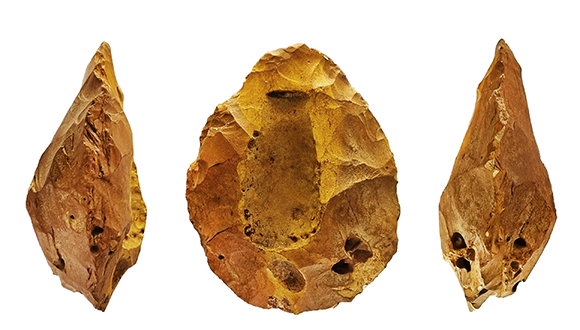
A handaxe shaped around the imprint of a fossil from the Sakhnin Valley
Beyond Survival: Early Signs of Aesthetic Thinking
According to the researchers, this unique phenomenon clearly demonstrates aesthetic and conceptual intention among early humans, beyond functional considerations of tool production. Embedded fossils and geological formations do not improve the tool's performance and may even impair it, yet such stones were repeatedly preferred as raw material. The conscious choice to invest effort in shaping a tool around an exceptional natural feature indicates that beyond survival needs, humans attributed special value to the stones' appearance and meaning. Knapping served as a means for framing, highlighting, and enhancing intriguing natural phenomena, reflecting advanced perceptual and cognitive abilities.
The researchers also note that the Sakhnin Valley is located near presumed routes of early elephants, which were a primary food source for humans during this period. Thus, as at other prehistoric sites such as Gesher Bnot Ya'akov, the handaxes were probably used to cut up elephants and extract calories from their fat and meat. However, such a high concentration of special handaxes is unknown in any other site worldwide, exceeding all comparable finds documented to date.
Prof. Barkai concludes: "The unique landscape of the Sakhnin Valley led early humans to behave in a distinctive manner. Apparently, they attributed great significance to the fossils and special geological features they found in the Valley, regarding them as manifestations of the potency, primordiality, and wonder of the cosmos. The integration of fossils and geological features endowed the handaxes with added potency and meaning, connecting them primeval elements. The findings from the Sakhnin Valley open a rare window into the inner world of early humans, indicating that already at the dawn of human history they were sensitive to aesthetics, attributed meaning to nature, and had complex relationships with their world. The discovery places the Sakhnin Valley and the Lower Galilee at the heart of the international scholarly discussion on the origins of cognition, aesthetics and meaning in human life."
* Prof. Ran Barkai is a prehistoric archaeologist at Tel Aviv University, specializing in the study of early human evolution and cultures. He is known, among other things, for his excavations at Qesem Cave and his research on the links between diet, animals, and the development of human consciousness.


