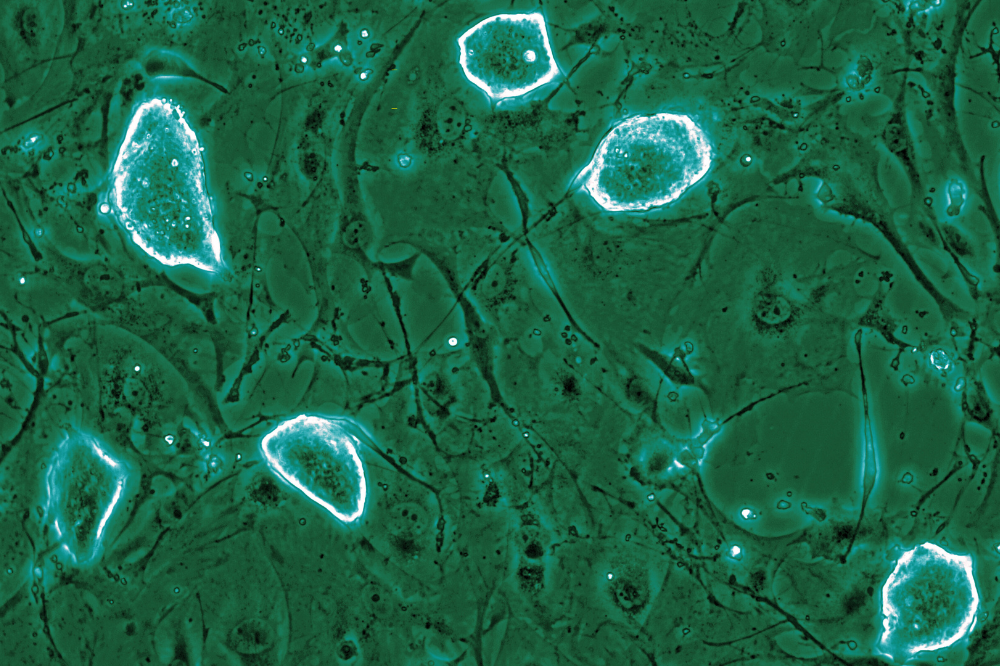
The dome shaped colonies representing diapause-like mouse embryonic stem cells. (Credit: Tarakhovsky lab)
Seals give birth only when conditions are right. After mating, a female seal can delay implantation of the embryo in the uterine wall-pausing pregnancy until she senses that her fat reserves are aligned with the season. This strategy, known as embryonic diapause, is practiced by hundreds of mammals, from mice to moose. But how does an embryo, built to follow a strict developmental schedule, seamlessly halt and restart?
Now, a new study in Genes & Development reveals how diapaused embryonic stem cells of mice maintain their ability to become any cell type. Whether due to insufficent nutrients or the absence of key growth signals, these cells consistently activated the same built-in brake: a molecular program that switches off pathways that normally push cells to differentiate. This newly discovered mechanism may explain not only how embryos thrive after diapause, but also how certain immune cells-and even cancer cells-can survive long periods of metabolic stress.
"The study of diapause is exciting, because we're dealing with the ultimate survival strategy," says Alexander Tarakhovsky, head of the Laboratory of Immune Cell Epigenetics and Signaling. "Our work explains how these cells enter suspended animation, which should derail the developmental schedule, yet still become normal embryos that give rise to normal animals."
Arrested development
Embryonic diapause is widespread throughout the animal kingdom, with mammals, fish, insects, and many species making use of the same basic strategy. (Humans are an exception). In mammals, development generally pauses at the blastocyst stage, shortly after fertilization, when the embryo is a ball of a few hundred cells. The blastocyst remains in limbo until conditions improve, upon which it implants in the uterine wall and proceeds to grow as usual.
Prior studies have shown that embryonic stem cells can slip into a diapause-like state of suspended animation in the lab, when exposed to different forms of stress. Blocking mTOR (a regulator of cellular growth and metabolism) shuts down the pathways that build proteins and other components, leading to diapause; reducing Myc family transcription factors (master switches that drive cell growth programs) quiets the gene-expression programs needed for rapid growth and altering chromatin regulators such as MOF likewise pushes cells into a low-energy mode. The fact that such distinct disruptions all lead to diapause-like conditions led researchers to view this state as a sort of protective default.
"Diapause appears to be a state that can be reached in many different ways and due to many different kinds of harsh circumstances," Tarakhovsky says. "Imagine that citizens of a city all evacuate, but for different reasons. One has no food, one has no water, the other has noisy neighbors. They all leave the city, but the pathway leading up to leaving will be very different."
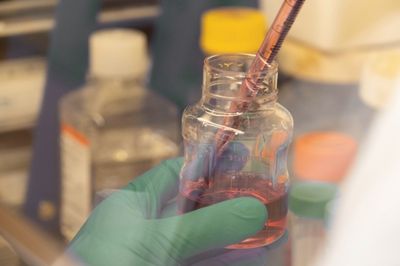
Media used to induce the diapause-like state in vitro. (Credit: Lori Chertoff)
But what machinery preserves a cell's identity and flexibility during suspended animation? Tarakhovsky set out to answer that question by pinpointing the transcriptional program that keeps stem cells pluripotent-capable of becoming any cell type-even under stress.
The team first established that they could induce a diapause-like state by exposing murine embryonic stem cells to I-BET151, a first-in-class BET inhibitor developed in the lab that mimics Myc deficiency. They also used mTOR inhibition, a standard way to simulate the metabolic slowdown caused by nutrient scarcity. In both cases, the cells behaved like embryos in diapause: they stayed pluripotent while sharply reducing metabolism, RNA production, and protein synthesis. Remarkably, the cells remained in this suspended state even when researchers tried to push them toward specialized cell fates and, once the inhibitors were removed, the cells resumed normal development and could still contribute to healthy embryos.
Upon examining the dormant cells more closely, the team found that all of the different stressors-mTOR inhibition, BET inhibition, and loss of Myc-triggered the same core response. The cells switched on a set of genes that act as natural brakes on the MAP kinase pathway, which normally pushes stem cells to commit to specific fates. When the researchers turned off these "brakes", the cells quickly lost their pluripotency and began showing signs of becoming specialized cell types, confirming that this braking system is essential for maintaining the diapause-like state. Further experiments showed why this happens: the stressors all displaced a protein called Capicua, which normally sits on these genes and keeps them silent. Removing Capicua lifted that block and allowed the brake genes to turn on, revealing a molecular switch that keeps cells paused yet poised during suspended animation.
Dormancy and human health
The results reveal a molecular mechanism that lets stem cells hold onto their identity during dormancy, showing that very different stresses ultimately push the cells to flip the same switch. This shared brake supports the emerging view of diapause as a state that arises from the structure of the network rather than from any one regulator.
The work builds on the Tarakhovsky lab's long-standing expertise in epigenetic control, including its pioneering work in the field of histone mimicry, in which small molecules are designed to imitate key features of the cell's gene regulation system. In this case, the BET inhibitor I-BET151 induces diapause by imitating the loss of a major transcriptional activator, BRD4, echoing the effects of Myc deficiency. More broadly, the results highlight how regulatory networks help cells maintain their identity, even when their metabolism and gene expression slow dramatically.
The implications may extend beyond suspended embryos. Many cell types survive by dialing down their metabolism for long stretches of time, and this newly identified molecular brake may help explain how immune cells persist for decades, how stem cells in tissue hold onto their identities in stressful environments, and how certain viruses and cancer cells can lie dormant for a time, only to come back with a vengeance. The team is also exploring whether diapause-like programs influence how neurons age or resist damage. Ultimately, the study positions diapause as a powerful model for understanding how organisms and cells endure deep metabolic stress, revealing a framework for exploring dormancy across biology.
"Humans don't experience diapause-we aren't hibernating like bears, and our embryos don't enter suspended animation under stress-but there are cells in our bodies that do," Tarakhovsky says. "With studies like these, we're hoping to gain insight into the general principles that explain the cell dormancies that impact human health."