
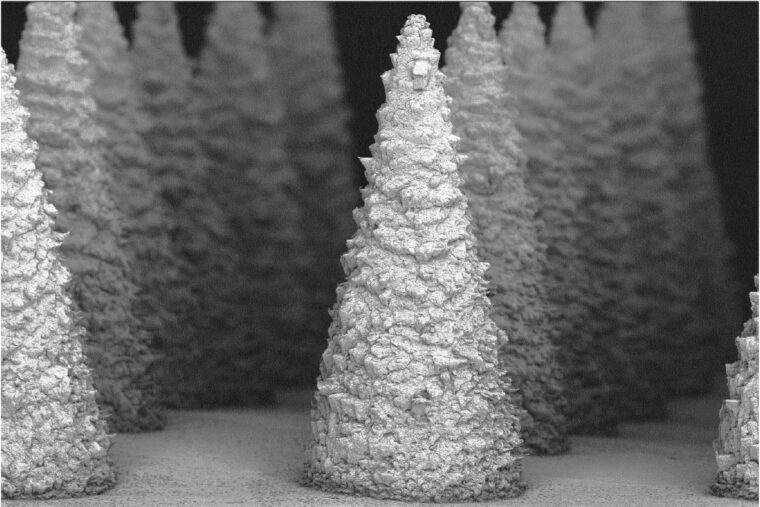
Kidney disease is silent in its early stages, progressing without symptoms until the disease is advanced. Researchers in the McKelvey School of Engineering at Washington University in St. Louis, in collaboration with researchers at WashU Medicine and at Texas A&M University, have been developing a minimally invasive method to improve diagnosis in earlier stages.
New research from the lab of Srikanth Singamaneni, the Lilyan & E. Lisle Hughes Professor in the Department of Mechanical Engineering & Materials Science, shows the early success of a microneedle patch that can be applied on the skin to quickly and safely capture biomarkers and quantify them accurately. The patch detected early signs of kidney injury and may one day support home or point-of-care monitoring without requiring refrigeration.
Results of their research were published online Aug. 5 in Advanced Materials. It is the first study to show that encapsulating biomolecules on microneedles preserved their biological functions.
The research team, which includes Yixuan Wang, a doctoral student in Singamaneni's lab, created microneedles coated with a metal-organic framework (MOF) that can sample interstitial fluid in the skin. The microneedles are coated with a material that creates a shell that detects and preserves neutrophil gelatinase-associated lipocalin (NGAL) antibodies, which are an early biomarker of acute kidney injury. The MOF shell preserved the antibodies for up to four weeks at 50 C (122 F) without refrigeration.
"This metal-organic framework encapsulation is a simple and highly effective way to create microneedle sensors that are resilient to environmental challenges and provide a scalable path to minimally invasive biosensing for at-home or remote health monitoring," Singamaneni said.
NGAL increases in the blood within hours of a kidney injury and is a clinically validated biomarker for kidney damage. However, because it requires drawing blood with a needle and cold-chain logistics, it has not been useful in home-based or resource-limited settings.
Previously, Singamaneni and collaborators established another type of microneedle patches that can look for biomarkers of disease. Adapting that low-cost, easy-to-use technology required them to create a biosensor with high sensitivity and a broader range, as well as addressing cold-chain logistics.
Learn more on the McKelvey Engineering website.
Wang Y, Liu Y, Debnath A, Li C, Want Z, Kondepati G, Balmoori S, Morrissey JJ, Chen YM, Tian L, Singamaneni S. Metal-Organic Framework-Preserved Thermostable Microneedle Patch for Minimally Invasive Detection and Monitoring of Kidney Dysfunction. Advanced Materials, published online Aug. 5, 2026. DOI: https://doi.org/10.1002/adma.74423
This research was supported by funding from the National Science Foundation (CBET 2224610 and CBET 560 2316285), the National Institutes of Health (R21DK131557A1, R35 GM147568, R01 2DK105056-6 and R56DK138158A1), the Congressionally Directed Medical Research Programs (HT94252310996 and W81XWH-19-1-0320), and VA Merit (I01BX006401A1).
Singamaneni and Jeremiah J. Morrissey are the inventors of the plasmonic-fluor technology, which has been licensed by the Office of Technology Management at Washington University in St. Louis.


