
Milkweed has found a new strategy in its epic evolutionary battle with monarch butterflies: upgrading its toxins to outmaneuver the monarch's resistance.
In a new study, published March 12 in the Proceedings of the National Academy of Sciences, researchers find that adding a small structural element containing nitrogen and sulfur to milkweed's toxins circumvents monarchs' ability to block them. The research sheds light on an underappreciated evolutionary tactic for plants: that not only can they increase their levels of toxicity, they can also structurally innovate to create new classes or subclasses of toxins.
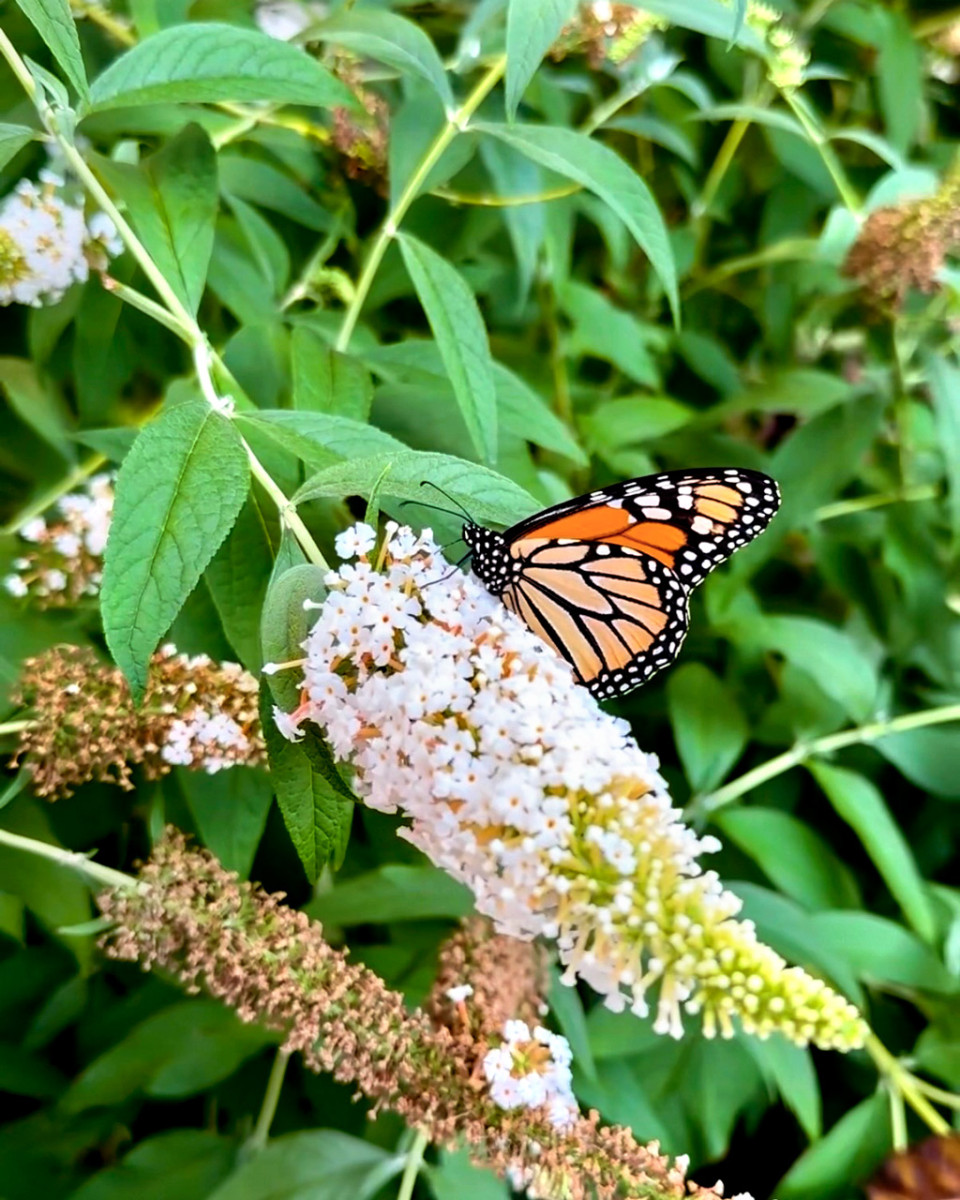
Milkweed and monarchs have coevolved over millions of years, each building defenses and counter-defenses.
"This structural innovation is a new axis for defining chemical toxins in the natural world," said co-author Christophe Duplais, associate professor of entomology at Cornell AgriTech, in the College of Agriculture and Life Sciences (CALS). "This very simple modification makes a huge difference in terms of its ecological effect, because now this molecule is toxic to the monarch."
Milkweed and monarchs have coevolved over millions of years, each building defenses and counter-defenses. One such defense is the monarchs' ability to block milkweed's toxins, called cardenolides, from binding to their target enzyme in the monarch's cells. Monarchs have even evolved to sequester the toxins in their wings, to poison birds that peck at them.
But for many years, researchers had observed that monarchs didn't fare as well on certain milkweed species. The research team, including first author and postdoctoral researcher Paola Rubiano-Buitrago, mined the toxins in 52 such species of milkweed and drilled down on their molecular structure. They sought to understand the toxins' composition and evolution to determine how they breach the defenses of monarchs and other resistant herbivores.
It turns out that adding a nitrogen-sulfur ring to the cardenolide improves the toxins' ability to bind to the target enzymes. The prevalence of the nitrogen-sulfur ring was also much higher than in previous studies, with nearly 70% of the species producing the structure.
The team found that milkweed species have evolved this structural innovation independently, multiple times, even across species that have evolved along divergent lineages. The finding underlines the prevalence of the strategy and provides insight into the role structural alterations play in evolution.
"We demonstrate that this is happening in compounds that have different evolutionary histories - when we discovered that, it was mind-blowing, beyond our expectation," Duplais said. "That challenges what we call chemical escalation, the idea of a plant creating toxins and the insect adapts. This structural innovation is showing that lots of iterative changes can happen to complicate that unilateral model of evolution."
Duplais said the study could help in monarch conservation efforts, providing guidance on safe and harmful species. It's also a showcase of Cornell's strengths in chemical ecology and cross-campus collaboration, he said - he and co-author Anurag Agrawal, the James A. Perkins Professor of Environmental Studies in CALS, have published more than 10 papers together, combining Duplais' expertise in chemistry with Agrawal's expertise in ecology. The team also tapped co-author Jeremy Baskin, associate professor of chemistry and chemical biology in the College of Arts and Sciences, and postdoctoral researcher Masaaki Uematsu for help modeling how the upgraded toxins bind to enzymes in the monarch's cells.
"It's important to not only figure out which toxins are involved but how it works," Duplais said. "Between the chemistry, the molecular modeling, the ecology, we've been able to tackle this tough question from so many different angles."
Research support specialist Amy Hastings is also a co-author.
Funding for the study came from the National Science Foundation.


