
Every second, a trillion of the elusive ghost particles, the neutrinos, pass straight through your body. Now, astrophysicists from the University of Copenhagen have mapped how many ghost particles all the stars in the Milky Way send towards Earth, and where in the galaxy they originate. This new map could help us track down these mysterious particles and unlock knowledge about our Galaxy that has so far been out of reach.
They're called ghost particles for a reason. They're everywhere - trillions of them constantly stream through everything: our bodies, our planet, even the entire cosmos - without us noticing. These so-called neutrinos are elementary particles that are invisible, incredibly light, and interact only rarely with other matter. The weakness of their interactions makes neutrinos extremely difficult to detect. But when scientists do manage to capture them, they can offer extraordinary insights into the universe.
Neutrinos are born in violent cosmic events - including nuclear reactions inside stars. Now, researchers at the University of Copenhagen have produced the most comprehensive model to date, mapping how many neutrinos all the stars in our own Milky Way generate and how many reach Earth - a complete picture that until now existed only in rough outline. The study has just been published in the scientific journal Physical Review D.
"For the first time, we have a concrete estimate of how many of these particles reach Earth, where in the galaxy they come from, and how their energy is distributed. Because ghost particles come straight from the core of stars, they can tell us things that light and other radiation cannot," says lead author of the new study, postdoc Pablo Martínez-Miravé from the Niels Bohr Institute.
- A neutrino is an elementary particle - one of the smallest building blocks of matter.
- Neutrinos are invisible, extremely light, electrically neutral and rarely interact with matter.
- They are formed in nuclear reactions in stars, in supernova explosions and other high-energy cosmic events.
- Billions of neutrinos pass through your body every second without you noticing.
- Because they are almost unaffected by other forces, neutrinos can provide direct information about processes deep inside stars and about the origin of the universe.
A 'Roadmap' for Observatories
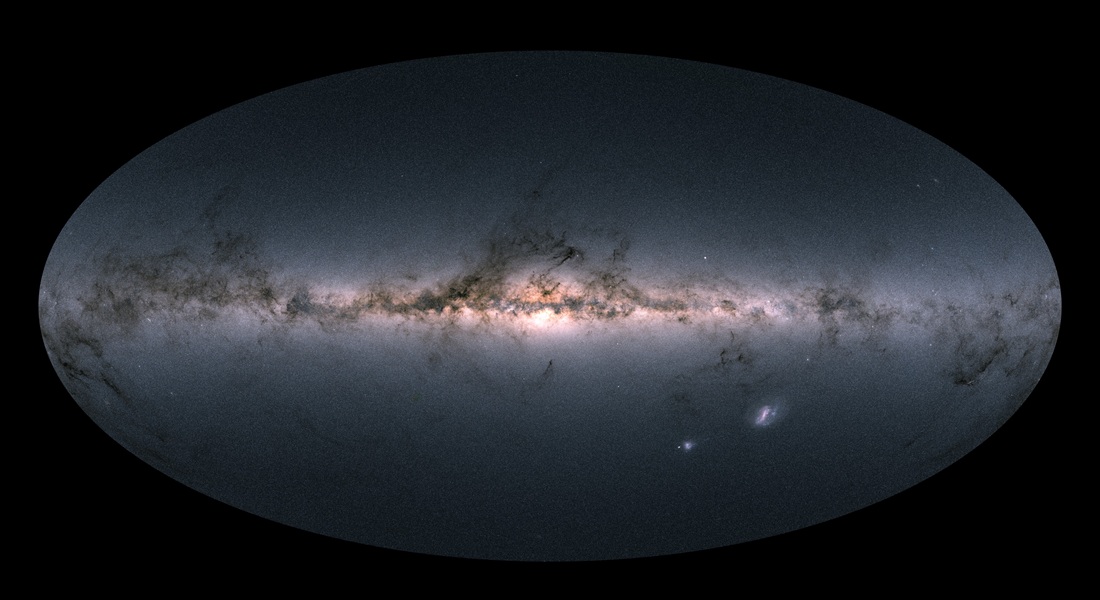
The researchers combined advanced stellar models with data from ESA's Gaia telescope to map where in the Milky Way neutrinos mainly originate.
The study shows that the vast majority come from the region around the galactic centre, where most stars are concentrated - particularly in areas a few thousand light-years from Earth.
This knowledge is a practical tool for scientists attempting to capture neutrinos with enormous detectors, often located deep underground. With this new map, they can increase their chances of "hitting the target."
"Now we know more precisely where to look for Galactic neutrinos. Our results show that most neutrinos are produced in stars that are as massive or more massive than the Sun. This means that the best chance of detecting neutrino signals is when looking towards the galactic centre, where the signal is the strongest," explains Pablo Martínez-Miravé.
A Window into Stellar Interiors - and Possibly New Physics
While traditional astronomy relies on light, X-rays, and gamma rays, neutrinos offer an entirely different way to explore the Universe. Their special advantage is that they can travel enormous distances without being affected, so when we measure them here on Earth, we get a very direct insight into what is happening out there.
- The model is the first complete map of neutrinos from all the stars in the Milky Way.
- The new mapping reveals that the neutrino flux spans a wide energy spectrum and includes contributions from light, intermediate and very massive stars.
- Stars closer to the galactic center contribute most to the overall neutrino flow towards Earth.
- Neutrino production varies with stellar age and mass: younger stars, heavier than the Sun, produce the most neutrinos.
- Most neutrinos originate in nuclear reactions, while some are created in thermal processes inside stars.
Just as neutrinos have told us for decades what goes on inside the Sun's core, researchers hope the same will become possible for all the other stars much farther away.
"Neutrinos carry information straight from the interior of stars. If we learn to harness them, they can give us new insights into stellar life cycles and the structure of our galaxy in a way no other source can," says senior author of the study, Professor Irene Tamborra from the Niels Bohr Institute.
Beyond expanding our understanding of stars and our own Galaxy, this knowledge could eventually touch on fundamental questions in physics. Neutrinos interact so weakly with their surroundings that they might reveal new physical laws that traditional experimental techniques could never be sensitive to.
"Because neutrinos are barely affected, we have clear expectations of how they should behave on their long journey to Earth. So even tiny deviations in their behaviour would be a strong clue to new, unknown physics," says Irene Tamborra, concluding:
"With neutrinos, it's like dimming the lights in a room and suddenly seeing what was hidden in the dark - and with this new model, we now have both a map and a compass to start navigating it."


