
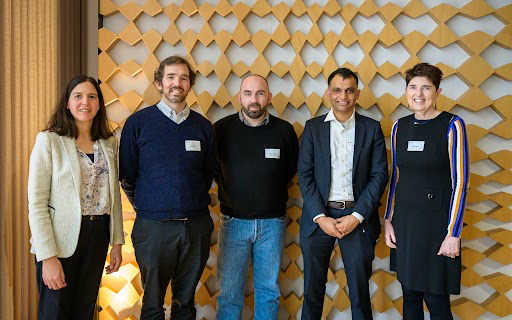
Image left to right: Dr Maria Maldonado, Professor James Letts, Dr Charles Crabtree, Dr Ashray Gunjar and Professor Robyn Ward AM
Monash University has welcomed four outstanding early and mid-career researchers from some of the US and UK's' most renowned institutions, as part of the university's EMERGE (Embedding Mid & Early-Career Researchers in Global Excellence at Monash) talent attraction program.
The newly recruited cohort brings an extraordinary wealth of expertise from premier global institutions, including Harvard, University of California Davis, Dartmouth and Cambridge University Hospitals NHS Foundation Trust.
The EMERGE program reflects Monash's ongoing commitment to nurturing talent - supporting our own researchers as well as attracting exceptional academics from around the world, while championing equity, diversity, and academic freedom.
The program is now fully subscribed, with eleven researchers in total recruited from leading international institutions. The first four researchers have now commenced work at Monash, with the remainder of the cohort expected to arrive throughout the year.
The new recruits span diverse, high-impact research fields critical to medicine and health, environmental sustainability and social cohesion, including:
- Cancer research and epidemiology
- Drug and alcohol recovery
- Climate modelling
- Social exclusion and inequality
The EMERGE cohort cited Monash's global reputation, research infrastructure and collaborative culture among the factors influencing their decision to join the University. Ranked 31st globally in the latest QS World University Rankings, Monash provides researchers with access to world-class facilities, international networks and opportunities to undertake research with global impact..
Welcoming world-class talent to Monash
Deputy Vice-Chancellor (Research and Enterprise) and Senior Vice President, Professor Robyn Ward AM, said the new talent from the EMERGE program benefits the entire Monash research community, introducing new opportunities for cross-disciplinary collaboration and international networks.
"Welcoming these exceptional scholars reflects the strength of our research community and our reputation as a destination for world-leading talent," Professor Ward said.
"By adding more world-class talent directly into our faculties, we are accelerating our work in critical areas like climate modelling and cancer epidemiology, and opening brand new pipelines for global collaboration."
"Researchers of this calibre choose to come to Monash because they recognise the excellence of our people, our research infrastructure, our culture of collaboration, and the opportunities available to pursue ambitious, high-impact research."
Professor Ward said researchers are drawn to Monash because of its strong commitment to principles that underpin world-class research: academic freedom, scientific excellence, transparency and public benefit.
"Equity, diversity and inclusion are inseparable from academic freedom. When more voices are able to contribute, research becomes more rigorous, innovative, and impactful," she said.
Insights from our new recruits
For Dr María Maldonado, who recently joined Monash as a Senior Lecturer and Lab Head in the Department of Biochemistry and Molecular Biology, access to the University's world-class research infrastructure was a key factor in her decision to relocate her research program to Melbourne.
"What's really exciting about doing our research at Monash is access to its world-class cryoEM facility, the Ramaciotti Centre for Cryo-EM. This facility is excellently equipped, staffed and run and, importantly, very well supported by the University. It will open a lot of avenues for our research. On a more personal note, I am very excited to be living in Melbourne and having access to all it has to offer. I am really looking forward to learning more about Australian history, art, literature and nature."
Dr Charles Crabtree, Senior Lecturer in the School of Social Sciences, joined Monash from Dartmouth College, and prior to that Stanford University.
"The opportunity to scale my research using Monash's advanced research infrastructure was a massive drawcard," said Dr Crabtree.
"EMERGE didn't just offer a position; it offered a values-driven ecosystem that values diverse perspectives as a core component of scientific rigour."
Associate Professor James Letts commenced with Monash in early May, bringing with him his laboratory of Electron Transport Membrane Proteins and Structural Bioenergetics to Monash's Biomedicine Discovery Institute.
"Relocating a laboratory is a monumental shift, but Monash's world-class infrastructure made the decision clear," Associate Professor Letts said.
"Having seamless access to premier imaging and advanced laboratories allows us to map critical biological structures faster, translating fundamental energy processes into real-world health insights."
Deepening global ties and industry connections
The EMERGE program has attracted a number of researchers from leading US institutions, strengthening Monash's long-standing engagement with the United States while expanding opportunities for collaboration across its international research and partner networks.
These connections are supported by the Monash Boston Hub, the University's dedicated enterprise and partnership office in the United States. Located in the Kendall Square innovation district, the Hub connects industry, research and innovation partners with Monash's globally recognised research and translational ecosystem, helping to expand the University's presence and partnerships across North America.


