
Lee esta nota de prensa en español aquí.
How do black holes at the center of galaxies form and grow over time? To answer this question, scientists need to detect and study supermassive black holes at great distances, which existed much earlier in the universe's history. New research suggests NASA's Nancy Grace Roman Space Telescope, which is on track to launch Aug. 30, 2026, will be able to detect these distant, ancient black holes that existed up to 11 billion years ago.
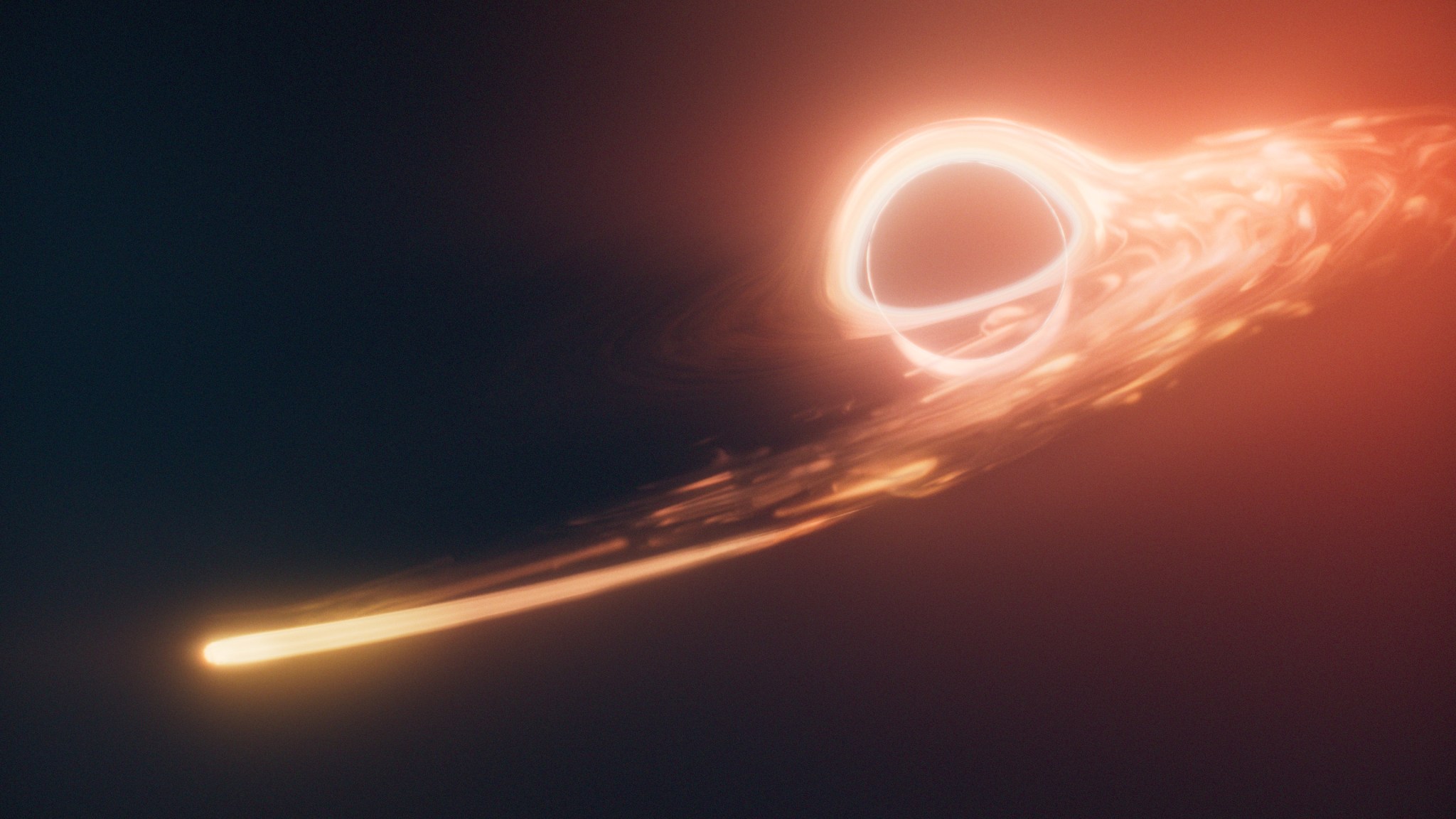
Black holes are best studied by looking for the light emitted from their accretion disk - the matter that swirls around them before being consumed. Lighter supermassive black holes are challenging to observe because they tend to be less luminous due to less accretion. But occasionally, they shred and consume an entire star, brightening to outshine their entire host galaxy - known as a tidal disruption event (TDE). By characterizing that population of early supermassive black holes and how they evolve and grow for billions of years, Roman will provide clues to the ultimate origin of these behemoths.
"The Roman Space Telescope is going to be transformative for transient science," said lead author Mitchell Karmen of the Johns Hopkins University, a graduate student and National Science Foundation Graduate Research Fellow. "Thanks to Roman's high sensitivity, we can find multiple tidal disruption events out to greater distances and earlier cosmic times than ever before."
A paper about this research published Tuesday in The Astrophysical Journal.
Shredding Stars
Roman's High-Latitude Time-Doman Survey, one of three core community surveys, is particularly well suited to find and study TDEs in the early universe. This survey will cover about 18 square degrees on the sky, an area equivalent to 90 full moons, at a regular cadence. By revisiting the same regions repeatedly, astronomers can find large numbers of transient events like TDEs.
Tidal disruption events are phenomena unique to lighter supermassive black holes. Heftier black holes weighing more than 1 billion Suns will swallow incoming stars whole. But lighter black holes of about 100,000 to 100 million Suns can shred a star before consuming it, creating a beacon that brightens over a couple of weeks before gradually fading away.
The rate of TDEs fluctuates over cosmic time. Previous work predicted that the rate of TDEs would decrease with increasing distance because most young black holes were too light to generate a TDE. However, this new research takes into account numerous factors that evolve over time, like the frequency of galaxy (and hence black hole) mergers as well as the number of stars within the core of each galaxy and how closely packed they are.
Karmen and his colleagues modeled these and other effects to predict how many tidal disruption events Roman could observe, as well as other observatories like the ground-based National Science Foundation-Department of Energy Vera C. Rubin Observatory and NASA's James Webb Space Telescope. The team forecasts that astronomers will see the rate of TDEs increase as Roman probes greater distances and earlier times until "cosmic noon," about 11 to 12 billion years ago when star formation peaked throughout the universe, before decreasing again.
Complementary Observations
Roman will observe near-infrared wavelengths of light. Light from distant TDEs becomes stretched to longer wavelengths by the expansion of the universe, a phenomenon known as cosmological redshift. As a result, Roman is inherently optimized to detect TDEs whose light traveled anywhere from 8 billion to 11 billion years to reach us.
The Rubin Observatory also will scan large swaths of the sky and pick up many new TDEs. However, it will observe visible light, which limits it to closer TDEs than Roman.
The research by Karmen's team finds that Rubin will detect thousands to tens of thousands of TDEs per year. While Roman is expected to find up to 100 TDEs per year, those black holes will be much more distant, within the realm of cosmic history that is most important for distinguishing among black hole origin scenarios.
"Just by counting the number of TDEs as a function of redshift, you can put meaningful constraints on the population of million-solar-mass black holes," said co-author Suvi Gezari, an associate professor of astronomy at the University of Maryland. "Roman will be transformative in that it can probe tidal disruption events out to greater distances, so you can look at how the rate of TDEs evolves over time."
Origins of supermassive black holes
Astronomers have observed truly gargantuan black holes very early in the history of the universe - so early that theories struggle to explain how they could have become so large, so quickly. They must have started smaller and grown over time, but how much smaller?
One theory, known as "light seeds," begins with black holes that are created from the deaths of massive stars. Such black holes might weigh up to a few hundred times our Sun. These black holes then would merge over time, as well as consume surrounding gas at an astonishing rate. In this scenario, every young galaxy would be expected to have a massive black hole at its center.
A second theory, known as "heavy seeds," suggests that a black hole could be born with a much higher mass, up to a million times our Sun, through a process such as the direct collapse of a gas cloud. This process should be less common, though, which would result in supermassive black holes being much rarer in early galaxies.
"Tidal disruption events help us probe the population of light supermassive black holes, which can help us discriminate between these models," Karmen said.
Ultimately, Roman's tally of tidal disruption events will help researchers trace global effects that impact the black hole population over time.
Once Roman and Rubin begin regular science operations, the team looks forward to comparing their forecasts to the actual detections those observatories make.
"Just like Webb has transformed our understanding of distant, high-redshift galaxies, Roman is poised to transform our understanding of high-redshift transients," Gezari said.
The Nancy Grace Roman Space Telescope is managed at NASA's Goddard Space Flight Center in Greenbelt, Maryland, with participation by NASA's Jet Propulsion Laboratory in Southern California; Caltech/IPAC in Pasadena, California; the Space Telescope Science Institute in Baltimore; and a science team comprising scientists from various research institutions. The primary industrial partners are BAE Systems, Inc. in Boulder, Colorado; L3Harris Technologies in Melbourne, Florida; and Teledyne Scientific & Imaging in Thousand Oaks, California.
By Christine Pulliam
Space Telescope Science Institute, Baltimore, Md.


