
In the winter of 2025-2026, 24% of Dutch honeybee colonies were lost. The upward trend observed in recent years therefore continues. This is the fourth consecutive year in which winter mortality has exceeded 20%. The figures are based on the annual survey of Dutch beekeepers. The results show substantial regional differences. Groningen recorded the highest winter losses, at 41.5%, while Overijssel had the lowest figure, at 16.9%.
The annual survey is conducted by researchers at Wageningen University & Research (WUR), in collaboration with the Nederlandse Bijenhoudersvereniging (NBV), Imkers Nederland, the biodynamic beekeepers (BD-imkers) and professional beekeepers (BVNI), on behalf of the Ministry of Agriculture, Fisheries, Food Security and Nature (LVVN).
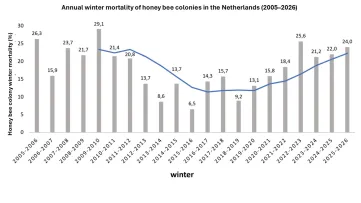
Overview of measured winter mortality from 2005 to 2025. The blue line shows the five-year average based on previous years.
Differences by region
As in previous years, regional differences in winter mortality were clearly evident. Losses were relatively high, particularly in the northern provinces. By contrast, Overijssel stood out, with most colonies making it through the winter. In Zeeland, Utrecht and North Holland, winter mortality was also slightly above the national average. Although the national mortality rate has been above 20% for several years, the picture varies considerably from one region to another. The exact causes of these differences are not known, but variation in beekeeping practices and local environmental conditions may play a role.
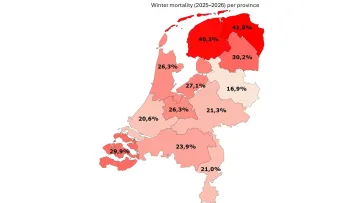
Winter mortality at provincial level. On average, Overijssel had the lowest winter mortality rate (16.9%), while Groningen had the highest (41.5%).
Several factors influence winter mortality
Winter mortality has multiple causes, which can vary from year to year and from place to place. The loss of a queen during the winter period, for example, is almost always fatal for a bee colony. Food shortages, diseases and a poor colony condition before winter can also contribute to higher losses. The parasitic mite Varroa destructor and the viruses it transmits remain among the greatest threats to honeybee health. Effective control of this mite therefore remains essential to ensure colonies enter winter in good condition. The survey shows that 86.9% of Dutch beekeepers took measures against the varroa mite last winter. This percentage is in line with previous years: 84.6% in 2025 and 86.8% in 2024.
Impact of the Asian hornet still uncertain
The possible impact of the Asian hornet on honeybee winter mortality is not yet clear. This invasive wasp species hunts on a wide range of insects, including honeybees, to feed its larvae and is spreading across the Netherlands. In 2024, just over a quarter of beekeepers (24.7%) reported the presence of the Asian hornet in their area. By 2025, this proportion had risen to more than half (56.4%). Although its effect on winter mortality is still difficult to determine, researchers expect the impact of this non-native species to increase further in the coming years.
Beekeepers keep working to protect the health of their colonies
This year, 840 Dutch beekeepers took part in the annual COLOSS survey, which is conducted in more than forty countries. The respondents therefore represented almost 8% of all beekeepers in the Netherlands. The Netherlands is estimated to have around 11,000 active beekeepers, only a small proportion of whom (2.5%) depend wholly or partly on beekeeping for their income. More than half of the participants (55.6%) reported that all their colonies had survived the winter. At the same time, 7.0% of beekeepers lost their entire stock. The results provide a valuable overview of the health of Dutch honeybees, and the challenges beekeepers face each year.


