
A new UConn study sheds light on the connection between neck mobility and the risk of shoulder and elbow injury in baseball pitchers
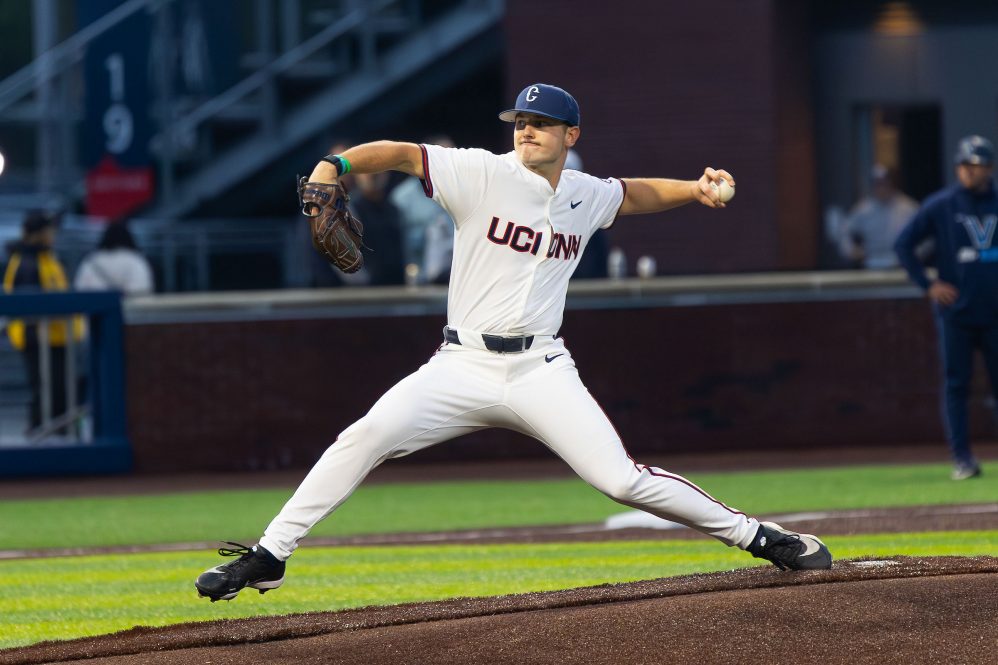
Cole Zabetakis/UConn Athletics)
The World Series is fast approaching, and the last thing any team or fan wants is to see a player scratched from the lineup because of an injury.

That's something Los Angeles Dodgers fans are all too familiar with this year, as pitcher Edwin Díaz was sidelined for over a month with a neck injury. Díaz is just one of many players who have been hampered this season by neck problems.
This is a familiar story to Laurie Devaney, head of the Department of Kinesiology in the College of Agriculture, Health and Natural Resources (CAHNR) , and co-director of the UConn Institute for Sports Medicine. During the early 2000s, Boston Red Sox pitcher Pedro Martinez, one of Devaney's favorite players, was removed from the lineup with a stiff neck. This got Devaney thinking.
"I said to myself, 'Huh, that has to affect his pitching mechanics, I wonder how he's going to do when he comes back,'" Devaney says. "That got me thinking, because the neck is my area of expertise and it had not been explored in baseball."
A new study led by Devaney sheds light on the connection between neck mobility and the risk of shoulder and elbow injury in baseball pitchers. This work was published in the Journal of Athletic Training.
The study included 126 pitchers from seven collegiate baseball teams across the country. At the start of the season, the researchers conducted neck mobility tests and then followed the players throughout the season.
They found that pitchers with reduced neck mobility at the start of the season were more likely to report arm problems and sustain an pitching-related arm injury than those with better neck mobility. Overall, they also lost more days out of play due to injury.
Devaney previously conducted a smaller pilot study that first identified this association in college baseball pitchers.
"It was good to see that relationship held, even across different settings," Devaney says.
Neck mobility plays an important role in much more than just turning your head, including in pitching.
"If you look at the modelling we do, the biomechanics of pitching, it stops at the neck," Devaney says. "People have studied, obviously, the shoulder and elbow on a regular basis, and the trunk, the hip, the knee. But we haven't really seen anything come out around head and neck position. That's why we've been trying to explore that relationship."
While the researchers don't yet know exactly how neck stiffness impacts shoulder and elbow injury risk, they have some ideas.
"If you have neck stiffness, it affects the downstream mechanics in your pitching motion," Devaney says. "So, if, for instance, you can't turn your head to find the target, then it might be that your trunk opens up early and that trunk rotation may predispose you to a throwing-related injury."
There are also anatomical links between the muscles and nerves in the neck and the shoulder blade, rotator cuff, and forearm.
While this research focused on college players, neck stiffness is a concern at every level of play, from youth sports through the major leagues. Devaney is currently leading a collaboration with the Wake Forest Pitching Laboratory to explore the mechanisms, and this spring Devaney's lab will study high school baseball players to see when this association first emerges.
"We've identified this as a risk factor," Devaney says. "Now we're trying to find out why and what we can do to change it in hopes of reducing injury burden in this population of athletes."
While this work has focused on a specific population of athletes, the lessons researchers are learning from it have broader applications. For example, understanding how neck mobility impacts how the whole body moves can shed light on fall risk in older adults.
"The lessons that we are learning through our work with athletes actually help us in assessing and managing other people and keeping them healthy too," Devaney says.
This work relates to CAHNR's Strategic Vision area focused on Enhancing Health and Well-Being Locally, Nationally, and Globally.


