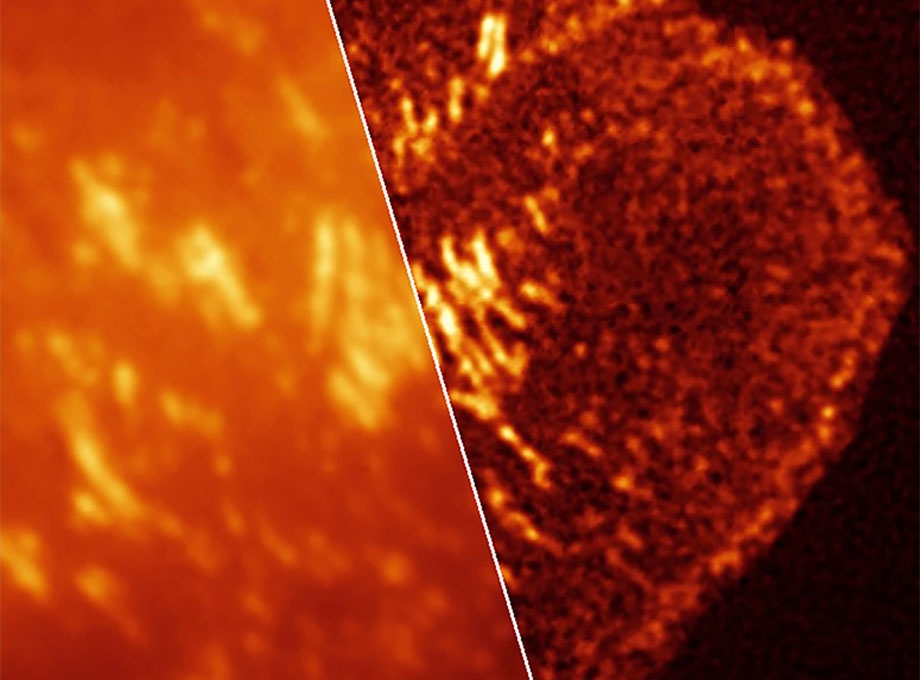
A new study co-led by an Oregon Health & Science University researcher describes a breakthrough in microscopy tools that could dramatically expand how cancer biology labs study the inner workings of living cells.
The research, published today in Nature Methods, introduces a series of fluorescent dyes that make it much easier to take ultra‑detailed images of living cells. These tools allow scientists to watch important cancer‑related processes as they happen, instead of relying only on still images of fixed cells.

The study was co-led by Catherine "Cathy" Galbraith, Ph.D., associate professor in the OHSU Biomedical Engineering Department and Discovery Engine Investigator in the OHSU Knight Cancer Institute, and Luke Lavis, Ph.D., senior group leader at Howard Hughes Medical Institute's Janelia Research Campus and head of Janelia's Molecular Tools and Imaging research area. The project was conceived jointly by Lavis, Galbraith, Brian P. English, Ph.D., senior scientist at Janelia, and Wesley R. Legant, Ph.D., assistant professor at the University of North Carolina-Chapel Hill.
Researchers use a technique called super‑resolution microscopy to see tiny structures inside cells that are normally invisible with standard light microscopes. While powerful, this approach can be difficult to use in living cells. Traditional methods often require special light patterns or harsh chemicals to force fluorescent tags to turn on and off, which can damage cells and discourage many labs from using the technology.
The newly developed dyes solve this problem in a simpler way. They blink on and off naturally, without the need for intense light or added chemicals. That makes it easier for scientists to localize individual molecules inside living cells using standard lab equipment. It also makes them well-suited for SOFI — Super-resolution Optical Fluctuation Imaging — which uses changes in fluorescence intensity to build high-resolution images much faster than localizing individual molecules.
"Luke's dyes remove a major barrier that has kept live super‑resolution imaging out of reach for many biology labs," Galbraith said. "By figuring out how to use the dyes systematically, matching each dye's blinking properties to the right imaging context, Brian and I made them useful to observe dynamic biological processes as they happen, and answer the kinds of questions cancer researchers are asking."
That ability is especially important for cancer research. Cancer is not static — tumor cells constantly change how they grow, move and respond to their environment. Understanding those changes requires tools that can capture activity inside living cells.
The new dyes allow researchers to study processes closely tied to cancer, including how DNA is packaged and accessed, how genes are turned on and off, how cancer cells migrate, and how molecules organize themselves inside cells.
"These tools let us see critical cancer‑related processes happening live, at the very small scale where key decisions are made inside cells," Galbraith said.
The Nature Methods paper marks Galbraith's second publication in a Nature‑family journal in just two weeks, highlighting her lab's growing influence at the intersection of cell biology, imaging and cancer research.
Lavis, whose Janelia Fluor dyes are already widely used in microscopy labs around the world, led the chemical design of the dyes. Galbraith established the framework for which dye to use in which context — a panel-based approach validated across living cells, fixed cells, and acidic compartments like those found in tumors, where different dyes from the series perform differently.
Researchers expect the tools to be quickly adopted, particularly by cancer labs that want easier ways to use live super‑resolution imaging.
"New tools open up biology," Galbraith said.
This study was supported by the National Institute of Neurological Disorders and Stroke, of the National Institutes of Health, under award numbers NS083085 and NS141768, National Institute of General Medical Sciences, under award numbers GM117188, GM126190 and 1DP2GM136653, the U.S. National Science Foundation, under award numbers 2345411 and 579662, the Howard Hughes Medical Institute Janelia Visiting Scientist Program, the Howard Hughes Medical Institute, the W. M. Keck Foundation, the Searle Scholars Program, the Beckman Young Investigator Program and the Packard Fellowship for Science and Engineering.