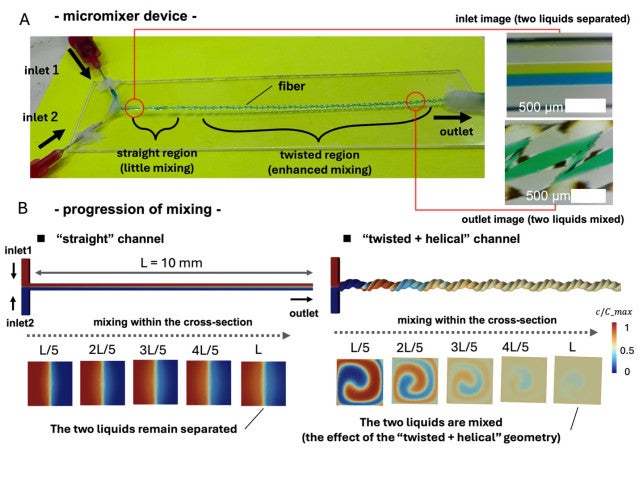
"Micromixer" might just sound like a fancy name for a tiny blender, but mixing liquids at the microliter scale is no simple task. Micromixers are essential components of microfluidic devices that are widely used across the pharmaceutical, life sciences, chemistry, and materials engineering industries, where they rapidly and evenly combine tiny amounts of reagents. Three-dimensional (3D) microchannels can make this mixing more efficient, but fabricating these precise structures has remained a challenge - until now.
Now, a research team led by Associate Professor Yuanyuan Guo of Tohoku University's Frontier Research Institute for Interdisciplinary Sciences (FRIS) and the Graduate School of Biomedical Engineering, together with Shunsuke Kato (a FRIS junior researcher) and collaborators at the Okinawa Institute of Science and Technology (OIST), has developed a way to fabricate "twisted" microchannels inside polymer fibers that are highly efficient at mixing. Previously, twisted microchannels were studied mainly using computational models, as they were considered extremely difficult to produce. This new production method may provide a practical way to produce microfluidic systems at a larger scale.
"Microfluidic mixers are essential to lab-on-a-chip systems used in diagnostics, drug discovery, and chemical analysis, but the best-performing 3D mixers have been difficult to manufacture," explains Guo. "Our method adapts thermal fiber drawing - the same scalable process used to mass-produce optical fibers - to fabricate high-performance 3D micromixers continuously inside thin, flexible fibers. This opens the door to compact, inexpensive, and even wearable fluidic systems, such as point-of-care diagnostic devices and environmental monitors."
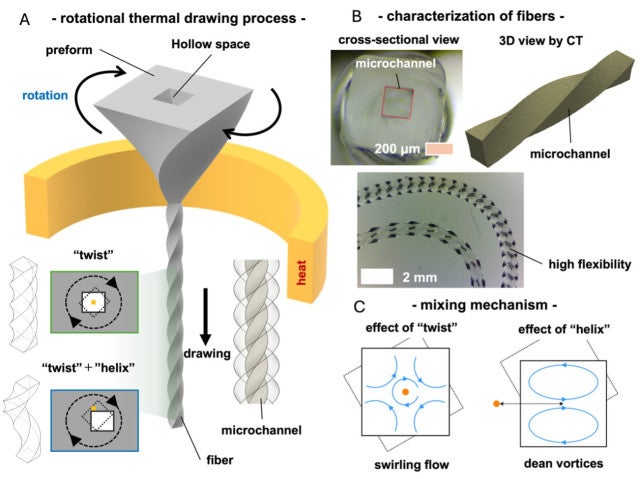
After creating these micromixers, cross-sectional observations by X-ray computed tomography and optical microscopy confirmed that the channels were formed with high precision. The precise shape of these channels is key to how micromixers work. Since flow inside microchannels is laminar (smooth), two liquids mix only through slow molecular diffusion, so channel geometries must be precisely designed and engineered to generate flows that promote mixing.
The twisted channel acts as a 3D micromixer: its rotating cross-section generates a swirling flow that stirs liquids even at low Reynolds numbers, where flows are gentle. By adjusting the channel layout, the team also fabricated channels that combine a twist with a helix. At moderate to high Reynolds numbers, centrifugal forces in these channels generate Dean vortices - pairs of counter-rotating secondary flows - which further boost mixing and yield high efficiency across a wide range of flow rates.
"From beautiful structures to novel functions - this work demonstrates how precise structural engineering of fibers enables functionalities that were previously inaccessible," remarks Kato.
The team aims to improve performance by optimizing design parameters such as the channel's cross-sectional shape and to exploit the fibers' flexibility by coiling, meandering, or weaving them into hierarchical mixing architectures. Their design benefits from being highly flexible - the shape can be adjusted in different ways depending on the desired task.
The twisted micromixer is a step toward multifunctional "lab-in-fiber" platforms that could carry out bioanalysis, chemical synthesis, and environmental monitoring continuously within a tiny space.
The results were published in the journal ACS Applied Materials & Interfaces on August 31, 2026.