Agriculture, from the outset, has been made possible by humans tweaking the genes of plants to make them grow faster, produce more of what we want, and survive drought, pests, and infection. For millennia, we did it with selective breeding. More recently, we advanced to genetic engineering. But even with today's ultra-fast sequencing technologies and streamlined CRISPR-based gene editing tools, successfully altering a plant is a slow, laborious process.
Scientists at the Joint BioEnergy Institute (JBEI) are helping to change that with a new technology called ENTRAP-seq, which can screen thousands of transcription regulators for plants, simultaneously. Transcriptional regulators are proteins that impact how a gene is expressed like a dimmable light switch; they can turn it off entirely or change how much of a specific product a cell makes by modulating how often the DNA is transcribed into RNA. Most of the enhanced traits we see in current crop and biofuel species are the result of transcription modulation, for example, thousands of years ago, ancient farmers bred natural variants of wheat that had higher expression of genes controlling grain size. Agricultural technology scientists would love to better wield these genetic switches, yet our understanding of them is limited, despite extensive studies of plant genomes.
"Even for the well-studied plants - where we know a ton about which genes control which things, and in many cases, how the gene works - it's not clear how to alter gene expression to make beneficial modifications," said Simon Alamos, a postdoctoral fellow at UC Berkeley and JBEI, a Department of Energy (DOE) Bioenergy Research Center managed by Lawrence Berkeley National Laboratory (Berkeley Lab). Alamos is co-first author on a study describing ENTRAP-seq now published in Nature Biotechnology. "We want to be able to use the plants' own transcription regulators, and proteins with this activity from other organisms like plant viruses, but until now, we didn't have a way to predict what they do or test them quickly."
ENTRAP-seq fills this unmet need by shrinking experiments that previously required a whole plant or whole leaf down to a single cell. The process uses a plant-infecting bacterium to insert DNA sequences for many potential transcription regulator proteins into a leaf, alongside the code for an engineered target gene. The scientists make a library of thousands of bacteria, each of which contains instructions for one protein variant. Afterwards, the bacterial library is injected into a leaf and each bacterium transfers its genetic cargo to a single plant cell, so that thousands of different variants are produced by different individual plant cells.
Once the plant cell has made these components, the protein variants are able to turn on or off molecular switches inside the cell nucleus, signaling if they have activating or repressing properties. If it does have activating properties, an engineered gene will be expressed that has been specially designed to stick to magnetic tag molecules. The scientists can then use magnets to physically isolate which cells have produced the target protein, sequence the DNA inside, and match the results to the list of potential proteins they introduced.
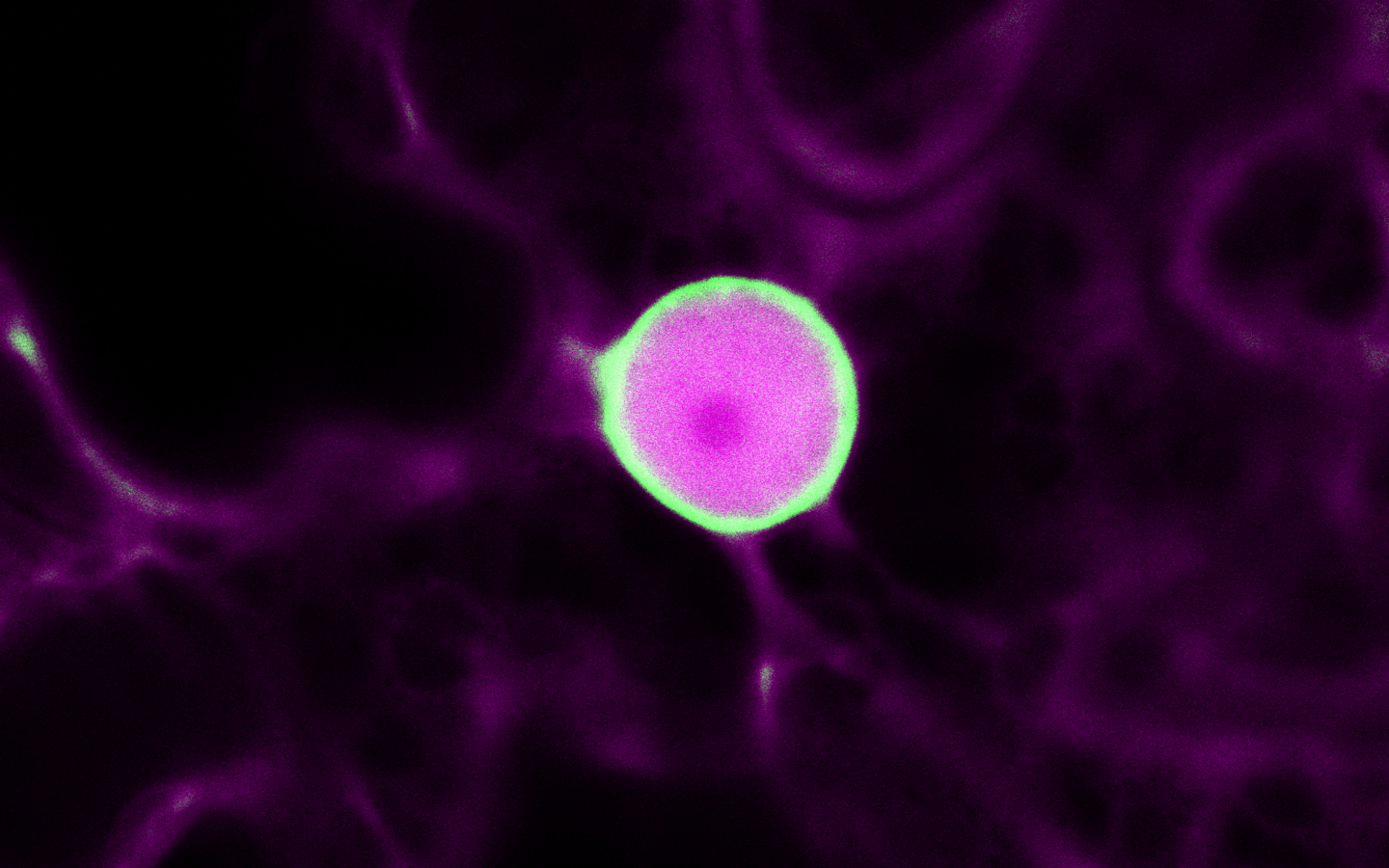
After developing the approach, the team demonstrated its unprecedented speed for real-world investigations. They used ENTRAP-seq to study gene regulation in a transcription activator known to mediate expression of a gene that controls flowering in Arabidopsis, a plant used as a model organism for botany research. They created 350 mutant versions of the protein and quickly screened which ones could tune flowering time up or down.
"This experiment took just a few weeks. In contrast, for a previous study, our team characterized the activity of 400 plant transcription regulators, which took two people full time over two years using the conventional, brute force approach of testing things one by one," said lead author Patrick Shih, Deputy Vice President, Feedstocks Division and Director of Plant Biosystems Design at JBEI.
Revealing the switchboard
Shih and his team generated potential activator designs for this study using an existing AI model that identifies DNA sequences that could encode gene activating proteins from any organism.
"The model's predictions allowed us to focus our experimental efforts on the most informative proteins across thousands of genomes," said co-first author Lucas Waldburger, a graduate student researcher at UC Berkeley and JBEI.
However, the accuracy of this model is limited by a scarcity of training data because, as the scientists know firsthand, methods to investigate transcription regulators used to be punishingly slow. With ENTRAP-seq, researchers will be able to quickly generate huge datasets that can refine these models. And better models mean that those researchers can quickly scan a plant's genome and discover where all the gene switches are encoded - information that is nearly nonexistent for many species. Then, completing the positive feedback loop, ENTRAP-seq will help scientists study the effects of natural and engineered variations in those proteins to create versions that enhance desired traits.
"We're looking for all the switches and we want to know, are they on or off switches? And then, how far up and how far down can it go? Cataloging all of that will be a huge advance," said Shih, who is also associate professor at UC Berkeley and faculty scientist in Berkeley Lab's Biosciences Area. "Then maybe we find an important switch for making bigger plants, higher yields, or more stress resilient crops, and finally: can we crank that dimmer switch to 11?"
ENTRAP-seq is available for licensing through Berkeley Lab's Intellectual Property Office. This research was funded by the DOE Office of Science.