
For several years, researchers in Würzburg have been using state-of-the-art single-cell analysis to study individual cells. The new "in situ RNA imaging analyzer" now also enables the visualization of complex disease processes.
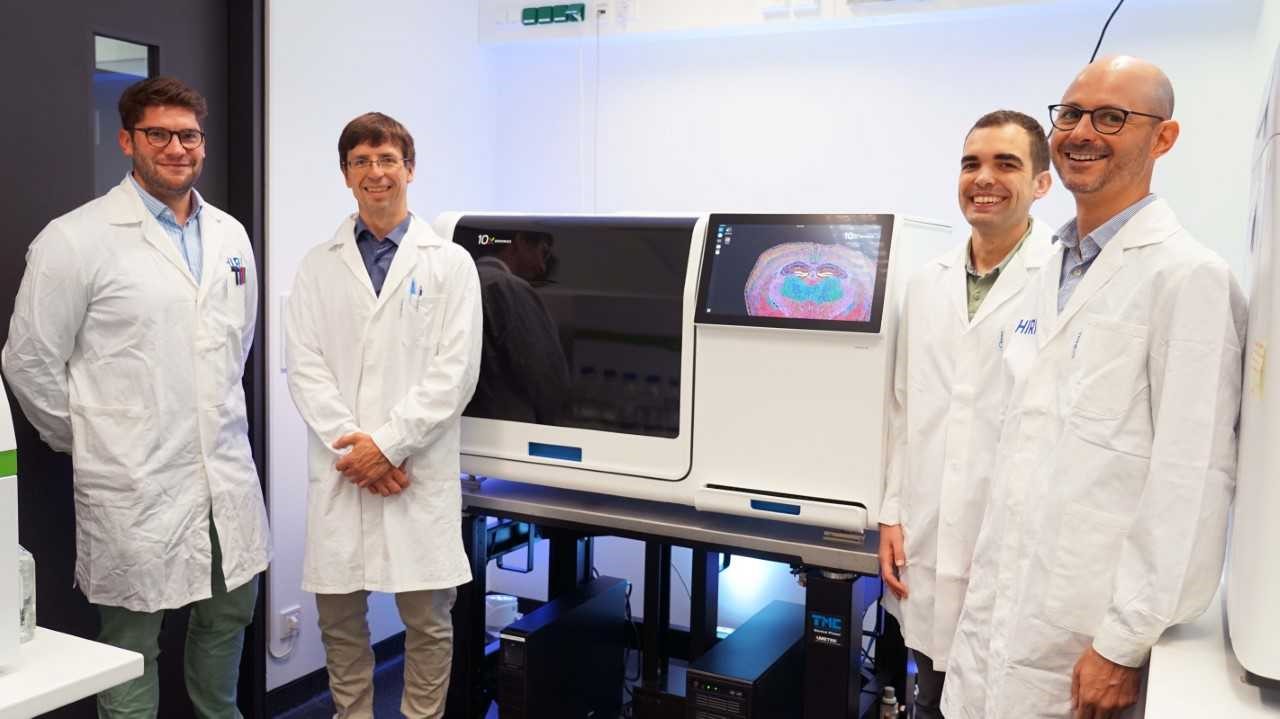
For several years, researchers at the Julius-Maximilians-Universität (JMU) and the Helmholtz Institute Würzburg (HIRI) have been observing individual cells. With the Single-Cell Center (SCC), the Würzburg science hub has state-of-the-art expertise in experimental and computer-assisted single-cell analysis. The new "In-Situ-RNA-Imaging-Analyzer" now makes it possible to visualize the complex processes involved in diseases.
Single-cell analysis used to be like looking through a keyhole; you could see the characteristics of a single cell, but not its environment. Spatial information was missing: What role does the neighboring cell play? How do cells influence each other when tightly packed in tissue?
This gap can now be closed with a new, high-end device that enables researchers in Würzburg to analyze tissue more effectively. "The In-Situ RNA Imaging Analyzer is a powerful tool for us. It allows us to visualize the spatial distribution of RNA molecules in cells and tissues, enabling us to understand biological processes much more accurately," explains Professor Dominic Grün, Chair of Computational Biology of Spatial Biomedical Systems and Deputy Spokesperson for the Single-Cell Center.
Professor Antoine-Emmanuel Saliba, spokesperson for the Single-Cell Center and research group leader at the Helmholtz Institute for RNA-Based Infection Research (HIRI), emphasizes the strategic importance: "With this investment, Würzburg is positioning itself as a pioneer in single-cell research. The Single-Cell Center provides state-of-the-art methods and expertise to efficiently evaluate data, creating ideal conditions for long-term research growth."
New insights into disease progression
For example, it enables researchers to examine the bone marrow of patients with multiple myeloma, a form of bone marrow cancer, more closely. Researchers can identify which cells are involved in the disease and how they influence each other at the molecular level. These molecular interactions significantly influence the course of the disease and tissue regeneration after treatment-and single-cell analysis can decipher these mechanisms.
Another application is healing after a heart attack. Scar tissue forms, causing the heart to lose its pumping power. In the long term, this can lead to heart failure. If we understand how the involved cells work together to control heart tissue repair, future therapies could support healing more effectively.
This technology is advancing our understanding of diseases such as cancer, autoimmune disorders, and infections. However, it also requires a high level of technical expertise. The enormous amounts of data are analyzed using machine learning and artificial intelligence. To this end, Dominic Grün's and Emmanuel Saliba's teams are developing special algorithms to interpret the information efficiently.
About the Single-Cell Center
The Single-Cell Center Würzburg is a joint competence center of the Helmholtz Institute for RNA-based Infection Research (HIRI) with the Faculty of Medicine of the Julius-Maximilians-Universität (JMU), the University Hospital Würzburg (UKW), and the Max Planck Research Group at the Würzburg Institute of Systems Immunology (WüSI).
About the Helmholtz Institute for RNA-based Infection Research
The Helmholtz Institute for RNA-based Infection Research (HIRI) is the first institution of its kind worldwide to combine ribonucleic acid (RNA) research with infection biology. Based on novel findings from its strong basic research program, the institute's long-term goal is to develop innovative therapeutic approaches to better diagnose and treat human infections.
HIRI is a site of the Braunschweig Helmholtz Centre for Infection Research (HZI) in cooperation with the Julius-Maximilians-Universität Würzburg (JMU) and is located on the Würzburg Medical Campus.
Picture: From left to right: Fabian Imdahl (Project Manager and Application Specialist at the SCC), Dominic Grün, Tobias Krammer (Spatial Transcriptomics Specialist and Coordinator for the SFB DECIDE / Cardio Single-Cell Projects at the SCC) and Emmanuel Saliba in front of the new state-of-the-art " In-situ RNA Imaging Analyzer." © HIRI / Luisa Härtig


