
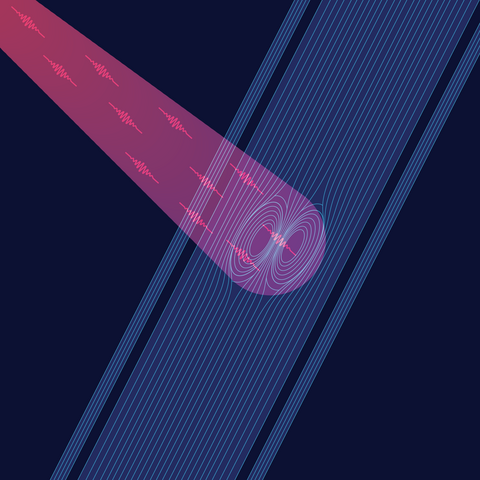
In this illustration, photons hit a strip of superconducting wire, disrupting the electric current and registering an electric pulse. Each pulse tells researchers about the light that has hit the detector, which is beneficial for applications like biomedical imaging and astronomy.
Natasha Hanacek/NIST
Our everyday life is flooded with photons, the quantum building blocks of light. For cutting-edge technology, from quantum computing to deep-tissue imaging, detecting every single photon counts.
"Photons carry information," said Kristen Parzuchowski, a postdoctoral researcher at the National Institute of Standards and Technology. "Whenever a photon comes into your measurement system, you need to be able to detect it."
Photons can transmit data in quantum networks or across deep space communication links. Catching and analyzing photons lets scientists build biomedical images and search the universe for dark matter.
Superconducting nanowire single-photon detectors (SNSPDs) are the best way to capture photons for all these applications. As their name implies, they use the phenomenon of superconductivity, in which electricity flows without resistance, to detect individual photons. Single particles of light create tiny splashes in the electric current, which disrupt the superconductivity and trigger a measurable electrical signal. NIST has drastically improved these devices over the years to the point at which they detect 98% of the photons that come in.
SNSPDs still have some drawbacks, however. They typically require highly specialized nanometer-scale fabrication techniques. Most importantly, the superconducting detector's edges limit detector performance. Detectors that can carry more current are known to perform better, but fabrication defects cap the maximum flow.
NIST researchers decided to think bigger. In a new Optica paper, NIST researchers found that they could size up the superconducting wires to a tenth of a millimeter - more than 100 times wider than typical SNSPDs - simplifying the photon detector's design and its fabrication using a method to unlock the material's true performance potential.
"Typically, everyone has worked to make smaller and smaller wires, which makes fabrication increasingly challenging," Parzuchowski said.
SNSPDs typically use a 100-nanometer-wide wire made of superconducting material connected to a readout circuit. Electric current flows through the wire like water through a river. When a photon hits the wire, like a rock hitting the river, it creates a hot spot disrupting the current. That hot spot creates a voltage pulse, which is picked up by the readout electronics.
Scientists believed that superconducting wires in SNSPDs needed to be nanoscale to maximize the photon's minuscule "splash" across the wire, points out NIST postdoctoral researcher Eli Mueller.
"Your photon energy needs to break superconductivity over the entire width of the wire," he said. "It's very difficult to have your device in a regime where the photon could break superconductivity over 100 microns wide, so devices needed to be on the order of hundreds of nanometers wide."
Due to that nanoscale size, SNSPDs have to operate at lower currents, which means that lower-energy photons don't make as much of a splash and are harder to detect. Readouts are fainter blips. The electric current doesn't behave perfectly, either: It doesn't flow evenly across the wire. Defects can also cause current to build up along the edges, like whirlpools or eddies along a river, leading to false signals called dark counts, Parzuchowski added.
"If we can get the middle of our device to flow more current than what was previously accessible, then we can generate a hot spot over an arbitrarily wide wire. And that hot spot is what's giving you the pulse out," Mueller explained. "If you're operating even closer to that transition between the superconducting state and the normal state, then you're still sensitive to the very low energy photons."
How do we solve this problem? Give it rails.
These superconducting rails border the central wire and run current in the same direction, generating a magnetic field. The rails' magnetic field meets the magnetic field of the central wire; together they redistribute the flow of current - no more current buildup along the edges. Evening out the current's flow let the group maximize the amount of current the superconducting wire could carry and enabled them to scale up the size of the wire. The wide SNSPDs are also polarization insensitive; regardless of the direction the photons' electric field "wiggles," the detector can pick it up. Now each photon makes a more noticeable splash that the team can read easily.
"For years, researchers have tried to get closer to the optimum performance of these detectors, but it was never clear how far you could push it. Now we've shown that you can actually reach the intrinsic performance limit," Parzuchowski added.
The group scaled up their wire to tenth of a millimeter, and it's possible to go even wider, added electronics engineer Marty Stevens, the group's leader.
It's unclear whether wide SNSPDs can reach the same 98% efficiency as their nanoscale kin; more testing is needed, Stevens said. However, the team reached a new record with the devices - their dark counts dropped by a billion times.
"It was very shocking," Parzuchowski recalled. "We were calling in some other people in our group into the room, telling them, 'Look at this, this is crazy!'"
This new architecture is simpler to fabricate, which would make very large detectors easier to manufacture. The size and sensitivity allows the detector to catch more photons, which is especially desirable in situations where light sources are extremely faint and less controlled. That's useful for healthcare imaging techniques such as diffuse correlation spectroscopy, where a beam of light is sent through human tissue and the scattered light is collected to measure blood flow. Another application is astronomy, where detecting faint low-energy light is necessary to study signatures from distant galaxies.
"There are many applications where you're working with handfuls of photons. Ideally, you need to detect all of them," Parzuchowski said.
Paper: Kristen M. Parzuchowski, et al. Reaching the intrinsic performance limits of superconducting nanowire single-photon detectors up to 0.1 mm wide. Optica. Published online Aug. 19, 2026. DOI: 10.1364/OPTICA.599984


