
Summer storms increase the risk of cyanobacterial blooms in clear water lakes.
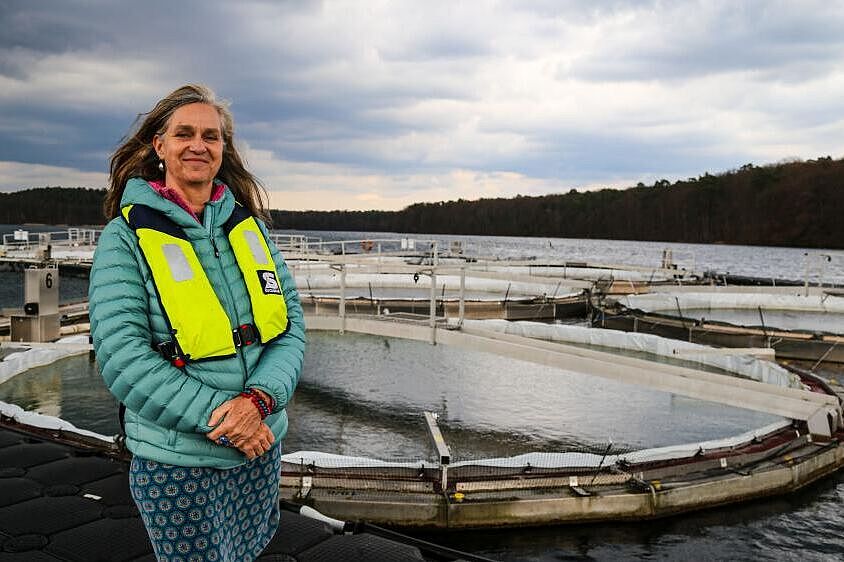
Dr. Stella Berger at LakeLab in Lake Stechlin | Photo: Astrid Scheuermann
Researchers at the Leibniz Institute of Freshwater Ecology and Inland Fisheries (IGB) have investigated how summer storms change the ecology of deep, clear lakes in a large-scale experiment in the "LakeLab" at Lake Stechlin. They simulated the effects of a storm in the experimental cylinders of the lake laboratory, in which the water column was deeply mixed. Nutrients, inorganic carbon and algae were brought to the surface from deeper layers, triggering a mass development of cyanobacteria known as blue-green algal blooms. The results show why such algal blooms not only occur in shallow, nutrient-rich waters in times of climate change, but also in deep clear water lakes.
A key finding: Extreme weather events such as summer storms not only change the physical conditions in lakes in the short term, but also influence their ecology in the long term. The simulated storm led to a cascade of biological and chemical reactions that lasted for weeks.
The LakeLab enables repeat and control studies under field conditions
Previous findings on the reactions of lakes to extreme storms were mainly based on observational studies. It was difficult to separate the effects of physical influences from secondary factors such as external nutrient inputs.
This experiment was different: the LakeLab is located in Lake Stechlin. In 24 lake enclosures, each with a diameter of 9 meters and a depth of approximately 20 meters, the water column is separated from the rest of the lake. IGB researcher Dr. Jens Nejstgaard developed a methodology to simulate the storm and mix the water evenly in some enclosures. "Since the other environmental conditions were the same in all basins, the experiment allowed for multiple replicates and controls with and without mixing. This is a unique experimental setup. Lake Stechlin itself remained unaffected by the changes", said the scientist.
Cascade of long-lasting ecological changes
The simulated storm transported nutrients and phytoplankton from the deep water to the sunlit surface, leading to a sharp increase in algae biomass. "In deep, clear lakes such as Lake Stechlin, algae can also grow in deeper water layers because there is sufficient sunlight there. When these algae are washed up by a storm, they can reproduce en masse due to the optimal conditions", explained IGB researcher Dr. Stella Berger, who coordinated the experiments in the lake laboratory together with Dr. Jens Nejstgaard.
The composition of the algae and microorganisms changed: some algae were consumed by microorganisms, while others sank to the bottom of the lake. Filamentous cyanobacteria remained, multiplying en masse as a result of mixing - an algal bloom developed. Cyanobacteria can be toxic to humans and animals.
Climate change: The risk of algal blooms is also increasing in deep, clear lakes
Climate change is causing an increase in summer storms, posing a new challenge for freshwater ecosystems."The warming of lakes due to climate change not only increases the risk of algal blooms in nutrient-rich shallow lakes. Deep, clear lakes are also at risk from increasing summer storms, as our results show", said IGB researcher Prof. Hans-Peter Grossart, the study's lead author. "These lakes in particular often have special conservation value, as they have been largely unaffected by anthropogenic influences in the past or have recovered from them."
Hans-Peter Grossart; Thomas Hornick; Stella A. Berger; Jens C. Nejstgaard; Michael T. Monaghan; Takeshi Miki; Darren P. Giling; Geza B. Selmeczy; Judit Padisak; Jörg Sareyka; Peter Kasprzak; Christian Wurzbacher; Georgiy Kirillin; Christof Engelhardt; Mark O. Gessner
Extreme summer storm elicits shifts in biogeochemistry, primary productivity, and plankton community structure in a large-scale lake enclosure experiment
Limnology and Oceanography Letters - XX(202X)X, XX-XX - October 2025
[Translate to English:]


