
Internal clocks can tick very differently. While some people are most productive in the morning, others are only active later in the day or at night. This phenomenon is known in science and medicine as chronotype.
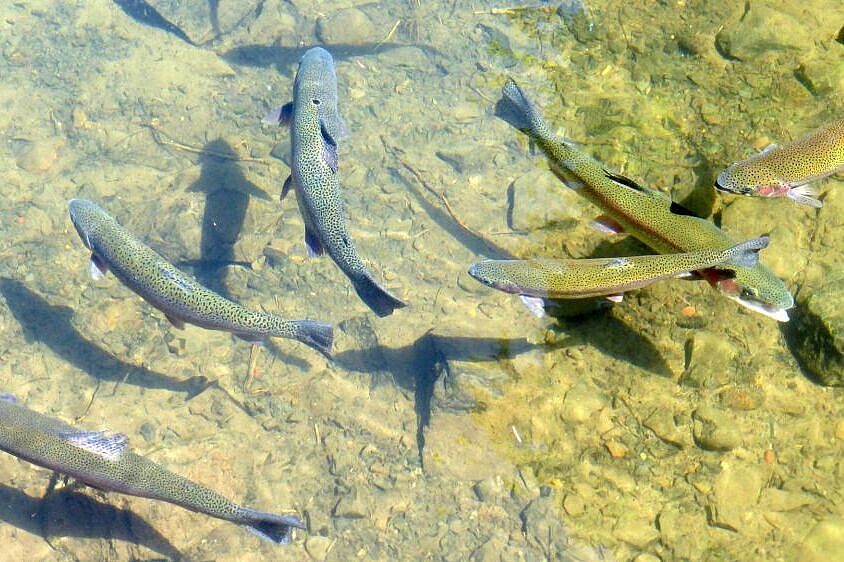
Even among fish, there are early risers and night owls, such as trout, for example. | Photo: Photoman on Pixabay
In a comprehensive analysis of the activity patterns of wild fish, a research team involving the Leibniz Institute of Freshwater Ecology and Inland Fisheries (IGB) has shown that fish - carp, trout, zander, and others - also have individual early and late risers. The results were published in the journal Fish and Fisheries.
It is known that some humans, mammals, and birds tend to be early risers, while others are active later in the day. These tendencies are referred to as an individual's chronotype. Previous studies have shown that these chronotypes are partly genetic. However, until now, little research has been conducted into whether such chronotypes also exist in wild fish.
The research group, with Prof. Dr. Robert Arlinghaus from IGB and Humboldt Universität zu Berlin, analyzed high-resolution activity data collected in the field using biotelemetry and biologging methods from 44 data sets on 34 different marine and freshwater fish species. In biotelemetry, the fish carry transmitters that send out signals and allow their locations to be determined, while bio-loggers store a fish's activity data, such as burst swimming events. The researchers only evaluated data sets in which the activity patterns of the animals could be analyzed constantly over several days. They examined whether consistent individual differences existed for the beginning and end of the animals' daily activity. Incidentally, whether fish sleep in the human sense is scientifically controversial. What can be determined without doubt, however, are periods of rest and periods of increased swimming activity. Outside of the spawning season, swimming fish are usually searching for food or trying to avoid predators.
Chronotypes found in many fish species
The research team succeeded in identifying chronotypes in 17 fish species. This is not about individual fish species being more active during the day or at night, but rather about systematic individual differences in terms of the start and end of activity within a fish species over the course of the day.
Trout: extreme early risers and morning grouches
The chronotypes were particularly pronounced in trout. Above all, the range of times at which individual animals became active or ceased activity varied considerably and systematically between the animals: some individuals were already active five hours before sunrise, others only five hours after.
Carp: each individual has fixed "bedtimes"
Carp showed clear individual patterns, especially with regard to their rest onset. The first ones settled down around three hours after sunset, while the night owls among the carp switched to rest mode nine hours later.
Zander: large zander rest earlier
Chronotypes were also observed in the often nocturnal zander. It was noteworthy that larger and older zander tended to settle down earlier in the night than their smaller, younger conspecifics.
Red grouper: strict daily routine
The red grouper, a marine fish, had the most rigid daily schedule overall, with individuals having strict waking and resting phases. Both "getting up" and "going to sleep" varied individually and systematically, in line with chronotypes.
"The results support the division into 'morning' and 'evening' types, which corresponds to the classic classification of chronotypes in humans" said fisheries scientist Robert Arlinghaus. "In our study, almost all of the fish species examined exhibited chronotypes. For the species in which we found no evidence, I assume that the reason is methodological in nature. To prove the existence of chronotypes in fish beyond doubt, long-term high-resolution data is required, but this is rare", added the fisheries ecologist.
High-resolution fish tracking and activity sensors enable undisturbed behavioral studies
Some of the studies on which this analysis is based were conducted using acoustic telemetry, including work by the IGB on native fish in a lake in Brandenburg. Here, a sample of fish carry small transmitters that send out signals several times per minute. These signals can be used to determine the swimming depth, swimming speed and location of the animals. Receivers installed in the lake record this data without disturbing the fish.
"High-resolution telemetry and biologging methods are particularly well suited for studying activity patterns in fish in the wild. These methods are especially good at capturing short transitions between resting and activity", said fisheries biologist Dr. Christopher Monk from the GEOMAR Helmholtz Centre for Ocean Research Kiel, who was also involved in the study. During his time as a doctoral student and postdoc in Prof. Dr. Robert Arlinghaus's research group, Christopher Monk played a key role in the fish telemetry work at IGB, which has been incorporated into the now published study.
In addition to providing fundamental scientific insights, the results help explain why anglers only catch certain individuals, as previous studies by Robert Arlinghaus and Christopher Monk have already shown. For example, if you fish in the morning, it is easier to catch fish that are active early in the day than those that are still resting when the bait hits the water. Through selection, the activity patterns of fish caught can systematically shift over generations.
September 2025, Revealing Chronotypes Across Aquatic Species Using Acoustic Telemetry, Martina Martorell-Barceló; David Abecasis; Mourad Akaarir; Alexandre Alonso-Fernández; Robert Arlinghaus; Eneko Aspillaga; Margarida Barcelo-Serra; Niels W. P. Brevé; Jan G. Davidsen; Antoni Gamundí; Amalia Grau; Bernat Hereu; Ivan Jarić; Andrzej Kapusta; Sue Lowerre-Barbieri; Christopher T. Monk; Anja K. Nickel; María C. Nicolau; Guðbjörg Á. Ólafsdóttir; Esben M. Olsen; Renanel Pickholtz; Marie Prchalová; Jan Reubens; Milan Říha; Inge van der Knaap; Pieterjan Verhelst; David Villegas-Ríos; Josep Alós, Fish and Fisheries. - 26(2025)6, 1134-1145.
DOI: http://dx.doi.org/10.1111/faf.70022
November 2023, Chronotypes‑personality behavioural syndromes in wild marine fish, Martina Martorell‑Barceló; Marco Signaroli; Margarida Barcelo‑Serra; Arancha Lana; Eneko Aspillaga; Amalia Grau; Robert Arlinghaus; Josep Alós, Scientific Reports. - 13(2023), Art. 20281.


