
Grief over the sudden death of a partner leads one in six surviving partners to experience such severe psychological distress that they begin taking sedatives or antidepressants. If the death also results in a noticeable loss of income, the share of widows and widowers using psychotropic medication is significantly higher. Economic insecurity greatly amplifies the mental strain after the death of a loved one, researchers conclude.

The sudden death of a partner often impacts the surviving partner's mental health so severely that they start taking anxiety-reducing or antidepressant medication.
When a woman dies suddenly, 8.6% of male partners begin using psychotropic drugs immediately after the death. Within the first year, that figure rises to 16% - and these are men who had no prior use of such medication in the years leading up to the loss.
The same pattern applies to 11.5% of women who suddenly lose their husband, with the number climbing to 18.5% within the first year. For some, the use continues for at least five years after the death.
If the surviving spouse also loses the household's main breadwinner, even more turn to psychotropic medication:
Specifically, 10 percentage points more widows and 5 percentage points more widowers.
This is shown by new research from the Department of Economics, Center for Economic Behavior and Inequality at the University of Copenhagen. The study has been accepted and is forthcoming in the prestigious journal American Economic Review: Insights and is supported by the ROCKWOOL Foundation.
The loss of a spouse or cohabiting partner often also means a significant drop in income for the survivor.
The research team estimate that the additional use of psychotropic medication among economically stressed widows and widowers amounts to 54% for widows and 32% for widowers.
"Although the death of a partner can be traumatic in itself, our data on the use of medication for anxiety and depression clearly show that a major loss of income - and possibly uncertainty about future finances - worsens the psychological consequences. The increased use of medication indicates that the mental impact of bereavement is significantly greater for those who, on top of grief, also experience a substantial financial loss," says Professor of Economics Torben Heien Nielsen from the University of Copenhagen.
12,000 Danish couples studied
In the study, economists examined the mental health of widows and widowers in 12,000 Danish couples aged 45-80, where one partner suffered a fatal heart attack or a stroke (blood clot or brain hemorrhage) between 1999 and 2013 and died within 12 months.
They did this by tracking how many began consuming psychotropic medication after the death - such as sedatives for anxiety and insomnia or antidepressants.
The researchers analyzed both the couple's income and medication use four years before and four years after the critical illness occurred and compared these findings with a control group of about 15,000 men and women with identical characteristics, whose partner suffered a fatal cardiac arrest or stroke-just five years later.
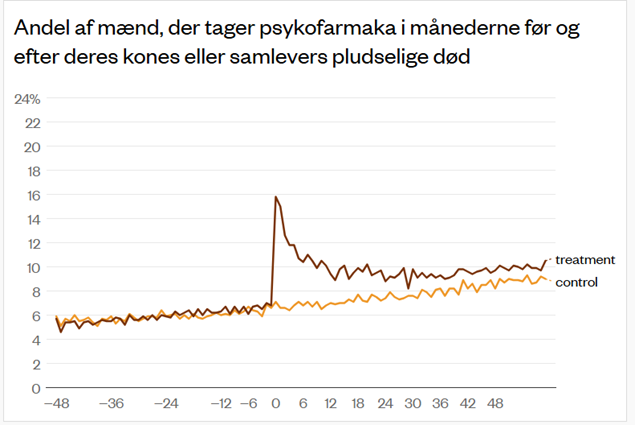
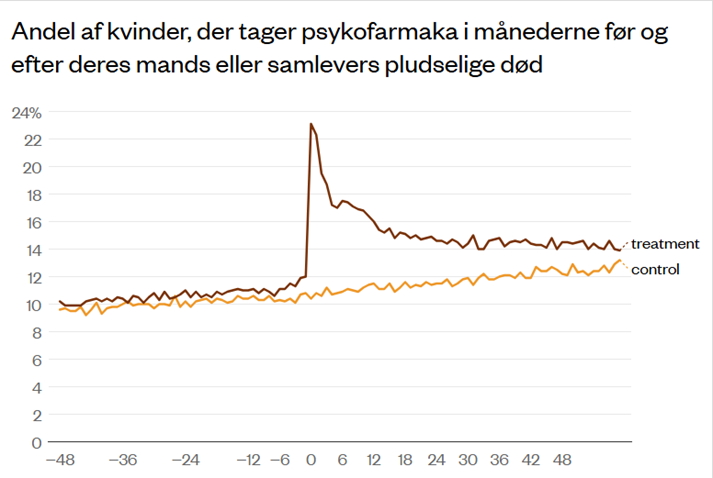
In the four years leading up to the heart attack or stroke, 11-12% of all women and 7% of all men use psychotropic medication, with usage gradually increasing with age. Immediately after the partner's death, the share rises sharply: 23% of women and nearly 16% of men now take such medication.
The brown graph shows women and men in married or cohabiting couples, where both were aged 45-80 when one partner suffered cardiac arrest or a stroke (blood clot or brain hemorrhage) and died as a result.
The orange graph shows the control group-couples exposed to the same illness and death, but five years later.
Source: Own calculations based on data from Danmarks Statistik and peer-reviewed by American Economic Review: Insights (The figure reproduces data from Figure 1 in the research article.)
Rich and poor suffer equally
Surprisingly, the researchers find that the couple's income level does not affect the surviving partner's mental well-being. What matters more is how much of the household income the widow or widower loses after the death.
Title: Survivors' Mental Health and the Protective Role of Income Stability, published in American Economic Review: Insights
Authors:
Torben Heien Nielsen, Professor of Economics, University of Copenhagen
Astrid Fugleholm, PhD student in Economics, University of Copenhagen and Special Advisor at the Danish Economic Councils
Itzik Fadlon, Associate Professor of Economics, University of California
- The study covers more than 12,000 Danish households where one spouse/partner suffered a heart attack or stroke between 1999 and 2013 and died within 12 months.
- The control group includes about 15,000 comparable households where one partner experienced the same illness and death five years later.
- Both partners were aged 45-80 at the time of illness/death.
- Data spans four years before and four years after the death/illness.
"The death of a partner is especially psychologically taxing for people who lose a large part of their prior income - regardless of whether the couple had a high or low income before the death. Conversely, our data also show that income stability creates mental stability in an extremely critical situation," says Torben Heien Nielsen.
The results of this extensive study can be useful for couples considering whether they have sufficiently secured each other financially in case of sudden death. Pension funds, insurance companies and policy makers can also benefit from these new insights into the consequences of economic instability following the loss of a partner, Nielsen adds.
The researchers tracked widows' and widowers' use of psychotropic medication in the years after their partner's death, and the data show that some are affected for at least five years. The impact of income security fades over time.
"We clearly see that lack of income stability hits hardest in the first year after the death, but disappears after a while. So it's not a permanent distress. This suggests that the bereaved are largely affected by anxiety and depression because of the financial uncertainty they face in the first years after the loss. Quick payouts from, for example, insurance policies that secure the widow's or widower's income in the first year could likely ease the mental stress many experience immediately after what is otherwise a truly dreadful and life-changing event," says Torben Heien Nielsen.


