
Psilocybin is a psychedelic drug with promising clinical applications for treating mood disorders and substance abuse disorders. Recent work in functional MRI (fMRI) studies show that psychedelics can reset brain network activity - and it is thought that this effect, which can linger for days, might explain its therapeutic benefits.
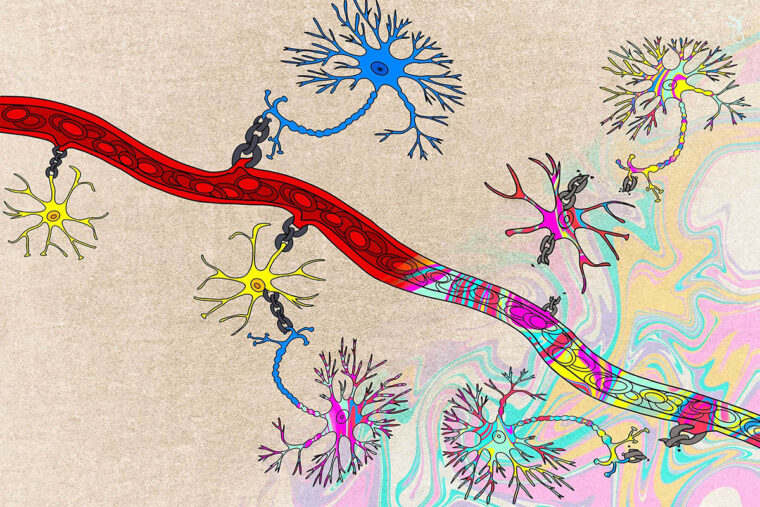
Psychedelics such as psilocybin act on a chemical in the brain called serotonin that controls the relaxation and contraction of blood vessels. Because fMRI uses changes in blood flow and blood oxygen levels in the brain as a proxy for brain activity, a team of WashU Medicine researchers set out to determine if these signals remained an accurate measure of brain activity in subjects dosed with a similar psychedelic that acts on the same chemicals.
They observed, in mice given this drug, that blood flow did not change as it normally would in relation to the activity of brain cells called neurons. When combined with a second medication that blocks a specific receptor in the brain that responds to serotonin, the blood flow effects from the psychedelic drug were removed.
The team's subsequent studies using psilocybin in mice produced similar results to those observed with the first drug. Reanalyzing results from an earlier fMRI study in human subjects given psilocybin revealed similar effects on brain responses.
These results have important implications for how researchers interpret fMRI scans of brain activity in people who have taken psychedelics, and they may aid the scientific search for how psychedelics achieve their potential therapeutic effects.
The research was led by Adam Q. Bauer, an associate professor at Washington University School of Medicine in St. Louis' Mallinckrodt Institute of Radiology; Jordan G. McCall, an associate professor of anesthesiology in the Center for Clinical Pharmacology; and Joshua S. Siegel, MD, PhD, who conducted the work at WashU Medicine and is now an assistant professor at New York University. The study was published in Nature Neuroscience.
Together, the results from mice and humans indicate that the neurovascular effects of psychedelics need to be better understood when interpreting blood flow-dependent neuroimaging. As compounds like psilocybin are increasingly studied for treating conditions including post-traumatic stress disorder, treatment-resistant depression, substance abuse and stroke, understanding how psychedelics affect the reliability of brain scans as a proxy for brain activity is important for clinicians and researchers examining the effects of these drugs.


