
According to the National Cancer Institute (NCI), more than 2 million new cases of cancer were diagnosed in the United States in 2025. By 2050, the number of cases worldwide is expected to reach 33 to 35 million, with annual cancer-related deaths at 18.2 million.
At the Binghamton University School of Pharmacy and Pharmaceutical Sciences (SOPPS) Department of Pharmaceutical Sciences, faculty and student researchers want to do something about bringing that number down.
One of the ways they test this idea is by doing something unexpected: focusing on proteins first.
"My lab, in essence, is a cancer biology lab and a cancer pharmacology lab, where we are looking for new and different ways to kill cancer," said Tracy Brooks, the chair and associate professor of pharmaceutical sciences, whose research has centered on anti-cancer therapeutics and the development of new targets for drugs through a focus on DNA. "But we don't focus on only one cancer; we focus on the proteins involved, in all of them."
To do this, Brooks partners with Tony Davis, an assistant professor of pharmaceutical sciences, whose chemistry background centers on drug discovery and biosynthesis. In Davis' lab, they manufacture chemicals to block the proteins that Brooks' lab goes on to test, with a special twist.
The goal is to remove as many of these overabundant proteins as possible, so the researchers find innovative ways to tell the cell to recycle them, like using "two-headed" chemicals - one part targeting the overabundant protein, and another made to target the "ubiquitination pathway."
"The cells naturally get rid of the proteins that are too old and not functional anymore," Brooks said. "One way is using PROTACs, which stands for proteolysis targeting chimera. Essentially, this means we are taking some protein that's causing a problem, and we're making a chimera chemical that will target it for proteolysis, or protein breakdown. We use this little double molecule, with a link in between, to pull it over to the recycling pathway, and the more you pull it over, instead of just inhibiting the protein, the cell gets rid of it entirely."
Davis describes these PROTACs, or "targeted protein degraders," as molecular bounty hunters that capture disease-causing proteins and deliver them to the cell's disposal unit. He said that his partnership with Brooks is particularly effective because their knowledge creates a useful intersection - and one where students can thrive.
"There's something special about being in the School of Pharmacy and Pharmaceutical Sciences, where we are multidisciplinary," he said. "The approach to the best, most innovative science is to take people who have different areas of expertise and look at how their interests align."
Targeting ovarian cancer
Though this research ultimately could be a boon to all cancer treatments, Brooks and Davis encourage students to follow their own interests, usually through concentrating on certain cell lines or cancer types.
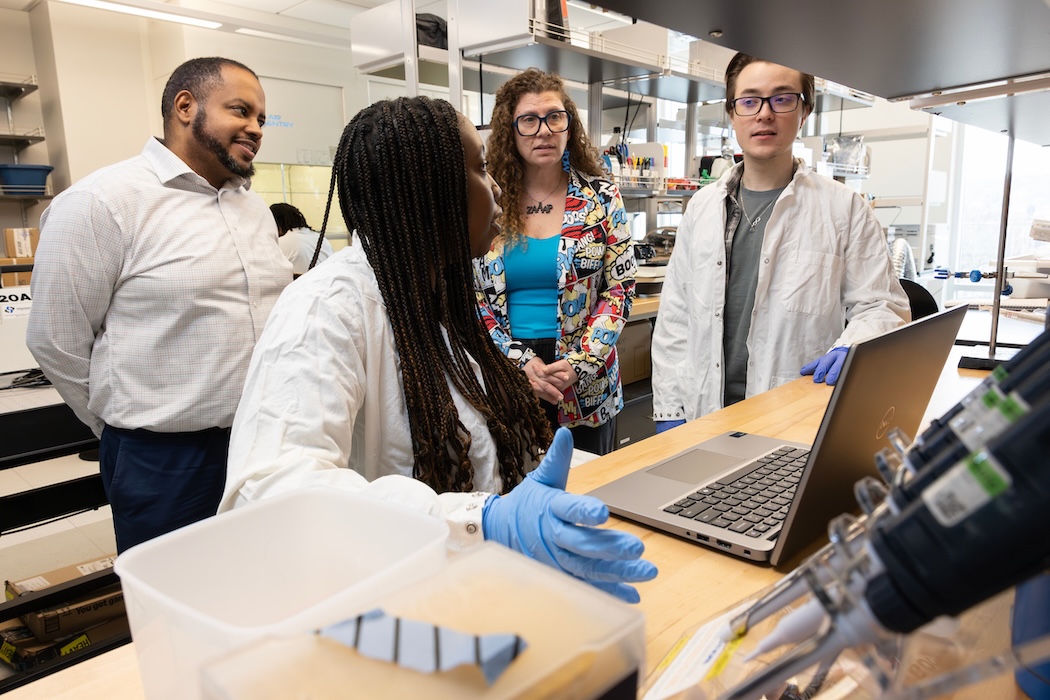
One of these students is Nelly Michura, a junior biology and global public health double major on a pre-med track at Binghamton University. In the Brooks lab, Michura works with ovarian cancer cell lines, treating them with different drug compounds and evaluating how the treatments affect cancer cell survival. By testing drug efficacy, including combination treatments, her work helps assess whether targeted protein degraders and related therapies could be effective strategies against ovarian cancer.
Born in Kenya, Michura's academic interests in biology and public health, along with a longstanding interest in health equity, drew her to research addressing disparities in cancer outcomes. She signed up to participate in Binghamton University Projects for New Undergraduate Researchers (BUPNUR), where she first met Brooks as a mentor. Her work through the program has centered on a recent focus in the Davis and Brooks labs - ovarian cancer in Black women, particularly.
"This work is deeply personal to me because I'm a Black woman, and I know that ovarian cancer is something that could affect me one day," Michura said. "Black women are often underrepresented in research and rarely highlighted in these conversations. Yet ovarian cancer is one of the deadliest gynecological cancers and the seventh most common worldwide. It affects countless women, which is why this research matters so much. Finding solutions has the potential to save many lives."
Brooks and Davis centered on ovarian cancer because it is particularly sensitive to one of their inhibiting chemicals, BRD4. They began to search publicly available databases, and they found that BRD4 is increased in ovarian cancer patients. 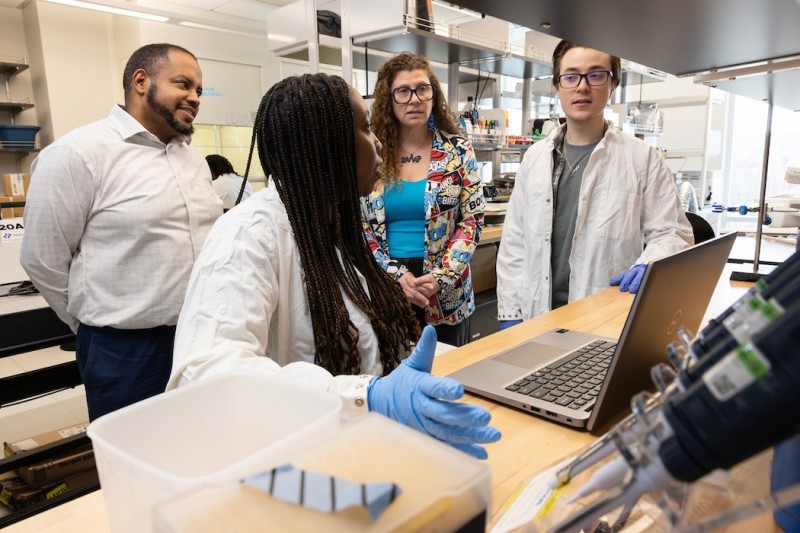
"When you look at patients, about 2% of all patients have too much BRD4, but when you look at ovarian cancer, it's 13% of patients. When you look at ovarian cancer in Black women, it's 25% of patients," Brooks said. "There was a racial discrepancy in the molecular amplification of BRD4, not only there but when you look at survival rates. Instead of having a four-year survival rate, they have an 11-month survival. This means it is a molecularly important therapeutic target in ovarian cancer, particularly for Black women."
But there are some complications that make this research difficult. Some of this data is no longer publicly available, funding can be difficult to acquire on this topic, and there is a disparity in available cell lines used to test compounds which represent Black women.
"We've combed through the database of all ovarian cancer cell lines, and there are few resources available. Getting patient samples is also hard to do when you're not connected to a big medical center, and for historical reasons, like the Tuskegee experiment, and Henrietta Lacks, whose cells became the foundation of biomedical research without her credit," Davis added. "Access to patient samples, cell lines, and other resources that we can use to study and test these new targeted protein degraders is a huge challenge, and not just for ovarian cancer."
Precise, minimal harm
Other students - such as Steven McKay, a fourth-year doctoral student who does both synthesis in the Davis Lab and testing in the Brooks Lab - are also exploring PROTACs. While his research is focused on pancreatic cancer, the concept is the same. However, McKay takes it further afield, while working to show not only that these compounds are effective, but that they cause as little harm as possible.
"If you get rid of particular proteins, the cancer cells should die, while sparing the healthy cells, because it's either normally expressed or because the normal cell is not as reliant on that protein," McKay said. "I'm working on the other end of the molecule and making sure that there's a difference in abundance, so degradation events are more likely to happen in cancer cells versus normal cells."
Testing toxicity in different cell lines is important, since medicine can react differently depending on genetics and drug contraindications.
"The next step of this research is to confirm the mechanism of action of these compounds, which have demonstrated strong efficacy against cancer cells lines in Dr. Brooks' work," Davis said. "Are they actually working by degrading proteins?"
Regardless, the research team forges on. Michura - who hopes to continue this research and eventually earn her MPH or even a master's degree in pharmaceutical sciences - has found her work with BUPNUR and Brooks extremely rewarding. She believes that through effective study, Binghamton can be a force for change in cancer therapeutics.
"One thing that I've learned from my public health courses is that even if that data has been deleted, all those numbers still exist," she said. "The issue is still there, even though people won't know it. But it's still prevalent, and the impact is going to be felt years from now. Anything that can be published or can be funded to address it is meaningful and needs to be heard."


