
The federal research funding supporting the development of a pediatric heart pump has been restarted, seven months after it stopped. But those lost months of work will add at least a year to the wait for the device.
"It's frustrating; it's unfair," said James Antaki, the Susan K. McAdam Professor of Heart Assist Technology at the Meinig School of Biomedical Engineering in Cornell Engineering, who has spent more than two decades working on the PediaFlow pump. "However, I accept that you make do with what life has given you. So we're going to try to make the best of our current situation and count our blessings. We're grateful that we have the federal funding, and we'll do our best."
Existing heart-pump technology requires children to be tethered to a refrigerator-sized compressor in a hospital. The PediaFlow could help children like 4-year-old Caleb Strickland, who NPR featured in a story about Antaki's research, go home. The device would already be in in-vivo trials at the College of Veterinary Medicine had the funding not stopped.
Antaki is one of the many Cornell researchers who received stop-work orders from the federal government in April. For nearly all of those researchers, including Antaki, the stop-work orders were lifted after the Nov. 7 agreement between the university and the federal government. Some researchers are waiting to hear about the status of their projects or renegotiating timelines, while others whose projects received termination orders are still looking for ways to keep their work going without federal funding.
But even those whose funds have been restored are struggling to restart their projects, dealing with issues that range from lost staff, students who graduated and paused experiments.
"The amount of time that was lost is greater than that seven or eight months when the grants were stopped," said Dr. Gary Koretzky '78, interim vice provost for research and professor emeritus of medicine at Weill Cornell Medicine. "For each individual group, that ramp-up time will differ, but it will be affecting every single one of them. Nobody is going to be able to just start up again without delays."
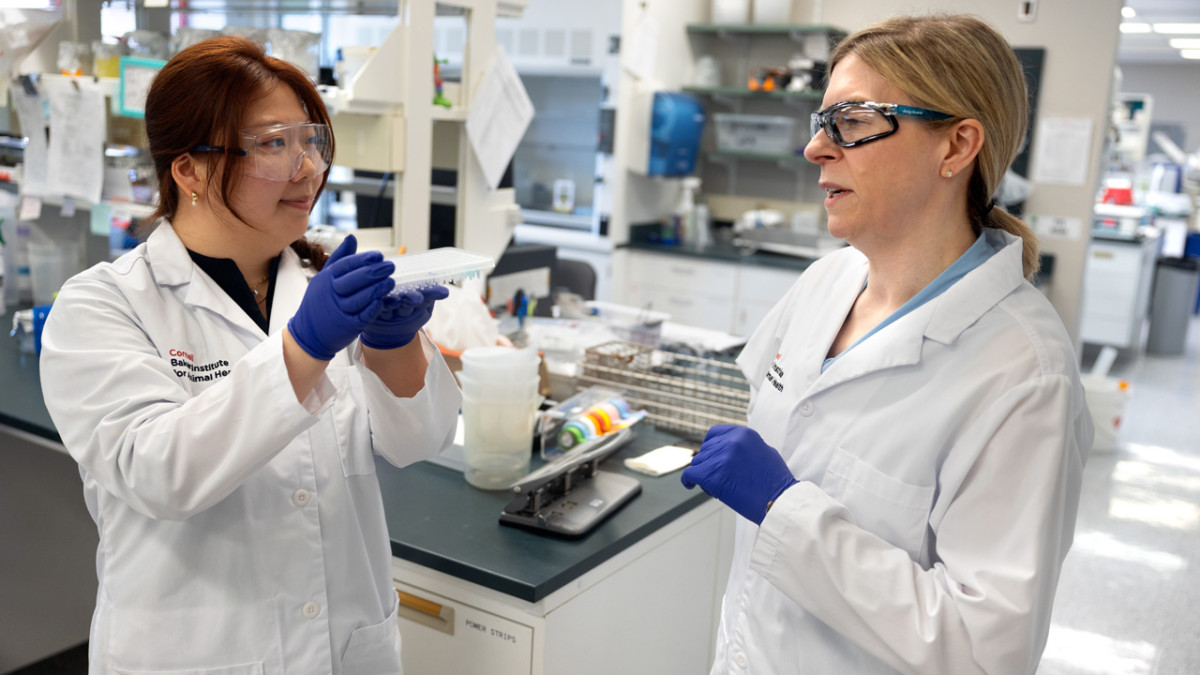
Research technician Xiyu Wang, MPH '24, left, and Laura Goodman, Ph.D. '07, assistant professor, work in Goodman's lab at the Baker Institute for Animal Health.
Laura Goodman, Ph.D. '07, assistant professor in the Department of Public and Ecosystem Health and in the Baker Institute for Animal Health in the College of Veterinary Medicine, received word that the U.S. Department of Defense was lifting the stop-work order on her project to develop a test to detect tick-borne diseases, but she had to immediately apply for an extension because the project's timeline ended during the funding pause. With approval on the new timeline, she is considering her staffing options to finish the lab work, while awaiting word on new federal grants she has applied for.
"I'm very committed to realizing both the human and animal health goals for this research," she said, "and I will not give up on it."
Martha Field, Ph.D. '07, assistant professor in the Division of Nutritional Sciences in the College of Human Ecology, is picking up her project exploring ways to ensure active-duty military personnel get adequate nutrition, though the graduate student who was primarily working on the project graduated. Two other students can finish up remaining experiments in about a year.
"More of a delay than I would like, but at least we are able to get things moving again," she said.
For Antaki, the $6.5 grant from the Department of Defense will fund preparation of the PediaFlow for in-human clinical trials, readying manufacturing and obtaining regulatory approvals. About the size of an AA battery, the device is designed to boost the flow of blood in children with heart defects. It can also provide support while a child's heart heals or until a donor heart becomes available for transplant.
During the pause, Antaki kept the PediaFlow project alive using discretionary funds, but one postdoctoral researcher left for a new job and Antaki had to lay off the staff member responsible for lab work and assembly when funds ran low in September.
Getting restarted may be daunting, but Antaki, like many researchers, has faced career setbacks before.
"I feel like I'm on a mission," he said. "No one else is developing a pediatric heart pump, because it's just not commercially viable. Just looking over the arc of my career, it seems as though I have been led to this place to complete this mission, and if I were to give up now, I would be shirking my responsibility. I have an obligation to continue and to keep pushing."


