
Soils store more carbon than the atmosphere and vegetation combined, with soil microorganisms playing the main role. As a result, the global soil carbon cycle-by which carbon enters, moves through, and leaves soils worldwide-exerts a significant impact on climate change feedback.
Now an important study led by researchers from the Institute of Earth Environment of the Chinese Academy of Sciences sheds new light on this cycle by overturning assumptions about the relationship between microbial respiration and carbon storage.
The findings, published in Science Advances on January 14, offer a new perspective for soil carbon management and climate change projection models.
The role of microorganisms in the soil carbon cycle is represented by two important values: the heterotrophic respiration rate (Rh), which measures how much CO2 is respired into the atmosphere as microbes break down plant material; and microbial carbon use efficiency (CUE), which measures how efficiently microorganisms convert absorbed organic carbon into their own biomass instead of releasing it as CO2.
Microorganisms with higher CUE are able to fix carbon more efficiently into biomass and subsequently soil organic matter, thereby enhancing carbon sequestration and mitigating climate change. Conversely, microorganisms with low CUE release most of the carbon they process back into the atmosphere via respiration, accelerating the carbon cycle and potentially exacerbating the greenhouse effect.
Scientists traditionally assumed that CUE decreases linearly as Rh increases-across all ecosystems. But the current study shows that the relationship between CUE and Rh is not uniform-instead, it varies nonlinearly with ecosystem productivity.
The research team estimated CUE using a stoichiometry-based approach (CUEST) that utilized 1,094 paired observations from a range of global natural ecosystems. Their analysis revealed distinct patterns across different productivity zones: In low-productivity regions (e.g., arid and cold areas), CUE decreased with increasing Rh, aligning with the traditionally assumed linear negative correlation. However, in high-productivity areas (e.g., tropical and temperate ecosystems), CUE became decoupled from Rh once Rh exceeded 340 g C m-2 year-1, stabilizing at approximately 0.27.
This decoupling, the researchers explained, reflects microbial adaptive strategies that prioritize nutrient acquisition over carbon assimilation under resource constraints. In productive ecosystems, microbes allocate energy to obtaining limiting nutrients (such as nitrogen and phosphorus), which increases carbon efflux and restricts additional soil carbon storage. This mechanism explains why vegetation greening may accelerate soil carbon loss, while nutrient inputs could potentially enhance carbon sequestration.
The study highlights how ecosystem productivity drives the nonlinear relationship between CUE and Rh. The researchers emphasized the importance of incorporating microbial metabolic adaptability into carbon cycle models to improve the accuracy of climate projections.
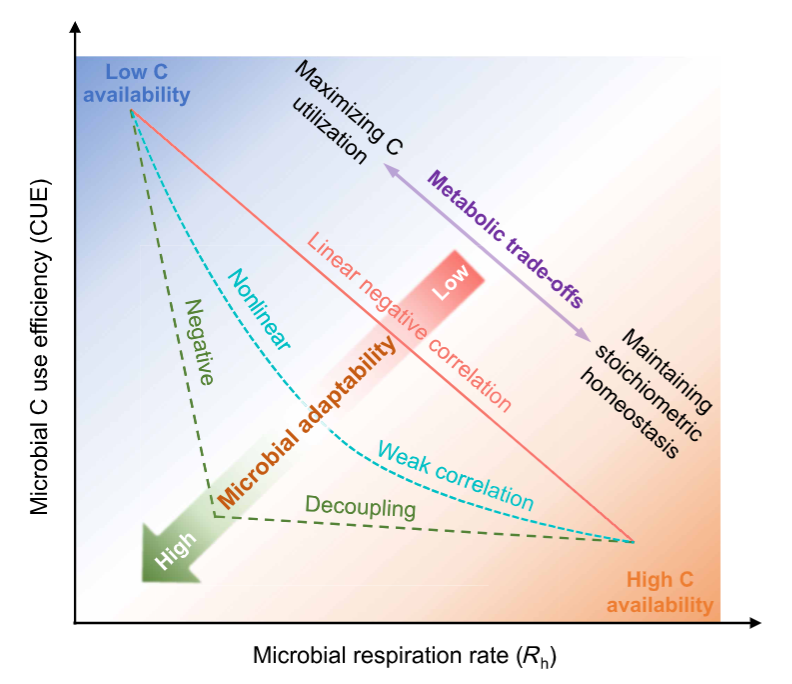
Conceptual framework illustrating the possible relationships between microbial CUE and Rh on the basis of stoichiometric theory and microbial community theory. (Image by CUI Yongxing, et al)
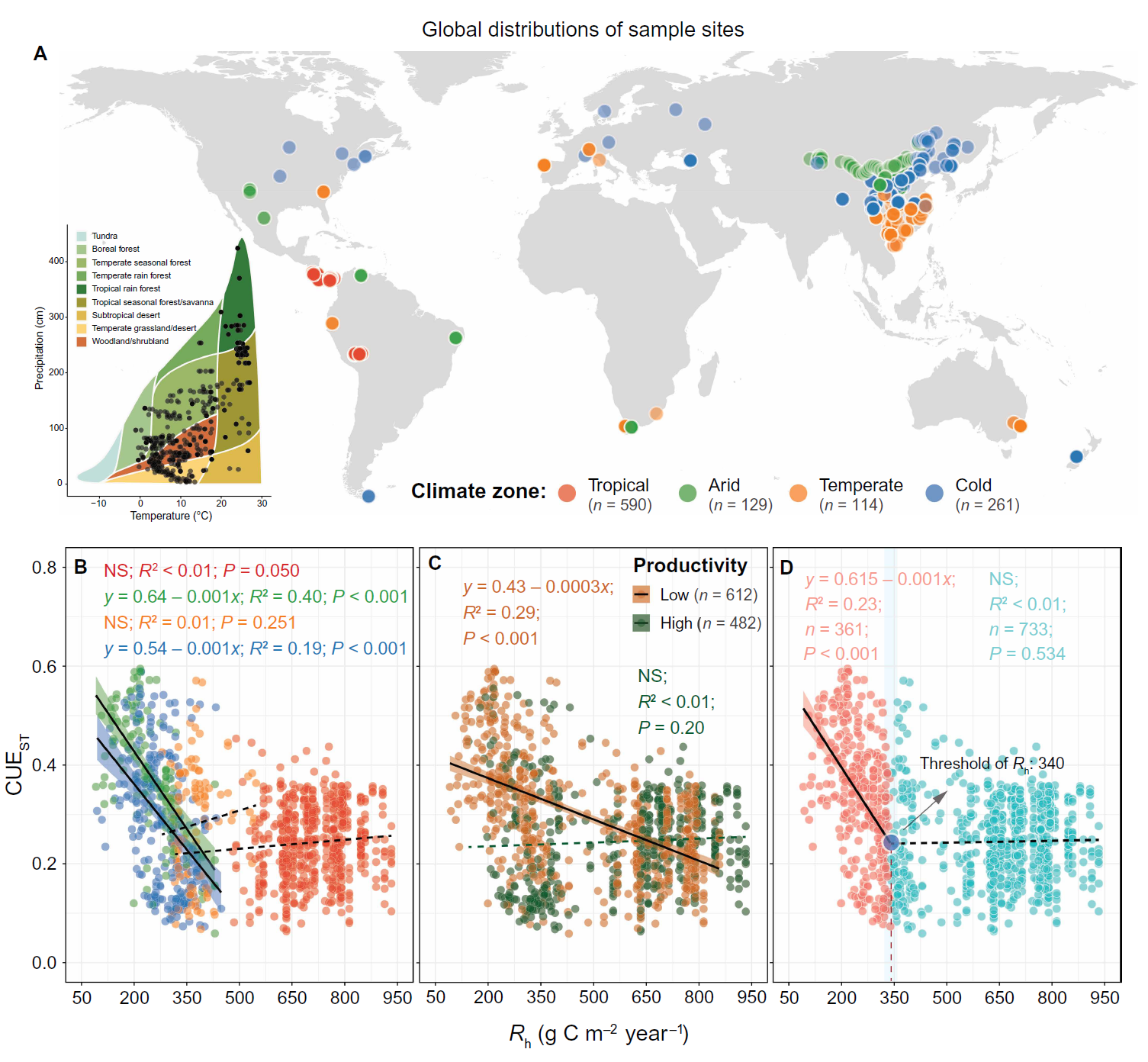
Geographic distributions of sample sites and relationships between CUEST and average annual Rh. (Image by CUI Yongxing, et al)


