
A Florida State University paleoclimatologist led the creation of a global database hosting thousands of seawater isotope measurements collected over almost 50 years that will aid scientists in generating more accurate climate reconstructions and predictions.
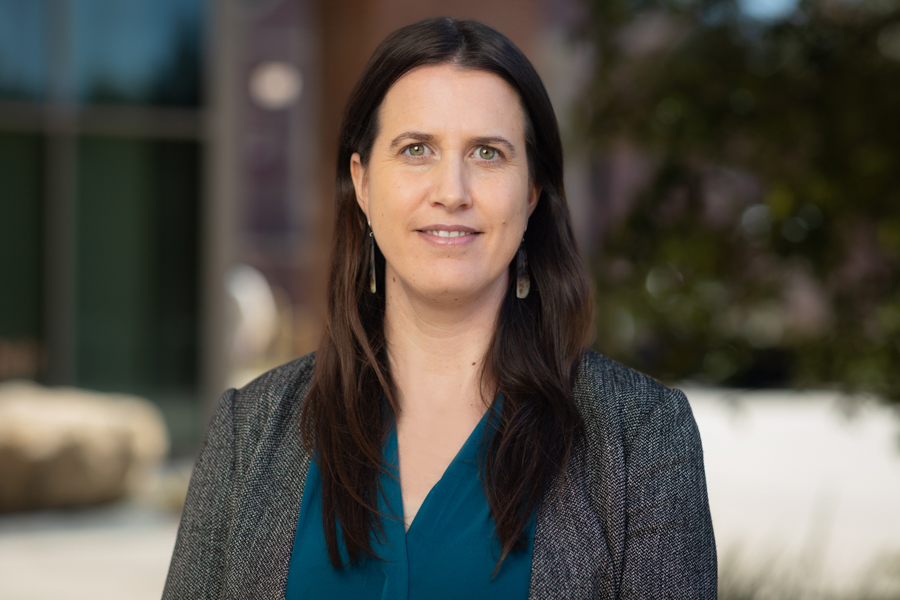
Associate Professor of Oceanography and Meteorology Alyssa Atwood led the Past Global Changes, or PAGES, project that created the new PAGES CoralHydro2k Seawater δ¹⁸O Database, a publicly accessible archive hosted by the National Oceanic and Atmospheric Administration National Centers for Environmental Information.
The database, presented in a recent publication by Earth System Science Data, reports the ratio of the heavy to light stable isotopes of oxygen, expressed as delta-oxygen-18 (d18O), and hydrogen, expressed as delta-hydrogen-2 (d2H), in seawater. It includes nearly 19,000 seawater isotope measurements.
Isotopes are variations of elements that differ based on the number of neutrons in the nucleus. Water molecules that contain heavier isotopes behave slightly differently than water molecules that contain lighter isotopes. Because of these tiny mass differences, the isotopes become unevenly distributed among the ocean, atmosphere and land, helping scientists to track the global water cycle.
"Water isotope ratios record how water moves among the ocean, atmosphere and land," Atwood said. "In the ocean, water isotope measurements can track precipitation, evaporation, freshwater runoff from rivers and ice sheets, and ocean circulation patterns, which serve as powerful tracers of Earth's modern water cycle. Because the hydrological cycle intensifies as global warming accelerates, seawater isotopes also provide important insights into how the global water cycle is changing as the planet warms. This database provides a robust observational framework to track these changes with unprecedented coverage."
In addition to seawater isotope data, the database includes measurements of ocean hydrology, salinity, temperature and hydrogen isotope ratios where available. It also incorporates extensive metadata that describes sampling locations, depths, data collection and analysis methods and data quality, which are essential for proper quality control, inter-comparison and interpretability across datasets.
"As the team compiled these datasets, we also documented their strengths and weaknesses to provide a set of best reporting and data standardization practices to the community for the future," Atwood said. "We've only scratched the surface in identifying how this data can help us understand how the ocean and global hydrological cycle are currently changing, how they've changed in the past, and what we can expect for the future. This database gets us one step closer to realizing that potential."
Reconstructing historical climate data
The database also supports the development of past climate reconstructions. Seawater isotope data helps refine paleoclimate records based on the oxygen isotope composition of marine organisms such as corals, single-celled amoeba called foraminifera, and mollusks, a type of invertebrate. This allows scientists to make better estimates of past climate conditions and how they have changed over time.
"In this way, the database can help scientists to extend climate records back into the preindustrial era, contextualize modern climate change and improve future climate projections," Atwood said.
Updating and centralizing seawater isotope data
This initiative began after an earlier CoralHydro2k project discovered that previous compilations of seawater isotope data were out of date. While significant advances in analytical techniques over the past few decades have led to a rapid increase in the quantity and quality of seawater delta-oxygen-18 measurements, much of this data wasn't publicly available or easily accessible.
"Despite the wide-ranging applications of this data across oceanography, atmospheric science and paleoclimatology, there was no single, actively maintained place where scientists could find and use seawater isotope data," Atwood said. "We sought to fill this gap by creating a comprehensive, up-to-date, global database of seawater isotope data."
In the new database, more than half the data compiled comes from "hidden" datasets found in student theses, supplemental tables of journal articles, cruise reports and private research archives.
"The centralization of global seawater isotope data provides an unprecedented resource for improving large-scale synthesis efforts in oceanographic and paleoclimate research by making them more accurate and reliable," said Michael Stukel, chair of FSU's Department of Earth, Ocean, and Atmospheric Science.
The database also has a submission portal through the EarthChem Library, allowing researchers to submit new datasets and continue to grow the database, facilitating future research discoveries.
The project team consisted of volunteer scientists from all academic levels, including graduate and undergraduate students, postdoctoral researchers, and early career to senior-level scientists from academic and research institutions in the U.S., Germany, France and Portugal. The study was supported by the PAGES project, the U.S. National Science Foundation, the U.S. Department of the Interior, the Louisiana Board of Regents and the German Research Foundation.
Visit the FSU Department of Earth, Ocean, and Atmospheric Science website


