
'Music is the thing that transfers across all cultures. ... That's what we've been able to do with these concerts'
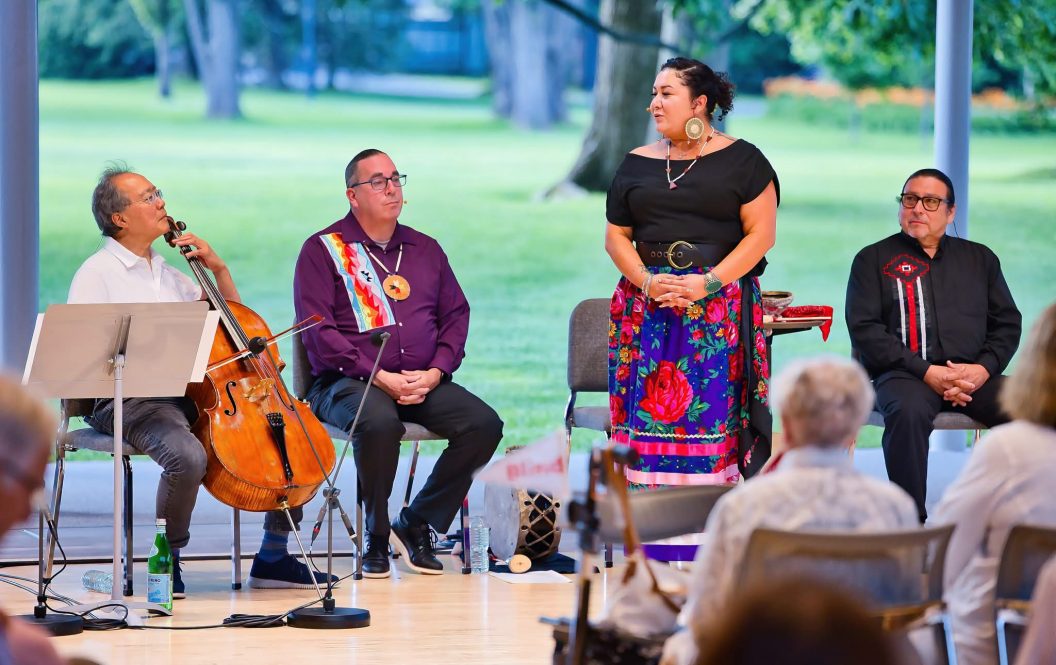
Yo-Yo Ma, left, and Chris Newell, UConn's Native American Cultural Programs director and an instructor-in-residence in the Department of Social and Critical Inquiry, at right next to Ma, participate in an event during Ma's Tanglewood residency in August. (Contributed art)
Standing at the edge of the Connecticut River that chilly October morning last year, the attention of paddlers in a flotilla of canoes fixed on him, UConn's Chris Newell watched for his signal to begin as a rising mist over the water made seeing it near impossible.
"I just kept thinking that before colonization, this would have been what it looked like when my ancestors were here," Newell says. "Because I couldn't see through the mist, I chose to use as a cue a bald eagle that showed up and landed right next to the performance site. When he landed, that's when I started, and it turned out to be perfect timing."
The silhouette of 20-time Grammy Awad-winning cellist Yo-Yo Ma burst through the fog that very moment, his canoe inching toward shore where he was to be greeted with proper Wabanaki protocols before a sunrise concert with a group of Indigenous performers, including Newell.
"I never imagined myself being in a position of co-curating an entire concert with Yo-Yo Ma of all people, but he is who he is. He's a real human being, very down to earth, and wants to do projects that mean something. He's out there to change the world in his own way," Newell says.
That includes an at-dawn performance for hundreds in Hanover, New Hampshire - plus a bald eagle that stayed until the end.
The larger project, "We Are Water," included that sunrise concert along with a more formal indoor performance to reopen a renovated Hopkins Center for the Arts at Dartmouth College, Newell says, and sought to honor the Connecticut River and its significance to the Native people who once lived and still live along it and other waterways.
It was the second of three times the world-famous Ma has worked closely with Newell, UConn's Native American Cultural Programs director and an instructor-in-residence in the Department of Social and Critical Inquiry.
Their partnership goes back to 2021, long after Newell himself too decided that he wanted to change the world in his own way and wanted to do it through the music of his people.
From The Office of Yo-Yo Ma
"Yo-Yo Ma says it very well that when it comes to music, every culture around the world has figured it out in some way, shape, or form," Newell says. "Music allows our brains to function in a way the moment calls for. If you're at a funeral, for example, you sing a sad song to bring people to a certain place in their mind.
"Our culture as Wabanaki peoples has figured that out," he continues. "We have music for good times, for parties, for fun. We have music for getting ready for political battles with the state and federal government. We have music for our lost loved ones. And, for us, music is also a way that we remember things. All of us remember better with music - think about the Alphabet Song. Music is a better memory tool than stories alone."
Newell is a Passamaquoddy tribal citizen who was raised in the community of Motahkmikuhk, or Indian Township, Maine, about two hours northeast of Bangor near the Canada border. His father Wayne was an elder on the reservation, known widely for his pursuits to educate others about Native cultures and keep the Passamaquoddy language alive.
The younger Newell traded life in Maine for a college experience at Dartmouth, where the one-time engineering major took the class, Music of Non-Western Cultures, and met the members of Huun-Huur-Tu, the Tuvan group that brought throat singing to the world. He says that even though he didn't speak the language, he felt the depth of emotion their music conveyed.
His life course changed.
Leaving Dartmouth without a degree, Newell joined the Mystic River Singers, the Mashantucket-based Connecticut group, and toured as one of their singers for a couple of decades. But, as he says, "powwow singing is a young man's game because it's hard on the voice," he pivoted toward educating in other ways, earning a Bachelor of General Studies from UConn in 2014.
At the Mashantucket Pequot Museum and Education Center, he worked several stints as educator supervisor during which he developed the program, "Demystifying Thanksgiving," to teach schoolchildren the true story of the holiday.
Then in 2020, two weeks before the pandemic shutdown, Newell took the helm of the Abbe Museum in Bar Harbor, Maine, the first Wabanaki executive director - and that's where he met Ma.
"I was at work one day and received an email with the subject line referencing, 'The Office of Yo-Yo Ma,' and thought it was spam, but I clicked on it anyway," he says. "It turned out to be a real email, and the senior producer for his production team was letting me know he was coming to Acadia National Park and wanted to know what he could do with music to honor the Indigenous people of the land."
Known collectively as the Wabanaki, the Indigenous tribes of the Maliseet, Mi'kmaq, Passamaquoddy, and Penobscot are all located in Maine, Newell explains, noting that Wabanaki translates roughly to "People of the Dawnland" because their ancestors understood they were among the first in what later would become the United States to see the rising sun, the birth of a new day. To celebrate it, Wabanaki people have a special sunrise ceremony.
"I didn't want Yo-Yo Ma appropriating a ceremony," Newell says. "But any human can sit on the coast and play or sing music to the sunrise. So, I suggested he play his cello on the coast at dawn. Now, Yo-Yo Ma, being who he is, said, 'No, I don't want to do this by myself. I want to do this in community with the Wabanaki people.'"
Across cultures
Originally, plans called for a pop-up concert in Acadia, a surprise for visitors who too were soaking in the sun's first light. But with a group of Indigenous performers and their guests, along with accepted invitations from then-Interior Secretary Deb Haaland, the state's congressional delegation, and the state's legislative leaders, the National Park Service quashed it, as large gatherings in 2021 still were taboo.
Newell, who was on the planning team, pivoted, and moved the event to a large field at the nearby private Schoodic Institute, where only invited guests were allowed entry. Ma was so affected by the concert and talking circle that followed, Newell says, that he vowed not to let the conversation end.
Four years later, the pair reconnected at Dartmouth.
"Music is the thing that transfers across all cultures. Take my moment with Huun-Huur-Tu, not understanding a word they said but feeling every single emotion. That's what we've been able to do with these concerts with Yo-Yo Ma," Newell says.
With authentic Native instruments - rattles fashioned from turtle shells and pebbles, rawhide drums stretched tight, and flutes chiseled from tree branches - Newell and his fellow Indigenous musicians aim to recognize the Native cultures from all regions of what is now the United States and preserve them for future generations.
After all, millions of Indigenous people lived on this land when European colonists arrived, and by 1900 only 250,000 remained, Newell notes.
"That's a horrible number. All of us who are here today are the descendants of those 250,000 who survived the colonization of America," he says. "Regardless of how it happened, we don't want to point fingers and say who did what wrong, all of this is about looking at our history as human beings. We're all here now, and we have a collective responsibility to our future generations."
Ma's involvement in those efforts just raises their profile, not their importance.
Less than a year after the bald eagle watched the Dartmouth performance, Newell - who by now had been working at UConn four years - received another invitation from Ma. Could Newell join him for six of his nine-day residency at Tanglewood in August 2026?
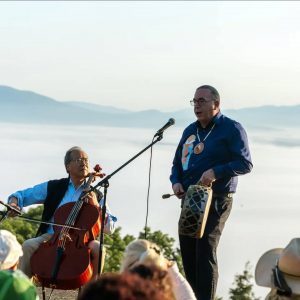
A sunrise concert at the top of Bousquet Mountain in the Berkshires started the week that continued with events including a children's concert and additional programming with the Boston Symphony Orchestra, all with the insight, expertise, and participation of Newell and other Indigenous and Wabanaki performers.
"I wish summer could come back, because that was a really beautiful moment," Newell says of the Bousquet Mountain concert, during which the land poked through a low-lying mist giving the illusion of people standing on the clouds. "Every time we put on one of these sunrise concerts, we just set a date and pray that nature responds. And we have been blessed with beautiful, gorgeous days."
As UConn Nation knows, Horsebarn Hill is beautiful and gorgeous too, perhaps Ma could … "Getting Yo-Yo here is complicated and requires a lot of moving parts. But it could happen if the University is interested enough," Newell says.
If and when that day comes, he says he's staying focused on spreading a concentrated message, especially during this Native and Indigenous Heritage Month, "The land is something that is a living being. If you take care of this living being, it will provide you with everything you need. We must be more considerate of how we 'develop' the land in the future."


