
Yang's work in AI for science will lead to scientific workflows that enable faster, safer, more cost-effective design of materials from batteries to polymers

(Envato stock).
School of Computing Associate Professor Qian Yang earned an NSF CAREER grant for her work on artificial intelligence models this year.
Her project titled, "Data-Driven Learning of Interpretable and Extrapolative Models of Complex Systems With Sparse Data" seeks to develop AI models that can learn the fundamental rules governing complex scientific systems from very small amounts of data. This allows researchers to make accurate, explainable predictions while reducing the need for costly experiments.
"This award will enable us to build not just the next AI algorithm or dataset, but a new framework for how to inject physics into AI for science in the small data limit, bringing it closer to practical application in experimental and computational labs across science," says Yang.

Machine learning has made amazing strides in accelerating scientific discovery for highly complex systems, but its adoption in scientific research remains limited by a crucial bottleneck: the shortage of labeled training data.
Obtaining large enough quantities of labeled data is often very costly, time-consuming, and frequently impossible. Data scarcity creates models that often fail when applied to new conditions or experimental conditions, and the reasoning behind the AI's predictions often remains in a murky "black box."
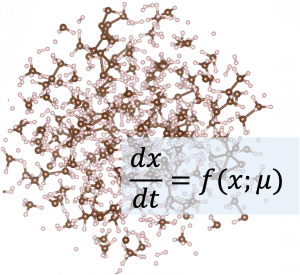
Yang's lab is building a unified framework for modeling the underlying physics or chemistry as dynamical systems governed by evolution equations, and using that structure to make learning far more data-efficient. The framework discovers families of interpretable governing equations from only a handful of expensive simulations or experiments.
Many AI models are too complex for human understanding, relying on performance evaluation on limited test cases, which established researchers, scientists, and engineers cannot accept. Yang's AI model can produce equations or rules that researchers can inspect and verify, offering them interpretable models they can actually evaluate and learn from.
"The bottleneck in AI for science isn't just better algorithms or more data, but also better use of data," Yang says. "We're trying to build models that can do more with the little data scientists can actually afford to collect. This is possible because physical systems are usually dynamical systems whose evolution follows a specific structure. That structure is exactly what allows us to learn more from less."
Having worked across diverse areas from catalysis to shocked materials to polymers to 3D printing, she has been able to gain a broad view of the commonalities in challenges across scientific domains that machine learning algorithms must address.
Yang joined the UConn College of Engineering in 2018. She was recently promoted from an assistant professor to associate professor in summer 2026.
Her work in AI for science will lead to scientific workflows that enable faster, safer, more cost-effective design of materials from batteries to polymers.
This research could accelerate innovation across chemistry, materials science, biology, and engineering fields, all by reducing costs, enhancing safety, and improving performance through AI-assisted automation and discovery.
As part of the grant, Yang will also develop educational tools and methodologies for training a workforce equipped to address the complexities of interdisciplinary research combining machine learning with domain science.
"I want students and practitioners to see that machine learning isn't just a big data problem; it can be a powerful tool for scientific discovery even when data is limited," says Yang.


