
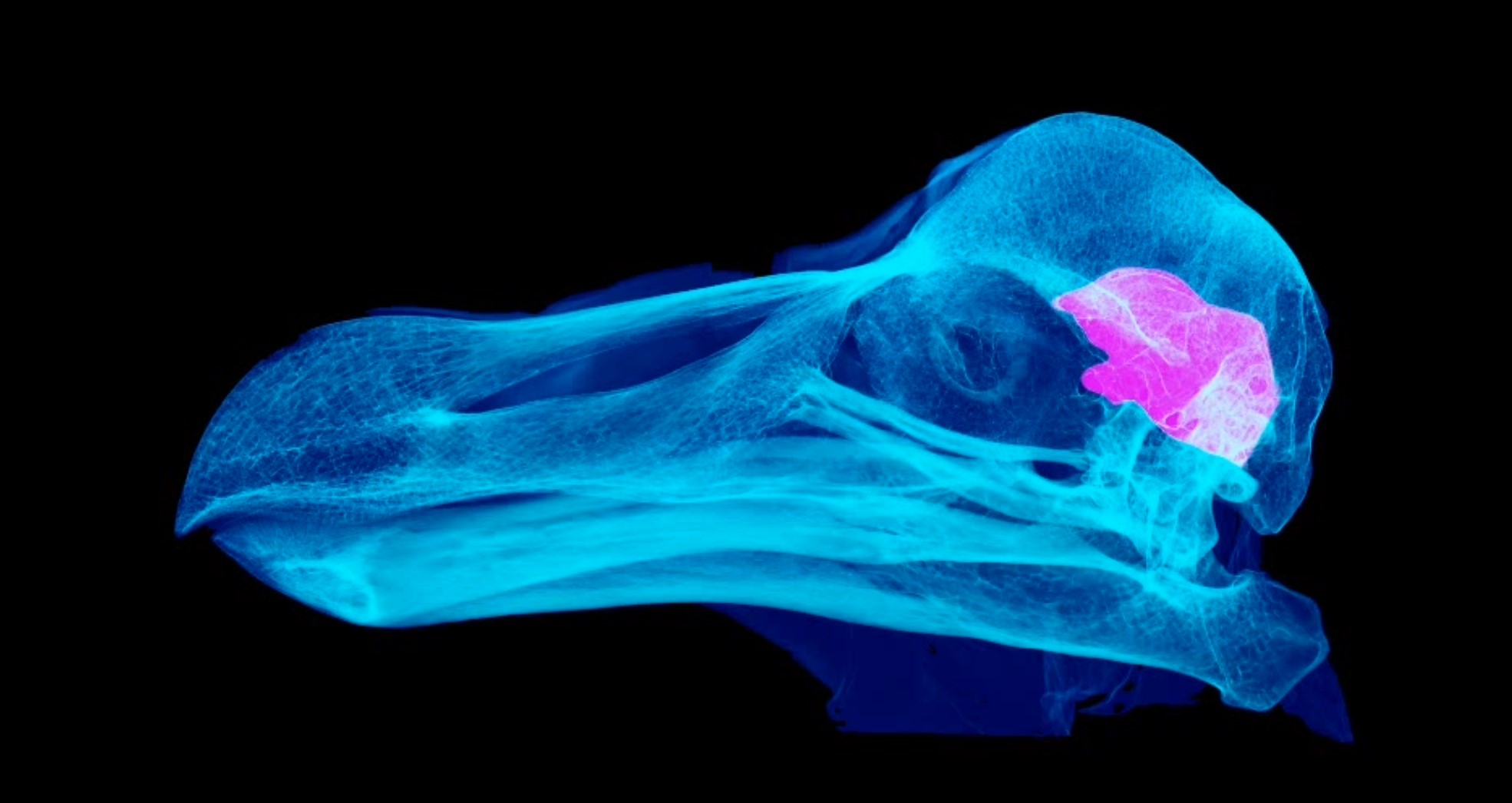
The Mauritian dodo - a global symbol of human-caused extinction, and one of the world's largest pigeons - may not have deserved its reputation as silly simpleton and may have been the only member of its group to live in the dark.

An international study, led by Canada's University of Lethbridge Iwaniuk Lab and including Flinders University researchers, has shown that the dodo's 'forebrain' - a region associated with a bird's 'smarts' including cognition and memory - was not smaller in proportion to any other pigeon, when compared to the rest of the brain.
The team also found several traits in its skull and brain that are usually only found in birds that are active at dusk or night, according to University of Lethbridge PhD student Sara Citron and Professor Andrew Iwaniuk.
"Dodos have always been portrayed as silly or confused birds, a reputation that probably came from their trusting behaviour that resulted in hundreds of animals being killed in a very short time," says PhD candidate Ms Citron. "Otherwise, very little was known about the dodo's habits and behaviour, so we set out to change that."
Professor Vera Weisbecker, Professor in Evolutionary Biology from Flinders University's College of Science and Engineering, says: "We suspected that dodos were better adapted to seeing in darker conditions. They had slightly larger eyes, but unusually small optic lobes, an area of the brain that processes light.
"This could mean that its visual abilities are poorer, because small optic lobes often mean that the light reaches the brain through fewer nerves.
"We see similarly small optic lobes in many nocturnal birds, like the elusive Australian night parrot or the New Zealand kakapo, indicating they relied little on sight and were active mainly at night," says Professor Weisbecker, a co-author of the study.
The researchers also suspect that the resulting vision was more 'pixelated' and light-sensitive overall.
The team - including Flinders PhD student Aubrey Keirnan and researchers from the Smithsonian Institution, National Museums Scotland and University of Copenhagen - studied computed tomography (CT) to scan the skulls of three dodos and a range of other pigeons from museums all over the world. They also included the dodo's closest relative, the extinct Rodrigues solitaire, which was the world's largest pigeon.
This allowed the researchers to compare skulls and the imprint of the brain in the skull.
"We found a range of other traits that we need more data to fully interpret. For example, we suspect that dodos may have relied quite strongly on their sense of smell because the area of the brain related to smell was quite large, unlike the Solitaire and other pigeons. But there just isn't enough comparative data to truly test this," says Ms Keirnan.
Senior author Associate Professor Andrew Iwaniuk, from the University of Lethbridge, says: "There is no evidence that the dodo was any less intelligent than its relatives - and we know that pigeons are pretty smart.
"The dodo has the most unusual skull with a strangely domed head, but the part of its brain that determines cognition was exactly as big as what one would expect for a bird of its size," he says.
Researchers conclude that the reputation of being a rather dim bird was probably due to its fatal tendency to curiously approach other dodos when they were in distress.
"These gentle animals were possibly quite social. Like many island species, they were also used to a life without predators. They may simply have had no reason to learn fearful behaviour," says Ms Citron.


