Decomposition of dead leaves in Veluwe forests has declined by tens of percent since the turn of the century. Meteorologists from Wageningen University & Research discovered this in an analysis of long-term measurements. The cause appears to lie in soil acidity. This is noteworthy, because nitrogen deposition in the area has actually decreased over the same period. The effects of nitrogen entering the ecosystem in the past may still be lingering.
The researchers analysed the decomposition rate of organic material in the Loobos forest near the village of Kootwijk, where a meteorological measurement station is located. Their study was recently published in Global Change Biology. According to prevailing theory, the decomposition of leaf litter on the forest floor (respiration) increases as forests mature. Most forests in the Veluwe region are less than 120 years old and were planted on previously bare soils. At that time, there was little organic material to decompose. Now, in 2026, these forests have developed thick humus layers. One would for this reason expect higher decomposition rates. However, measurements from 1997 to 2021 show that decomposition in Loobos forest has in fact decreased.
'As acidic as a glass of cola'
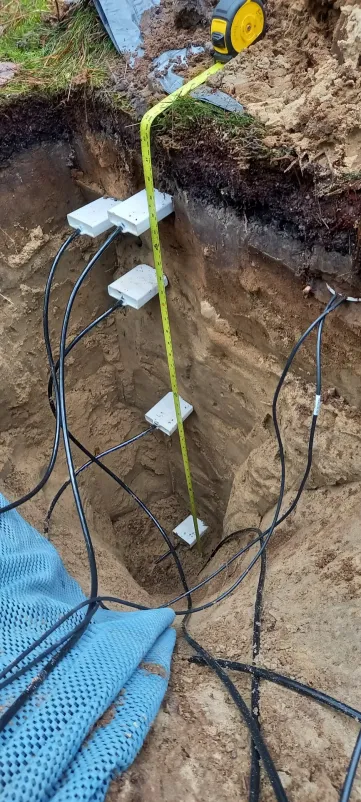
"Of course, we were curious to know why," says Michiel van der Molen, one of the researchers. "We took some soil samples back to the lab. There we found that fungi and bacteria, also called microbes, were present in the soil. These organisms normally break down the litter layer." However, microbial activity is hindered by high acidity. Van der Molen explains: "Our soil samples had a pH of 2.9, comparable to a glass of cola. Under such conditions, microbes can no longer effectively break down the layer of litter, so dead leaves remain on the forest floor."
'As acidic as a glass of cola'
"Of course, we were curious to know why," says Michiel van der Molen, one of the researchers. "We took some soil samples back to the lab. There we found that fungi and bacteria, also called microbes, were present in the soil. These organisms normally break down the litter layer." However, microbial activity is hindered by high acidity. Van der Molen explains: "Our soil samples had a pH of 2.9, comparable to a glass of cola. Under such conditions, microbes can no longer effectively break down the layer of litter, so dead leaves remain on the forest floor."
Climate benefits, but also sustainable in the long term?
The high soil acidity is caused by nitrogen deposition. On the one hand, nitrogen acts as a fertiliser, supporting forest growth: trees continue to increase in both height and diameter. But it also slows down the decomposition of dead leaves. This means that large amounts of organic material accumulate both in the trees and on the forest floor.
This organic material stores a lot of carbon, which is good news in the context of climate change. It keeps carbon out of the atmosphere, where it would otherwise contribute to greenhouse gas emissions (CO2). "But at the same time, there are concerns," says Van der Molen. "How long can a forest remain healthy if dead leaves are no longer broken down and the nutrient cycle is disrupted?"
Similar trends observed worldwide
The researchers also examined whether these findings are unique. The Netherlands may seem exceptional because of its high nitrogen deposition. To find out, they compared their data with other long-term measurement series worldwide. Van der Molen: "We saw a similar decline in respiration at nearly a quarter of all measurement sites. That may seem surprising, but perhaps it isn't when you consider how widespread climate change, acidification and pollution are. Forests are under pressure everywhere. The question is whether they can cope with that in the long term. In the Veluwe region, the effects of acidification are clearly still ongoing."

Similar trends observed worldwide
The researchers also examined whether these findings are unique. The Netherlands may seem exceptional because of its high nitrogen deposition. To find out, they compared their data with other long-term measurement series worldwide. Van der Molen: "We saw a similar decline in respiration at nearly a quarter of all measurement sites. That may seem surprising, but perhaps it isn't when you consider how widespread climate change, acidification and pollution are. Forests are under pressure everywhere. The question is whether they can cope with that in the long term. In the Veluwe region, the effects of acidification are clearly still ongoing."