
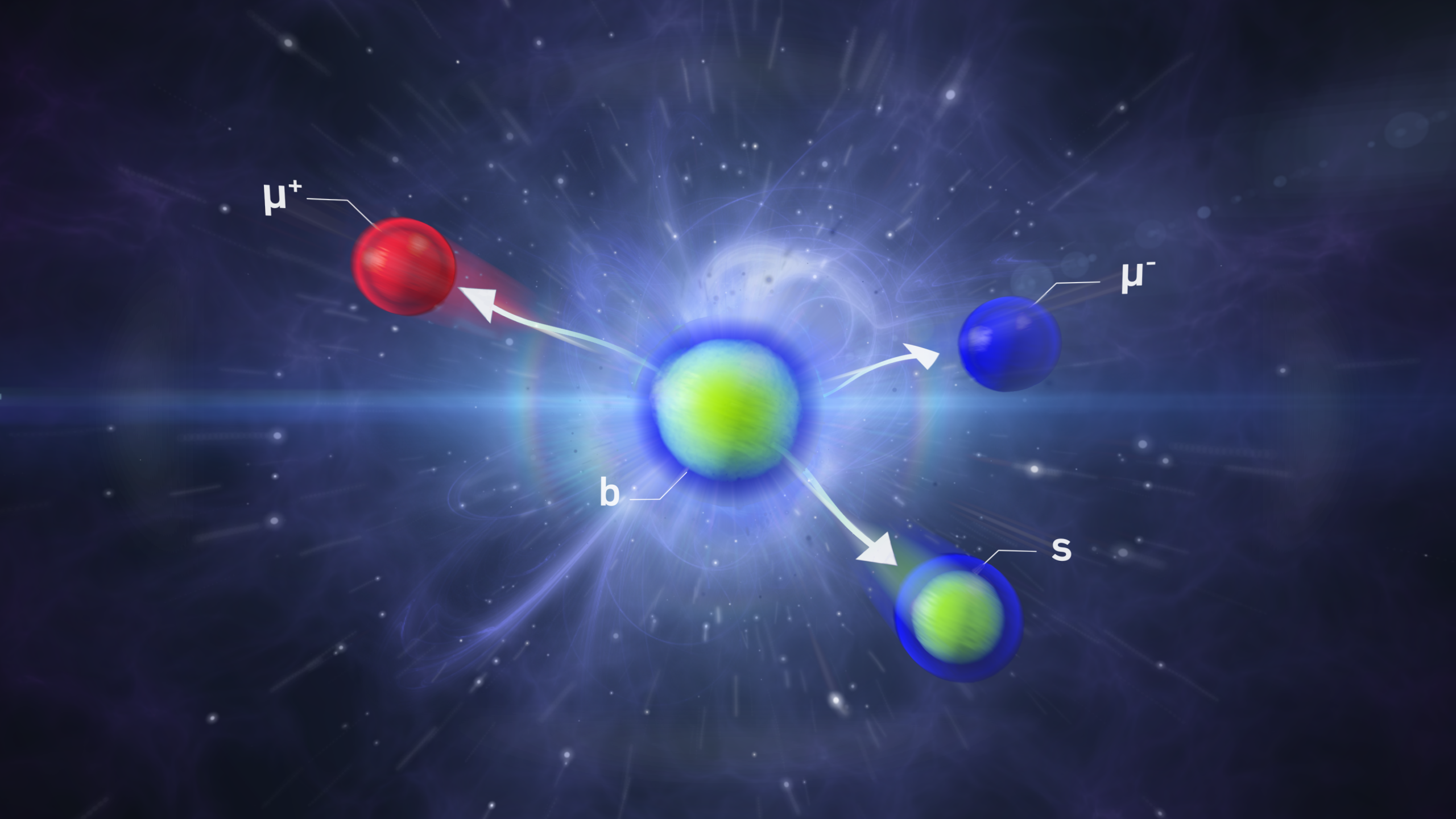
Studying rare processes is part and parcel of particle physics, providing stringent tests of the Standard Model. At the recent International Conference on High Energy Physics (ICHEP), the CMS and LHCb Collaborations presented their latest research into one such process: the transformation of a beauty quark into a strange quark, a muon and the oppositely charged antimuon (b→sμ+μ–).
Flavour transitions - when one type of quark turns into another - can only take place via the weak interaction, one of the four fundamental forces. Quantum physics describes how other particles, not directly involved in a particular transition, can influence how that transition takes place. If a process happens differently than is predicted by the influence of the particles we know about, which make up the Standard Model, this difference could point to the existence of as-yet-undiscovered particles and interactions.
Some of these transitions are extremely rare, which makes them very sensitive to any potential contributions from particles that may exist beyond the Standard Model. The b→sμ+μ– transition is one such process, only occurring approximately once in every ten million decays of particles containing beauty quarks, known as beauty particles. Over the past decade, signs have begun to appear that this transition may not occur as expected.
To investigate the b→sμ+μ– transition, the CMS and LHCb Collaborations analysed the decays of beauty particles into particles that contain strange quarks alongside muons and antimuons. Examining six types of these decays, CMS measured the individual rates at which they take place, described by branching fractions. This is the first simultaneous analysis of these decay types, implying that related background signals and sources of uncertainty in the data could be treated consistently across all the decay types. Whilst the difference between the predicted and measured branching fraction for each decay type was small, this difference was consistent across the six decay types.
CMS also collected a much larger sample of data from these decays than has been used in previous analyses- a sample taken from the third, most recent run of the LHC. During this run, they deployed a new trigger that enabled them to measure the branching fractions of these six decays with unprecedented statistical uncertainty.
Meanwhile, using data from the first and second runs of the LHC, LHCb analysed one of the six decay types: the transition of a neutral beauty meson, which contains an antibeauty quark, to an excited kaon, which contains a strange quark (B0→K*μ+μ-). For this decay type, the Collaboration measured a property known as P5', which describes the angles at which the particles resulting from the decay travel after they have been produced.
LHCb's measurement, which was obtained using a new model-independent analysis of the decay, indicated a small difference compared with the prediction made using the Standard Model.Model-independent means that no theoretical assumptions were made about what might be going on inside the decay. The Collaboration will now seek to include Run 3 data in both this measurement and those of the other b→sμ+μ– processes.
Although far from conclusive, the signs of possible tensions with the Standard Model provide a strong motivation for further investigation of the b→sμ+μ– transition. As researchers are able to take increasingly detailed measurements of rare processes, hints of the unknown may one day become clearer.


